
KATECH Report in Three Brief Points
- On 2026/09/29, the Korea Automotive Technology Institute (KATECH) released a report analyzing the annual revenue and operating profit of 20 major global automakers. The key signal for investors is that higher sales alone can no longer protect profits, while the ability to align production across multiple powertrains with demand is driving profitability gaps between companies.
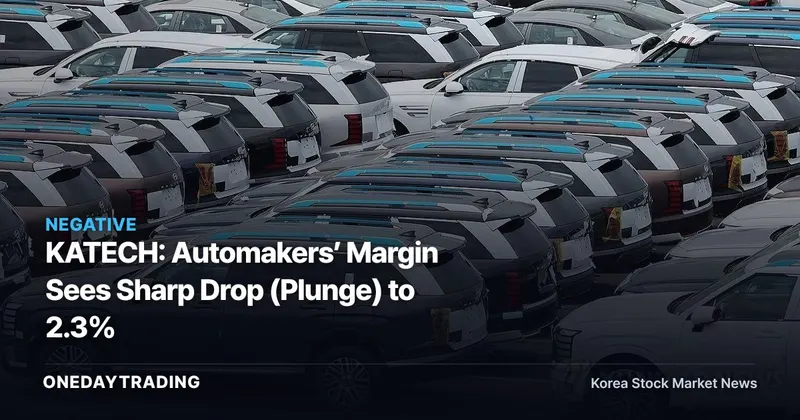
- According to analysis reported by Yonhap Infomax, the combined operating margin of the 20 automakers fell from 7.9% in 2023 to 2.3% in 2025.
- Hyundai Motor Group and Japan’s Toyota were cited as companies that maintained stable profitability through their competitive strength across multiple powertrains, including hybrids.
Production Flexibility Matters More Than Sales for Automaker Profitability
Changes in automaker profitability are not simply about whether revenue is rising, but how much of that revenue remains as operating profit. KATECH’s analysis found that revenue growth at 20 major global automakers slowed after peaking in 2023, while operating profit also declined. This is why investors cannot assume an early earnings recovery in the automotive industry sector based solely on top-line growth.
The point where this development affects earnings is capacity utilization. When electric-vehicle demand is weak, previously funded facilities remain underutilized, slowing the conversion of invested capital into sales and profit. Margins therefore depend less on the size of the investment itself than on whether companies can preserve the profitability of existing operations while deploying new capacity in line with actual demand.
There is a clear distinction between what has and has not been confirmed. The industry sector-wide margin decline and the defensive benefits of multiple powertrains are evident, but the disclosed information does not allow comparisons of revenue, operating profit, operating margin, or the exact starting year of the analysis for each company. It also provides no basis for definitively ranking individual companies or predicting when profitability will recover.
What the Decline in Operating Margin From 7.9% to 2.3% Means
According to Yonhap Infomax, the combined operating margin of 20 major global automakers fell from 7.9% in 2023 to 2.3% in 2025. This figure suggests that declining profits, rather than slower revenue growth, should be central to investment decisions. Instead of valuing the automotive industry sector as a single group, investors need to assess how each company’s core markets, product portfolio, and production system protect its bottom line.
KATECH explained that the scale of change varied by region, country, and product category, leading to differentiated profitability based on each automaker’s primary markets and product mix. In other words, even when all companies face the same industry pressures, their financial outcomes will differ. Although the market may price in a broader industry slowdown, applying the same assessment to company-specific differences in production responsiveness would oversimplify the analysis.
McKinsey Highlights the Cost and Time Required to Convert Production Lines
McKinsey estimated that automakers need about $200 million–$400 million and 9–15 months to switch vehicle models and production lines in response to changes in powertrain demand. Such conversions are not immediate adjustments but decisions requiring both time and money. If demand forecasts prove inaccurate, low capacity utilization becomes a burden, while a delayed response can also postpone margin improvement because of the lengthy conversion process.
In the automotive industry, where consumer demand matters more than order backlogs, the critical issue is how capacity is allocated rather than how much capacity exists. A recovery in EV demand would provide a path toward better utilization of previously installed facilities, but continued weakness would weigh on both capacity utilization and investment returns. The ability to manage multiple powertrains within limited production resources therefore serves not merely as product diversification, but as a mechanism for protecting profits.
How Hyundai Motor Group and Toyota Have Defended Profitability
- Hyundai Motor Group was identified in the report as a corporate group with strengths across multiple powertrains, including hybrids. Its ability to adjust its product mix when demand is not concentrated in a single power source was linked to stable profitability.
- Japan’s Toyota was also cited as a company that maintained stable profitability through its competitiveness across multiple powertrains. From an investment perspective, the deciding factor is not the hybrid label itself, but the execution needed to align production and the product portfolio with changing demand.
- The global automotive industry faces pressure from the decline in its combined operating margin. If new investment does not translate into actual sales or production conversions are delayed, lower capacity utilization will weigh first on operating profit.
Risks and Inflection Points for Automotive Investors
- At the next earnings release, investors should assess whether operating profit, operating margin, and production-facility utilization are recovering alongside sales. If sales rise without an improvement in margins, it is difficult to characterize the result as a profitability recovery.
- When companies announce vehicle-model or production-line conversions, investors should examine both the cost and the conversion timeline. McKinsey’s cost and time estimates warn that responses to demand shifts will not immediately feed through to the bottom line.
- Expanding joint development and standardization of new technologies could reduce the burden of duplicate investment and allow companies to focus in-house development resources on areas of differentiation. Whether this translates into actual investment returns must be confirmed through sales and profits.
- If Hyundai Motor Group and Japan’s Toyota continue to maintain stable profitability, the defensive case for multiple powertrains will strengthen. Conversely, if their profitability also deteriorates, it would signal that industry-wide pressure has overwhelmed the buffer provided by their product mix.
Bottom Line: Capacity Utilization Will Separate Automotive Stocks
An earnings recovery in the automotive industry cannot be achieved through sales growth alone. Only companies that preserve the profitability and utilization of existing operations while connecting new production capacity to actual demand will be positioned to outperform. The next test is not an optimistic transition narrative, but whether company-level operating margins, capacity utilization, and investment returns improve together.
This article was automatically summarized and analyzed from the original news report. View the original article (Yonhap Infomax)