
Key Takeaways
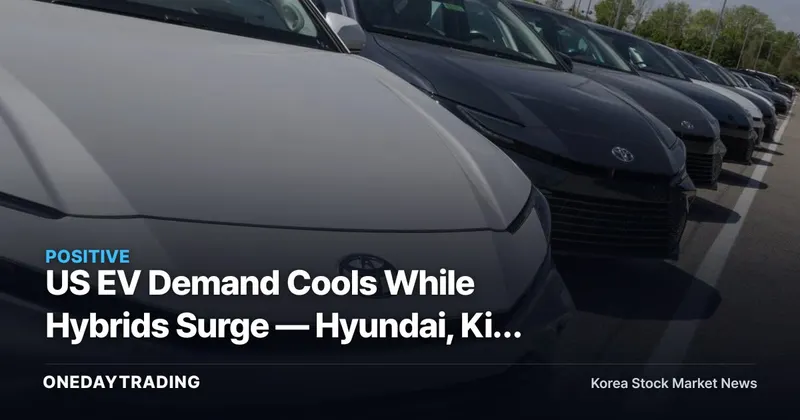
In the US auto market, growth in demand for pure battery-electric vehicles has slowed noticeably, while hybrids have established themselves as an independent growth pillar. Once treated as a transitional product on the way to full electrification, hybrids are now winning over consumers for practical reasons — fuel efficiency without range-anxiety concerns, and a relatively lower purchase burden.
What's Happening
A clear trend is emerging in the US automotive market: hybrid sales are outpacing sales of pure electric vehicles. Just a few years ago, hybrids were seen as a stepping-stone product meant to acclimate consumers ahead of mass EV adoption. Now, consumers appear to be embracing hybrids as their final choice.
This shift is spilling over into automakers' product strategies as well. Companies that expanded their hybrid lineups early are enjoying strong sales, while those that bet heavily on a pure-EV-only strategy are bearing the full weight of the demand slowdown.
Background and Context
This should be read as a turning point in the powertrain cycle. Automakers and battery manufacturers pushed ahead with massive capacity expansion on the assumption that EV penetration would keep rising sharply every year. But the slower-than-expected pace of charging infrastructure buildout, combined with uncertainty over resale value, has flattened the pure-EV demand curve. Hybrids have stepped in to fill that gap, and this should be understood not as a passing fad but as a structural rebalancing of the powertrain mix.
Market and Stock Impact
- Hyundai Motor · Kia: Having broadly deployed hybrid lineups in the US market — including the Tucson, Santa Fe, Sportage, and Sorento — the two automakers are direct beneficiaries of this shift in sales mix. Since hybrids command higher price points than comparable internal-combustion models, per-vehicle margin improvement can also be expected.
- LG Energy Solution · Samsung SDI · SK Innovation: Slowing growth in demand for pure-EV batteries weighs on the three battery makers' utilization rates and the payback timeline for their capacity expansion investments. Because hybrids require only a fraction of the battery capacity of pure EVs, they offer limited upside for overall battery revenue growth.
- Auto parts and materials suppliers: Because hybrids combine internal-combustion and electrification components, the supply chain for engine and transmission parts is likely to persist longer than previously expected.
- Pure-EV-only platform makers: The more concentrated a company's lineup is in pure EVs, the harder it is hit by the demand slowdown.
Investor Checkpoints
- Track the hybrid share trend in each automaker's quarterly sales-mix disclosures
- Monitor whether the three battery makers adjust utilization rates or expansion timelines at their US plants
- Watch for changes to US government EV subsidy and fuel-economy regulation schedules
- Check automakers' powertrain investment reallocation announcements — specifically, the split between hybrid and pure-EV investment
Outlook
If hybrid strength persists, it could show up with a lag in the form of improved per-vehicle margins for automakers and shifts in the order-book composition of the three battery makers. That said, there is also a downside scenario. If emissions regulations tighten again, or if falling battery costs drive pure-EV prices down quickly, the current hybrid strength could revert to a cyclical phenomenon vulnerable to policy and pricing variables. Whether hybrids have truly evolved from a transitional product into a permanent fixture will hinge on upcoming shifts in automakers' powertrain investment allocations and utilization indicators at the battery makers.
Hyundai Motor by the Numbers
Hyundai Motor's most recent closing price was 482,000 won (-1.13% from the previous session), and the composite signal combining foreign-investor/institutional-investor order flow with news and momentum reads 🟢 net buying bias. With foreign investors, institutional investors, and news flow all turning positive, this stock (ticker) is worth watching.
- ▲ Dual buying — Foreign investors +72.9 billion won · institutional investors +47.6 billion won, buying in tandem
- ▼ Trend alignment — Short- and medium-term downtrend (-1.1% today · -4.2% over 1 week · -33.9% over 1 month)
- ▲ News flow — 9 positive catalysts vs. 4 negative catalysts — positive catalysts lead
Recent related news skews favorable, with 9 positive catalysts versus 4 negative catalysts.
※ Price and foreign-investor/institutional-investor order-flow data are provided by Korea Investment & Securities (KIS) and reflect figures as of publication time.
This article is automatically summarized and analyzed content based on the original news report. View Original (MarketWatch)