
Summary
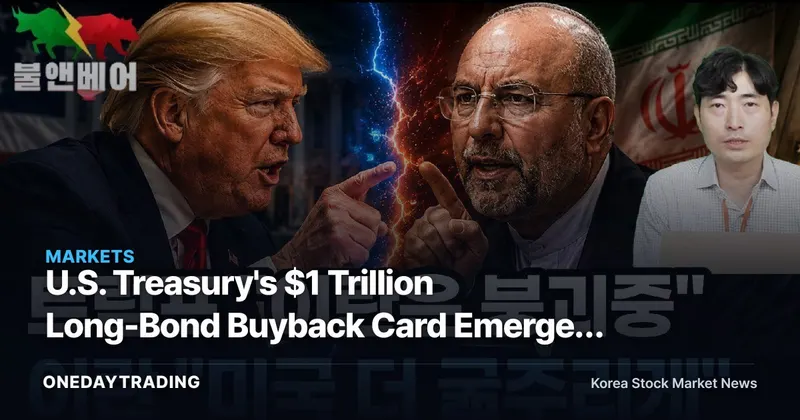
Market speculation has emerged that the U.S. Treasury could deploy $1 trillion in cash holdings to purchase long-term government bonds. At the same time, the Treasury unveiled a new round of sanctions against Iran, and President Donald Trump and Iranian parliament speaker Mohammad Bagher Ghalibaf traded barbs online. With all three developments landing on the same day, the conditions are in place for U.S. Treasury yields, global oil prices, and the won-dollar exchange rate to move in tandem.
The Full Story
The Treasury's firepower is not small. The $1 trillion in cash far exceeds what's typically needed for routine bond maturity redemptions and reissuance, and the market is divided over how this money will be used. One leading interpretation is that the Treasury plans to channel this cash into purchases of long-dated bonds — effectively a buyback — to improve supply-demand (order flow) conditions at the long end of the curve and push yields lower. That would align with the issuance strategy of recent years, which has leaned toward short-term issuance while restraining long-term issuance.
The question the headline poses — will it work this time — carries an implicit premise: similar moves have been tried before, and they haven't always succeeded in bringing down long-term rates. Unless the overall volume of bond issuance itself declines, buybacks only offset part of the supply-demand (order flow) burden. Whether the Treasury's cash is actually funneled into long-bond purchases, and whether the scale is large enough for markets to notice, will become clear at the next quarterly refunding announcement.
Structural Background
Geopolitical risk is compounding the picture just as this issue comes into focus. Observers expect the Treasury's Iran sanctions to stick to the familiar pattern of targeting crude oil export networks and the financial and shipping channels used to circumvent them. Adding to the tension, President Trump and parliament speaker Ghalibaf exchanged barbs online. Geopolitical risk feeds into concerns over oil supply, oil supply concerns feed into oil prices, and oil prices in turn feed back into inflation expectations in the U.S. Treasury market. With the Treasury's rate-easing card and Iran-driven geopolitical tension colliding on the same day, part of the intended effect of long-bond purchases may end up offset by oil-driven inflation concerns.
Stock (Ticker) and Industry Sector Impact
- S-Oil, SK Innovation: If Iran sanctions heighten concerns over oil supply disruptions, there is room for global oil prices to rise, and the direction of earnings will hinge on how the higher feedstock costs feed through to refining margins.
- Korean Air: Airlines, which carry a heavy fuel-cost weighting, bear the direct cost burden of rising oil prices. The stronger the sanctions, the greater the cost pressure.
- KB Financial Group, Shinhan Financial Group: If U.S. long-term rates actually decline, domestic long-term rates have room to move in the same direction, which would affect banks' net interest margins.
- Hyundai Motor: If the Treasury's cash deployment acts as a driver of expanded dollar liquidity and dollar weakness, the won could strengthen — a headwind for exporters' translation gains.
Bullish vs. Bearish Scenarios
The bullish scenario is one in which the Treasury actually purchases long-dated bonds on a large scale. If long-term rates are pushed down, it would create a favorable environment for high-P/E growth stocks with heavy valuation burdens, and growth-stock leadership in the domestic market would gain a relative advantage as well. The bearish scenario is one in which tensions surrounding Iran escalate into an actual supply disruption. If oil prices spike and oil-driven inflation resurfaces, much of the Treasury's rate-easing effect would be neutralized, and the pace of Fed rate cuts could slow as well.
Investor Action Points
- Watch the next U.S. Treasury quarterly refunding announcement for changes in the share of long-bond issuance.
- Check whether OFAC discloses the specific targets of Iran sanctions — crude oil exports, shipping, or financial networks.
- Watch what level in the upper-1,300-won range triggers a reaction in the won-dollar exchange rate.
- Watch how much global oil prices (WTI, Brent) actually react to Iran-related risk.
Frequently Asked Questions
Why is there speculation that the U.S. Treasury will use $1 trillion in cash to buy long-term bonds?
As the Treasury's cash holdings exceed what's needed for bond maturity redemptions, one interpretation is that it plans to deploy the excess into long-bond purchases to improve supply-demand (order flow) conditions at the long end of the curve. This would be consistent with the recent trend of increasing short-term-weighted issuance.
How do Iran sanctions affect the domestic stock market?
If the sanctions target oil supply networks, they would affect global oil prices, which would alter the earnings trajectory of oil-sensitive industry sectors such as refining and airlines. However, the actual impact can only be gauged once the specific targets and enforcement intensity of the sanctions are confirmed.
How would the Treasury's long-bond purchases affect the KOSPI?
If U.S. long-term rates decline, it could ease the valuation burden on domestic growth stocks and high-P/E sectors. That said, this remains speculative until the purchase scale and whether it will actually be carried out are confirmed in the next issuance plan.
This article was automatically summarized and analyzed based on the original news report. View original (Maeil Business Newspaper, Securities)