
Key Takeaways
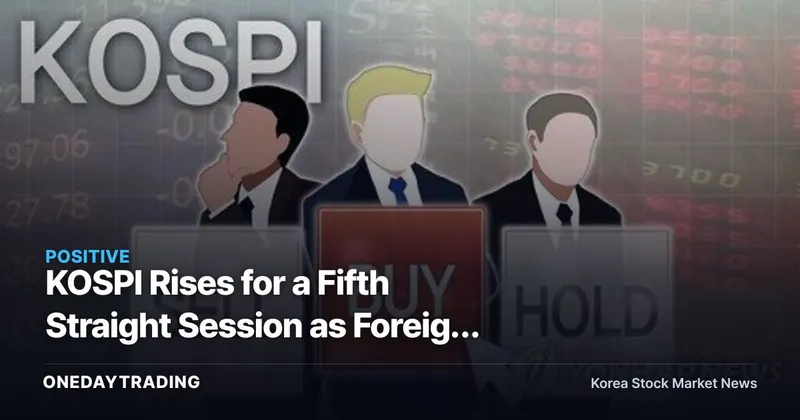
The KOSPI rose for five straight trading days last week. Over the same period, foreign investors net bought 6.5 trillion won worth of shares, driving much of this month's index gains. The key question is whether this buying reflects a fundamental reassessment of the KOSPI or a conditional bet tied to the exchange rate and interest rates.
What Happened
According to a Yonhap News report, the KOSPI extended its rally for five consecutive sessions last week, with foreign investors net buying 6.5 trillion won during that stretch. Foreign capital has also been the main driver behind the KOSPI's rise so far this month.
What matters is that the hand pushing the index higher belongs to foreign investors, not retail investors or institutional investors. Domestic institutional investors typically engage in bargain-hunting or rebalancing flows with weak directional conviction, while retail investors tend to move reactively during periods of volatility. Foreign investor flows, by contrast, are directly tied to macro variables such as exchange rates, interest rate differentials, and global risk appetite, giving them a clearer directional imprint. More telling than the fact of five straight days of gains is the fact that foreign investors are the ones behind them — that detail is the key clue to how sustainable this rally really is.
Background and Context
Foreign net buying generally falls into two categories. One is medium- to long-term capital driven by a reassessment of earnings and valuations; the other is short-term capital seeking currency gains during a phase of won strength and dollar weakness. Both types register as the same figure on the KOSPI's order books, but they differ in how long they stay. The former flows in alongside a rate-cut cycle or upward earnings revisions and tends to stay for a quarter or more, while the latter reverses the moment the exchange rate level shifts. Determining which type currently dominates requires looking at both this week's leading sectors by net buying and the trajectory of the exchange rate.
Impact on Markets and Stocks (Tickers)
- Samsung Electronics (005930) and SK hynix (000660): A substantial share of the absolute value of foreign net buying typically flows into large-cap semiconductor stocks (tickers) with high market capitalization, as their heavy weighting in the index makes them a priority target for passive and index-tracking funds.
- KB Financial Group (105560) and Shinhan Financial Group (055550): If the foreign capital inflow reflects a bet on valuation normalization, low-PBR financial holding companies stand to benefit directly from this trend.
- Hyundai Motor (005380) and other large exporters: If foreign net buying is linked to a shift in exchange rate expectations, a turn toward won strength could actually weigh on these companies' earnings when translated back into won.
- KOSDAQ and small/mid-cap stocks (tickers): Foreign order flow tends to concentrate heavily in KOSPI large caps, so whether this rally's momentum has spread to KOSDAQ needs to be verified separately.
Investor Checkpoints
- Whether the KRW/USD exchange rate breaks back out of the range seen during this rally — if the exchange rate reverses, foreign order flow is likely to reverse along with it.
- The rate decision and tone from the next Monetary Policy Board meeting — shifts in the domestic-to-global interest rate differential are a direct variable in determining the direction of foreign bond and equity flows.
- The composition of this week's leading stocks (tickers) and industry sectors by foreign net buying — concentration in a specific sector points to earnings-driven reassessment, while a broad spread across sectors suggests currency-gain-driven capital.
- U.S. inflation data and remarks from Federal Reserve officials — these shape the dollar's direction and feed straight through into the KRW/USD exchange rate.
Outlook
In the optimistic scenario, foreign net buying aligns with an improving earnings season and evolves into a broader valuation reassessment. In that case, the five-day rally could mark the early stage of a trend reversal. Conversely, if this order flow is largely dependent on a bet on won strength and dollar weakness, foreign capital could quickly reverse into outflows the moment the KRW/USD exchange rate rebounds. Whether the KOSPI has risen and whether the KOSPI will keep rising are different questions — and the answer is likely to become clear within the next week or two, as the true nature of this capital flow comes into focus.
This article was automatically summarized and analyzed based on the original news report. View original (Yonhap Infomax)