
How a 5% US 10-Year Yield Changed Investment Decisions
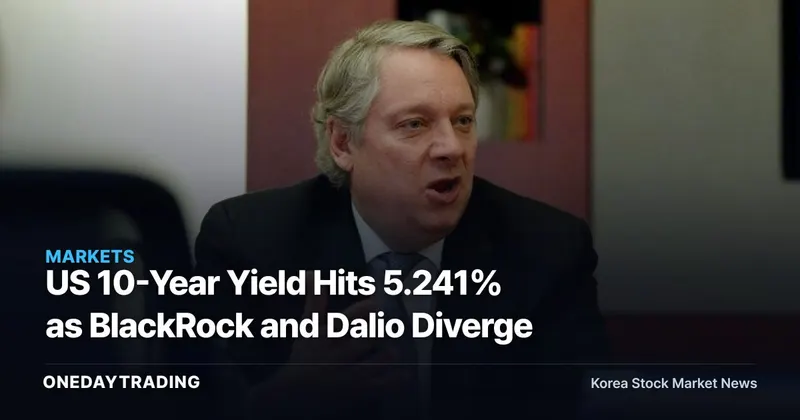
As the yield on the 10-year US government bond climbed to 5.241% on the 28th local time, BlackRock and Bridgewater Associates took diverging views. The investment implications of this debate, reported by Maeil Business Newspaper’s securities desk, are clearer than any attempt to predict the peak in rates. Even in the same high-rate environment, bond selection and equity valuations depend on whether investors prioritize locking in interest income or avoiding assets vulnerable to further rate increases.
With the yield on the 10-year US government bond exceeding 5% for the first time in 19 years, six leading Wall Street asset managers offered different strategies. The bond debate pits those who view current yields as an investment opportunity against those who believe government debt could drive rates even higher.
5.241% and 5.561%: Greater Caution at Longer Maturities
The yield on the 10-year US government bond reached 5.241% on the 28th local time, its highest level since June 2007. The 30-year government bond yield rose to 5.561% on the same day, its highest since June 2002. What investors need to assess now is not “bonds as a whole,” but which maturities and issuers to choose.
This is also why high yields cannot automatically be interpreted as a signal to buy long-term bonds. Rick Rieder has begun gradually adding long-term bonds, while Sonal Desai said she is avoiding ultra-long-term bonds that are vulnerable to further rate hikes by the Federal Reserve (Fed). Their assessments reflect the simultaneous presence of high interest income and the risk of rising rates.
The Bond Opportunities Seen by BlackRock and PIMCO
Rick Rieder, BlackRock’s global chief investment officer (CIO) of fixed income, who oversees more than $2 trillion in assets, said the fund is currently generating a yield of more than 7% with a three-year duration, calling it an opportunity he has waited 40 years for. His view is also based on the strong bond returns recorded in the 12 months after the 10-year yield previously moved above 5%.
PIMCO CIO Dan Ivascyn favored bonds over highly valued equities. While expecting some economic slowdown, he stopped short of forecasting a recession and said investors could build a high-quality bond portfolio yielding 6–7%. This approach centers investment decisions on the interest income available rather than price forecasts.
Brian Whalen, CIO of fixed income at TCW, said more than half of US growth comes from borrowers that are not sensitive to interest rates. His view is that high rates do not affect every driver of growth with equal intensity.
Ray Dalio’s Warning on Government Debt
Bridgewater Associates founder Ray Dalio warned that the US government spends more than $1 trillion a year, or about 1,356 trillion won, on interest on its debt. Citing the government debt burden, he recommended diversification and advised investors to avoid rate-sensitive assets. His position is that investors should not assume a favorable outlook for long-term rates based solely on current interest-rate levels.
Rob Arnott, founder of Syzygy Asset Management, said, “We are looking at a bubble right now.” Citing the valuation gap between S&P 500 companies and the next 500 largest companies, he favored small- and mid-cap stocks over large-cap stocks that posted a sharp gain (surge) amid the AI boom. In effect, he viewed rising bond yields alongside valuation pressures in the equity market.
Franklin Templeton Draws a Line Between Government Bonds and AI Corporate Debt
Sonal Desai, global CIO of fixed income at Franklin Templeton, rejected the view that high rates would derail the economy. However, she said rates could rise further if government borrowing and AI infrastructure investment compete for capital. She therefore proposed avoiding ultra-long-term bonds and focusing on stable interest income.
The securities under consideration included corporate bonds issued by Microsoft, Meta, Amazon and Alphabet, which were identified as AI hyperscalers. The scope of this assessment should be limited to the consideration of corporate bond purchases, rather than an outlook for gains in the companies’ shares. The material did not establish whether or how much of each corporate bond was actually purchased, nor the overall positions.
What Determines Whether Rates or Bonds Strengthen
When the 10-year government bond yield exceeds 5%, the case for locking in current interest income becomes stronger. If rates reverse course, Rick Rieder’s decision to gradually add long-term bonds would gain support. If rates continue rising, Sonal Desai’s avoidance of ultra-long-term bonds and Ray Dalio’s caution toward rate-sensitive assets would become more compelling.
The equity market also cannot be treated as moving in a single direction. Dan Ivascyn judged bonds more attractive than highly valued equities, while Rob Arnott focused on the valuation gap between large-cap stocks and the next-largest group of companies. The choice depends less on high rates themselves than on which assets are being compared and how elevated their valuations already are.
Key Indicators for Korean Investors to Monitor
- Direction of US 10-year and 30-year yields: Whether they continue rising from 5.241% and 5.561%, respectively, or reverse course will be pivotal to decisions on long-term bonds.
- Whether the Federal Reserve (Fed) raises rates again: This is a direct factor in assessing the vulnerability of ultra-long-term bonds.
- US government debt-interest spending: Investors should monitor whether the annual burden remains above $1 trillion to evaluate Ray Dalio’s warning.
- Disclosure of actual positions: Statements from the six managers alone do not reveal their full bond holdings or maturity profiles. Their next portfolio disclosures must show the allocations to long-term bonds, high-quality bonds and AI hyperscaler corporate debt before investors can determine whether their actions match their remarks.
US 10-Year Yield IndicatorsAs of 2026-09-29
| Performance by Period | 1 Week +5.58% 1 Month +12.16% |
|---|
Index, commodity and exchange rate figures are based on global markets and reflect values at the time of publication.
This article was automatically summarized and analyzed based on the original news report. View the original article (Maeil Business Newspaper Securities)