
Key Takeaways
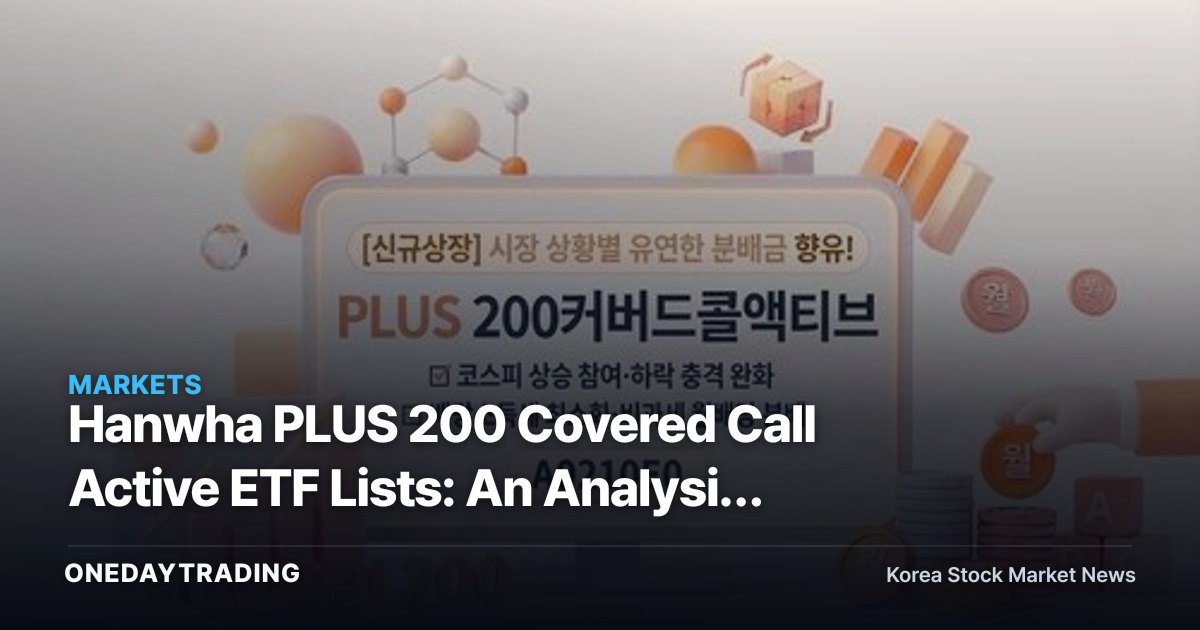
Hanwha Asset Management has listed a monthly-dividend active ETF that combines option selling (covered calls) with dividend avoidance, using the KOSPI 200 as its underlying index. It is an income-oriented product that aims to capture two birds with one stone — participation in index gains and regular distributions — targeting investors who prioritize cash flow in low-growth, range-bound markets.
That said, the covered call structure has an inherent limitation of giving up part of the upside in a bull market, so mistaking it for a simple high-dividend product can leave expectations misaligned with results.
What Happened
The newly introduced PLUS 200 Covered Call Active ETF invests in the constituents of the KOSPI 200 while selling call options to secure option premiums, which it then uses as the source for monthly distributions. Added to this are a dividend-avoidance strategy that sidesteps the ex-dividend date, and active management in which the portfolio manager adjusts the proportion and maturity of option sales at their own discretion.
The key point is that it is active. Whereas existing passive covered call ETFs sold options mechanically according to fixed rules, the active version can make adjustments such as reducing the proportion of options sold to increase upside participation depending on the volatility environment, or capturing more premium when volatility is high. The design aims to use management expertise to strike a balance between the stability of the distribution source and the ability to track the underlying asset.
Background and Context
Monthly-dividend and covered call products have recently been one of the fastest-growing areas for inflows in Korea's domestic ETF market. As demand for regular cash flow has risen amid slowing deposit rates and an aging population, asset managers have been competitively expanding their income-oriented lineups. Hanwha Asset Management's latest listing is an extension of this trend, seeking to absorb income demand using the KOSPI 200, a benchmark index, as its base.
Impact on the Market and Stocks
- Hanwha financial affiliates: Hanwha Asset Management is unlisted, and it has an indirect connection through its listed parent, Hanwha Life, which holds a stake, from the perspective of expanding assets under management and the fee base. However, the listing of a single ETF has only a limited impact on earnings.
- Asset management competitors: This signals intensifying competition in the covered call ETF market, which has been led by large managers such as Mirae Asset and Samsung, and could increase pressure to cut fees and expand lineups.
- Brokerage and trust channels: Expanding sales of monthly-dividend products is a gradually favorable factor for brokerages' ETF trading value and sales fees.
- KOSPI 200 large caps: Because the ETF holds index constituents, some passive supply-demand (order flow) into those stocks could occur depending on the scale of inflows, but given the nature of the option-selling structure, the order-flow effect is smaller than for a pure index ETF.
Investor Checkpoints
- Don't look only at the distribution-rate figure; check the management report to see whether the distribution source is option premiums or a partial return of principal.
- Regularly check how much the tracking performance diverges from the KOSPI 200 index during bull-market phases (the extent of upside given up).
- Compare the total expense ratio and actual cost burden, and whether the active management actually delivers excess performance versus passive, on a six-month and one-year basis.
- Assess the taxation method of the monthly distributions and the effectiveness of the dividend-avoidance strategy in light of your own account type (pension or general).
Outlook
If a range-bound or gently sideways market continues, option premiums can accumulate as additional returns, highlighting the strengths of an income-oriented product. Conversely, in phases where the index rises sharply, the upside is capped by call-option selling, posing the risk of lagging a simple KOSPI 200 ETF. Ultimately, success or failure hinges on how flexibly the portfolio manager responds to market direction and the volatility environment, and investors need to evaluate the product from a total-return perspective rather than the surface number of a high distribution.
Hanwha Life Through Real-Time Data
Hanwha Life's latest closing price is 4,905 won (-1.90% versus the previous day), and the traffic-light signal, which combines foreign and institutional investor order flow with news and momentum, is 🔴 Caution. Foreign investors, institutional investors, news, and momentum are all negative, so caution is warranted right now.
- ▼ Dual-front selling — foreign investors −600 million won and institutional investors −400 million won selling in tandem
- ▼ Trend alignment — short- and mid-term alignment to the downside (same day -1.9% · 1 week -11.6% · 1 month -10.0%)
Recent related news is negative, with 0 positive catalysts and 1 negative catalyst.
※ Price and foreign/institutional investor order-flow data are provided by Korea Investment & Securities (KIS) and are as of the time of publication.
This article is content automatically summarized and analyzed based on the original news report. View original (Yonhap News Securities)