
At a Glance
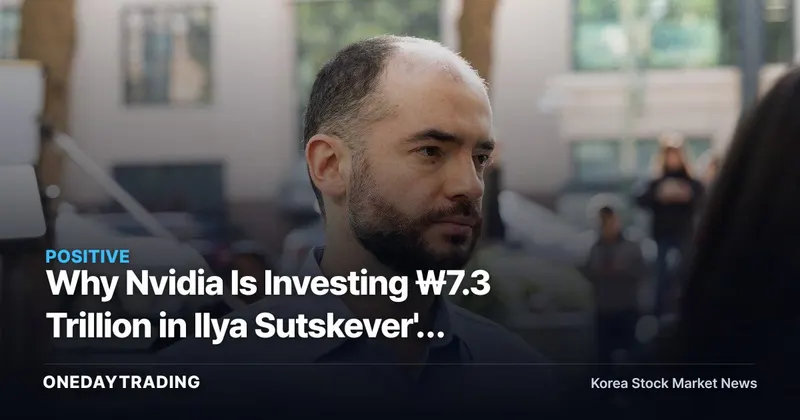
Nvidia has invested 7.3 trillion won in the AI startup founded by Ilya Sutskever, the former chief scientist at OpenAI who led development of ChatGPT. The company has no commercial product and no proven revenue to date. The logic behind Nvidia putting trillions of won into a revenue-less company is simple: that money is ultimately expected to flow back into purchases of Nvidia's own GPUs.
Why It Matters Now
Nvidia has already forged a large-scale compute partnership with OpenAI and made equity investments in xAI and CoreWeave. The investment in Sutskever's startup simply adds another name to that list, but the pattern is identical: capital flows to a private AI developer, and that capital comes back around as GPU orders for building massive training clusters. A company with no revenue and no product ultimately needs just one thing — large-scale computing resources — and the supplier of that resource is Nvidia itself.
Sutskever's company is reportedly focused on AGI safety research rather than launching commercial products. What such a company needs is a cluster of cutting-edge GPUs, along with the HBM, power supply, and data center capacity to support it. For Nvidia, this kind of investment effectively creates demand for its next-generation GPUs on its own. It can also serve as leverage for prioritizing capacity allocation and accelerating adoption of next-generation architectures.
The catch is that this structure isn't free of circular-financing controversy. Critics have repeatedly pointed out — going back to the OpenAI and xAI investments — that this looks like an accounting illusion in which money Nvidia invests simply loops back as Nvidia revenue. There are also strong counterarguments that equity investments made without proven revenue or a product roadmap make fair-value assessment inherently opaque, and could obscure the true quality of data center revenue growth.
FAQ
- What kind of company is Sutskever's startup? — It is an AI developer founded by Ilya Sutskever, formerly chief scientist at OpenAI, reportedly focused on large-scale model research rather than launching commercial products
- Why is Nvidia investing in a company with no revenue? — It's interpreted as a strategy to directly secure a next-generation customer that will consume large volumes of its own GPUs
- What impact does this investment have on the semiconductor supply chain? — Expansion of GPU clusters translates directly into demand for HBM and advanced foundry packaging
- What is the circular-financing concern? — It's the criticism that invested capital flows straight back as GPU revenue, making it hard to tell whether the resulting demand reflects genuine end demand or simply capital recycling
Related Stocks (Tickers) and Sector Impact
- Nvidia — The investor itself. It secures a future GPU (tickers) buyer, but this comes with the accounting burden and cash outflow of an equity investment
- SK Hynix (000660) — GPU cluster expansion translates directly into a key beneficiary line for expanded HBM supply
- Samsung Electronics (005930) — Exposed to rising demand on both the HBM and foundry fronts
- TSMC — Stands to benefit from demand for contract manufacturing and advanced packaging capacity for Nvidia's latest GPUs
- Hanmi Semiconductor — Supplies HBM back-end bonding equipment and is closely tied to the capacity-expansion cycle
Investment Considerations
- Equity investments in unlisted startups carry uncertain fair-value assessments and have not been validated by revenue
- If the circular-financing controversy intensifies, it could spill over into accounting and investor-confidence issues around the quality of data center revenue
- There is a time lag between an investment announcement and actual GPU order volumes — it's premature to treat an announcement alone as confirmed demand
- If the capex cycle turns down, the valuations behind these equity investments could themselves become a burden
Overall Outlook
In the optimistic scenario, these equity investments increase the visibility of the GPU and HBM demand pipeline, supporting utilization rates across the broader supply chain. The offsetting risk is that as circular-financing concerns deepen, doubts could spread across valuations throughout the AI value chain, including Nvidia itself. The key indicators to watch next are clear: the timing and scale of this startup's actual GPU orders, Nvidia's data center revenue guidance for the next quarter, HBM shipment volumes from SK Hynix (000660) and Samsung Electronics (005930), and TSMC's advanced packaging utilization rates.
This article is automatically summarized and analyzed based on the original news report. View original (Yonhap News Securities)