
Key Summary
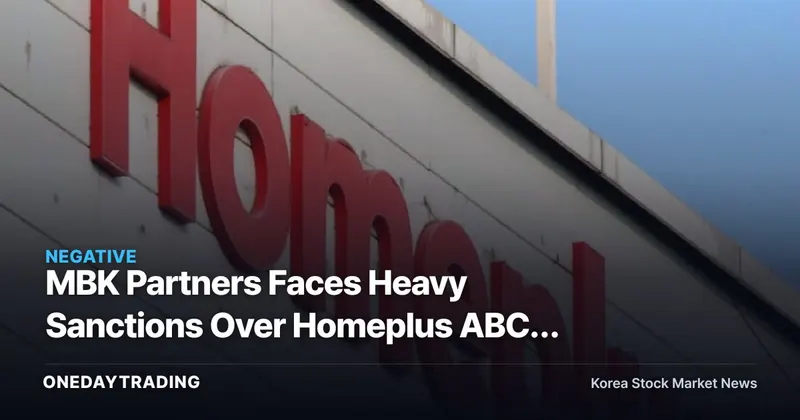
The Financial Supervisory Service (FSS) has reportedly decided on heavy sanctions against MBK Partners, the private equity fund (PEF) manager that acquired Homeplus. The decision still requires confirmation through a regular meeting of the Financial Services Commission (FSC), but it is unusual for a PEF manager to face direct sanctions from financial regulators over how it handled the distress of a specific portfolio company. Since this decision represents effectively the first administrative conclusion on the asset-backed commercial paper (ABCP) issuance controversy that persisted right up to Homeplus's rehabilitation filing in March 2025, it is likely to serve as a benchmark for the overall regulatory intensity facing the domestic PEF industry.
What Happened
According to a Maeil Business Newspaper report, the FSS has decided on heavy sanctions against MBK Partners in connection with the Homeplus case, and the matter is set to be finalized after going through an FSC meeting. The specific severity of the sanctions and the scope of executives targeted have not been made official pending the FSC's resolution, but the weight carried by the term "heavy sanctions" itself is not insignificant. PEFs have historically been subject to relatively loose oversight under the Capital Markets Act, and there are only a handful of precedents in which the FSS has directly sanctioned a management firm or its individual executives.
The trigger was Homeplus's method of fundraising. At the core of the controversy is the fact that asset-backed commercial paper (ABCP) continued to be issued and sold right up until a credit rating downgrade was imminent, and then, shortly after, in March 2025, Homeplus filed for court receivership (rehabilitation), leaving investors who had purchased those bonds fully exposed to losses. If there was a gap between when the company internally recognized the credit risk and when that information was disclosed to the market, this goes beyond a simple management failure and becomes a matter of unfair trading practices and breach of investor-protection obligations. It is understood that the FSS investigation zeroed in precisely on this point, forming the backdrop to the heavy sanctions decision.
Background and Context
MBK Partners is a leading large-cap domestic PEF manager that acquired Homeplus in 2015 for roughly 7.2 trillion won. It has pursued a classic PEF strategy of acquiring large retail companies through leveraged buyout (LBO) structures and then recovering returns via asset sales and balance-sheet restructuring, a process that has drawn sustained criticism from labor groups and civic organizations over "jobless asset recovery." This case marks an instance where that criticism has shifted into the language of financial regulation centered on investor protection. At the same time, MBK has in recent years also entered the Korea Zinc management-control dispute, expanding its presence in the domestic capital markets, so the fallout from these heavy sanctions is likely to extend well beyond the Homeplus case alone, affecting both the PEF industry broadly and the MBK brand.
Impact on the Market and Stocks (Tickers)
- K Car - A listed used-car platform in which MBK is the largest shareholder. If controlling-shareholder risk comes into focus, a renewed governance discount could weigh on the stock.
- Listed and soon-to-be-listed companies in PEF portfolios broadly - Companies with PEF firms as controlling shareholders may face heightened regulatory scrutiny in future fundraising and IPO review processes.
- Securities firms that underwrote ABCP and other short-term bonds - Whether underwriting and distributing brokerages fulfilled their investor-protection obligations could also become a subject of follow-on investigations, adding to compliance costs across the securities industry.
- Retail stocks with balance-sheet concerns - This could prompt investors to reassess credit risk at retail and service companies with high financial leverage from PEF acquisitions and LBO structures.
Investor Checkpoints
- The timing and specifics of when the FSC's regular meeting finalizes the sanction severity and targets (the firm and/or individual executives)
- The progress of prosecutorial investigations into Homeplus and MBK, and whether indictments follow
- The schedule for financial regulators to announce reforms to PEF disclosure and investor-protection rules
- Governance and share-price reactions at MBK portfolio companies such as K Car
Outlook
In the optimistic scenario, these heavy sanctions serve as closure on an individual case, with the PEF industry voluntarily strengthening disclosure and risk management and thereby restoring market confidence. If large PEF managers proactively overhaul their compliance frameworks, this could actually broaden the foundation of trust in capital markets over the medium to long term. On the other hand, the risk is that this case spills over into National Assembly discussions on PEF regulatory legislation, structurally raising the regulatory cost burden on fundraising and exit structures across the private equity industry as a whole. That could act as a valuation discount factor for both listed and unlisted companies with PEF firms as controlling shareholders. The FSC's final announcement and the subsequent outcome of the prosecutorial investigation are the next variables that will determine which direction this fork in the road takes.
K Car by the Numbers
K Car's most recent closing price was 8,330 won (-3.03% from the previous day), and the signal combining foreign investor/institutional investor supply-demand (order flow) with news and momentum reads 🟡 neutral / wait-and-see. With positive and negative signals mixed, this is a stock to watch.
- ▼ Trend alignment — short- and medium-term downward alignment (-3.0% today · -0.8% for the week · -3.9% for the month)
- ▼ 52-week position — near the bottom of its 52-week range, at the 3rd percentile
※ Price and foreign/institutional investor supply-demand (order flow) data are provided by Korea Investment & Securities (KIS) and reflect the time of publication.
This article is auto-summarized and analyzed content based on the original news report. View original article (Maeil Business Newspaper - Securities)