
At a Glance
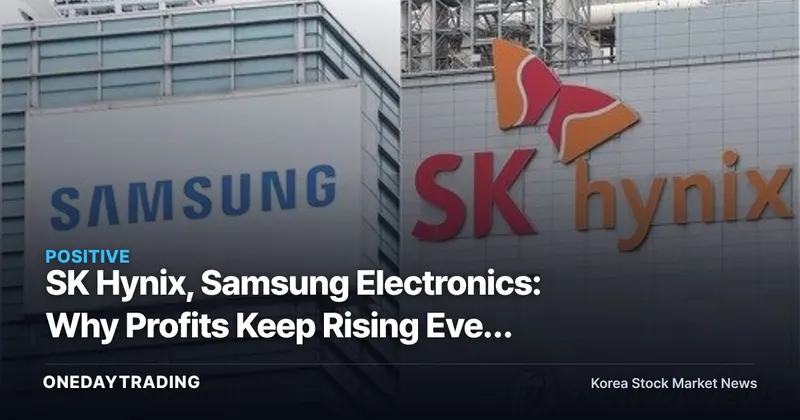
Reports that memory chip prices posted a smaller month-over-month gain in July have stoked concerns that the industry cycle has peaked. Market analysts caution against misreading this as the end of the price rally. A slowdown in the pace of increase and an actual price decline are entirely different phases, and the earnings-improvement cycle at Samsung Electronics and SK Hynix remains firmly in progress, they say.
Why It Matters Now
The reason to distinguish between a slowdown in the rate of increase and an actual price decline is simple. Even if the pace of gains narrows, as long as the direction stays positive, average selling prices (ASP) are still climbing — and memory makers' quarterly earnings track the absolute price level and product mix at a given point in time, not the month-over-month growth rate. In particular, during periods when the share of high-value-added products like HBM is expanding, blended ASP often improves even as the price growth rate for commodity DRAM moderates somewhat.
On the supply side, as long as the output-cut stance holds, pricing power remains with the manufacturers. As Samsung Electronics and SK Hynix run utilization rates conservatively to normalize inventory, demand from customers looking to secure volume ahead of time helps prop up prices. This structure would break down not when the growth rate slows, but when monthly prices actually reverse into a decline or manufacturers pivot toward capacity expansion and higher utilization.
There are risk factors worth flagging in the other direction, too. Share prices have already priced in a substantial portion of the expected earnings improvement, so if next quarter's results fall short of market expectations, the price-growth slowdown itself could belatedly become the trigger for a genuine correction. Even with solid server- and AI-related demand, if demand for general-purpose devices such as smartphones and PCs comes in weaker than expected, commodity DRAM prices could still face renewed pressure.
Frequently Asked Questions
- Why isn't the slower rate of increase a peak-out signal? Because even with smaller gains, prices themselves are still rising, meaning ASP continues to climb.
- What's the real impact on memory makers' earnings? Rising selling prices combined with an expanding mix of high-value-added products like HBM are likely to keep driving operating profit margin improvement.
- What should investors watch for a genuine peak-out signal? Whether monthly prices actually turn negative, whether customer inventories start building up again, and whether output cuts ease and utilization rates rise.
- Is there a valuation concern at current levels? Some note that share prices have already priced in a considerable amount of the expected earnings improvement, so confirmation via the next earnings report is needed.
Related Stocks and Sector Impact
- SK Hynix: As the leading supplier of HBM, any expansion in customer orders translates directly into earnings through improved ASP and product mix.
- Samsung Electronics: Benefits from price gains across its entire DRAM and NAND product lineup, serving as a barometer for how quickly its semiconductor division's earnings recover.
- Hanmi Semiconductor: Tied to orders for HBM back-end bonder equipment, it is positioned for derivative benefits from the HBM capacity-expansion cycle.
- Semiconductor equipment and materials suppliers: As utilization rates normalize in earnest, the timing of benefits from renewed equipment and materials orders could move up.
Investment Considerations
- Don't judge solely on the month-over-month growth rate — check the absolute price level and directional trend together.
- Watch the pace of inventory normalization and the timing of demand recovery in end markets like servers and smartphones in the next earnings report.
- Track announcements from Samsung Electronics and SK Hynix on capacity expansion and utilization rates to gauge whether supply is re-expanding.
- Check the gap between expectations already priced into shares and actual reported results through next quarter's guidance.
Overall Outlook
In the optimistic scenario, the output-cut stance combines with structural HBM demand to keep the earnings-improvement cycle going even as price growth slows. The risk scenario is one where weakening demand for general-purpose devices coincides with an early resumption of capacity expansion, tipping the market back into oversupply. What ultimately separates the two scenarios is next quarter's price data and utilization figures — not a single month's growth-rate number.
SK Hynix: A Real-Time Data Snapshot
SK Hynix's most recent closing price was KRW 1,803,000 (-2.28% versus the previous day), and the composite signal — combining foreign and institutional investor supply-demand (order flow) with news and momentum — reads 🔴 Caution. With foreign investors, institutional investors, and momentum all trending negative, caution is warranted right now.
- ▼ Supply-Demand Streak — Foreign investors have been net sellers for 3 straight days (−KRW 1.398 trillion)
- ▼ Dual-Sided Selling — Foreign investors −KRW 1.398 trillion · institutional investors −KRW 1.4833 trillion, selling in tandem
- ▼ Trend Alignment — Short- and mid-term trends aligned to the downside (-2.3% today · -18.1% over 1 week · -21.2% over 1 month)
- ▲ News Flow — 3 positive catalysts vs. 2 negative catalysts — positive catalysts outweigh
Recent related news skews favorable, with 3 positive catalysts versus 2 negative catalysts.
※ Price and foreign/institutional investor supply-demand (order flow) data are provided by Korea Investment & Securities (KIS) and reflect figures as of the time of publication.
This article is automatically summarized and analyzed content based on the original news report. View original article (Yonhap News Agency, Securities)