
At a Glance
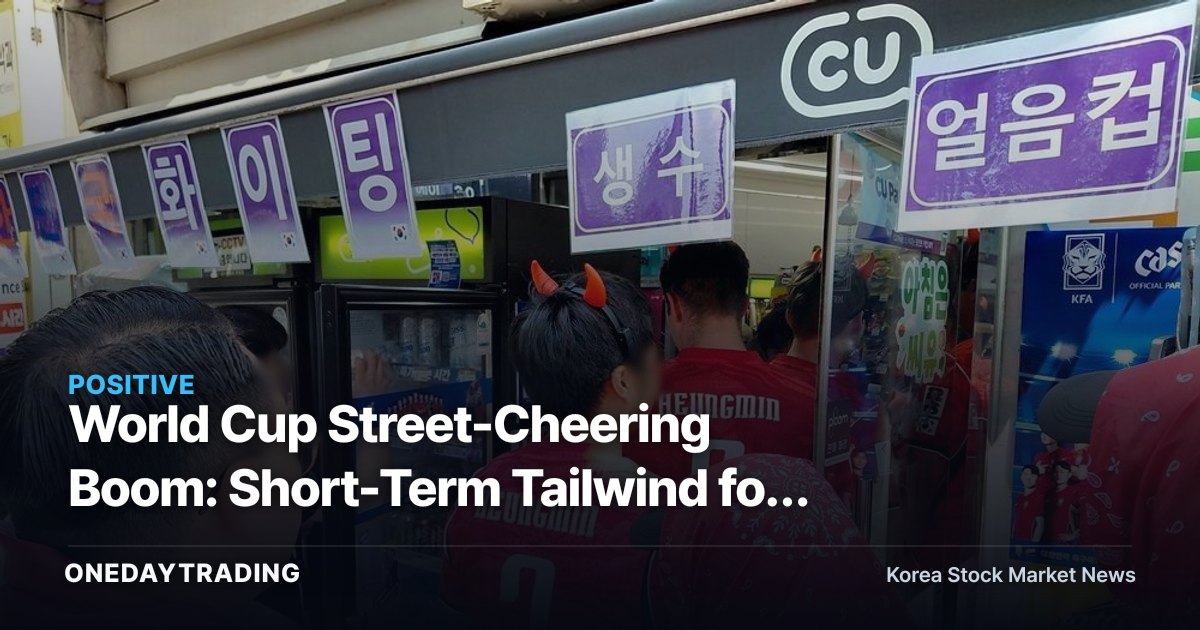
World Cup street cheering is a textbook event-driven consumption catalyst, funneling a flood of foot traffic into specific locations. The up-to-sevenfold jump in beer sales at nearby convenience stores during the June 19 cheering event at Gwanghwamun Square illustrates how high-ticket categories such as liquor and ready-to-eat meals sell simultaneously at stores in cheering hubs.
From an investor's standpoint, however, the key point is that this demand is a one-off, concentrated on specific dates and specific stores. Short-term momentum must be viewed separately from any structural improvement in quarterly earnings.
Why It Matters Now
Understanding the profit structure of convenience-store franchisors helps gauge the strength of the benefit. A franchise headquarters' revenue and profit come from franchise fees and product-supply margins that are tied to store sales. As a result, even if sales surge at a handful of stores in cheering hubs like Gwanghwamun, the effect on nationwide headquarters operating profit is diluted relative to the total store count and thus limited. The real significance lies less in short-term earnings than in the signal it sends about consumer sentiment and a recovery in average spend per customer.
For liquor makers, the mechanism is more direct. Beer is the product most closely tied to street cheering, and a rise in sales volume translates directly into production and shipments. That said, the World Cup is a time-limited event, so investors must also factor in the base effect of demand reverting to normal levels once the tournament ends.
Moreover, when a heat wave, outdoor cheering, and the summer peak season overlap, seasonal demand across beverages and liquor stacks on top of event demand. Distinguishing how much of the sales increase is a genuine World Cup effect is the crux of interpreting the earnings.
Frequently Asked Questions
- Will it show up immediately in convenience-store franchisor share prices — Sales surges at a few hub stores account for a small share of the overall headquarters, so the contribution to short-term earnings is limited.
- Are beer companies the more direct beneficiaries — Because higher sales volume feeds into shipments, the mechanism is direct, but the demand is confined to the tournament period.
- Will this effect persist — Street cheering occurs intermittently in line with the match schedule and normalizes once the tournament ends.
- Can it be confirmed in earnings — The actual size of the event effect can be verified in second- and third-quarter earnings and in card-spending data.
Related Stocks and Sector Impact
- BGF Retail — As the operator of CU, a direct beneficiary of beer and ready-meal sales at cheering-hub stores, though the impact on headquarters profit is diluted in proportion to those stores' share.
- GS Retail — Owns the GS25 convenience-store network; potential short-term benefit from higher average spend per customer as downtown foot traffic rises.
- HiteJinro — The most direct beneficiary of rising beer sales volume, with a high degree of product alignment with street cheering.
- Lotte Chilsung — Holds both liquor and beverages, creating a structure where cheering demand and summer beverage demand overlap.
- Retail and food-and-beverage sector overall — Recovering downtown event spending acts as a sentiment indicator, but note that it is a one-off variable.
Points to Watch When Investing
- The "up to sevenfold" figure is based on stores in specific locations and should not be equated with company-wide earnings growth.
- Investors should price in the reverse base effect from demand normalizing after the World Cup in advance.
- It is worth checking whether the current valuations of retail and liquor stocks have already partly priced in event expectations.
- Because summer seasonality and the event effect are intertwined, caution is needed to isolate the pure World Cup contribution.
Overall Outlook
In an optimistic scenario, street cheering recurs throughout the tournament, convenience-store average spend per customer and beer shipments improve in the short term, and subdued downtown consumer sentiment shows signs of recovery. Conversely, if the effect is confined to the few days when cheering events are held and the contribution to headquarters profit is small, share prices could quickly revert to normal levels once the momentum is exhausted. A reasonable approach is to treat the next quarterly earnings release and card and retail-sales data — where the actual scale of the event effect becomes apparent — as the checkpoint.
BGF Retail Through Real-Time Data
BGF Retail's latest closing price is 114,700 won (-2.38% from the previous day), and its signal light — combining foreign and institutional investor order flow with news and momentum — is 🟡 Neutral / Wait-and-See. With positive and negative signals mixed, it is a zone to watch.
- ▼ Trend Alignment — Short- and mid-term downward alignment (today -2.4% · 1 week -11.3% · 1 month -14.3%)
Recent related news is negative, with 0 positive catalysts and 2 negative catalysts.
※ Price and foreign/institutional investor order-flow data are provided by Korea Investment & Securities (KIS) and are as of the time of publication.
This article is content automatically summarized and analyzed based on the original news. View Original (Yonhap News, Industry)