
Three-Line Briefing
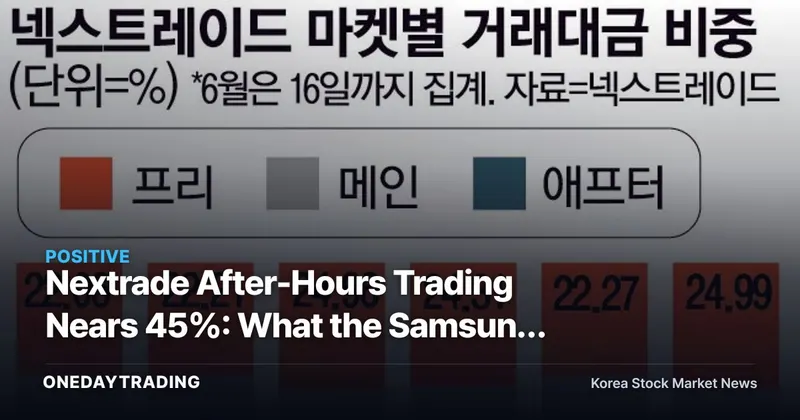
- Since the launch of the alternative trading system (ATS) Nextrade, trading outside regular session hours — pre-market and after-market combined — has expanded to roughly 45% of total volume.
- Movements in U.S. semiconductor stocks such as Nvidia and Micron are now priced into Samsung Electronics and SK Hynix quotes before Korea's regular session even opens, lengthening the window during which prices swing.
- The direct beneficiaries of rising trading value are brokerages, whose fee base widens as a result, while the key variable to watch is the thin order book during overnight and early-morning hours.
What's Changing
For investors, the essence of this shift is that price discovery in the Korean market is moving toward something close to a round-the-clock system. In the past, semiconductor-related news that accumulated after the U.S. market closed would all hit at once as a gap at Korea's 9 a.m. opening auction. Now, that news is priced in gradually during the pre-market session instead. This is also why Samsung Electronics and SK Hynix — the two stocks (tickers) most closely watched by foreign investors and institutional investors — are the most sensitive to swings in U.S. semiconductor stocks.
From a brokerage's perspective, extended trading hours mean a larger base for trading value and brokerage commissions. The more executions that occur during the additional hours beyond the six-hour regular session, the more the brokerage revenue base structurally thickens. Brokerages with a higher share of retail trading stand to benefit the most.
That said, more trading hours doesn't mean liquidity has grown evenly across the board. During the overnight and early-morning hours, participation is thin, order books are shallow, and execution prices can diverge from the regular-session reference price. Convenience of trading does not necessarily guarantee a good price.
Numbers in Context
The fact that after-hours trading share has approached 45% of the total means that nearly half of the execution volume once monopolized by the traditional exchange has now been distributed to an alternative venue. Nextrade is an ATS competing with the Korea Exchange (KRX), drawing trading activity through extended hours and diverse order types. It's a natural outcome that Samsung Electronics and SK Hynix — top-tier stocks by market capitalization that are directly tied to the U.S. semiconductor cycle — sit at the center of this trend.
Stocks to Watch: Winners and Losers
- Kiwoom Securities: With a high share of retail brokerage business, it is the most direct beneficiary of the rise in trading value driven by extended trading hours.
- Mirae Asset Securities, NH Investment & Securities, Samsung Securities: These firms have a broad revenue base in brokerage commissions and margin/custody-related income, positioning them to benefit from higher trading turnover.
- Samsung Electronics, SK Hynix: When positive catalysts from U.S. semiconductor stocks are priced in during the pre-market session, the burden of regular-session gaps is spread out — but in turn, the window of exposure to volatility also lengthens.
- Korea Exchange (KRX): As more trading migrates to the ATS outside regular hours, KRX faces pressure as its execution share and price representativeness are partially eroded.
Risk Check
- Thin order books during the overnight and early-morning hours can cause execution prices to diverge from the regular session, resulting in slippage.
- A sharp drop (plunge) in U.S. semiconductor stocks could widen pre-market gap-downs and amplify losses, underscoring that extended trading hours cut both ways.
- As the ATS is still in its early stages of adoption, operational variables such as system stability and regulatory refinement remain outstanding.
- As trading becomes more dispersed over time, the representativeness of a single reference price weakens, making fair-value judgments for individual stocks (tickers) more difficult.
Bottom Line
Extended trading hours represent a structural change that simultaneously boosts brokerage revenue and improves price-discovery efficiency — but the execution gaps caused by thin overnight order books, along with the longer window of volatility exposure, are costs that retail investors must also bear.
Kiwoom Securities: A Real-Time Data Snapshot
Kiwoom Securities's most recent closing price was KRW 369,000 (unchanged from the prior day, 0.00%), and the signal combining foreign investor/institutional investor supply-demand (order flow) with news and momentum reads 🟡 neutral / wait-and-see. With positive and negative signals mixed, this is a stock (ticker) to watch closely.
- ▲ News flow — 3 positive catalysts vs. 1 negative catalyst — positive catalysts lead
Recent related news skews favorable, with 3 positive catalysts versus 1 negative catalyst.
※ Price and foreign/institutional investor supply-demand (order flow) data are provided by Korea Investment & Securities (KIS) and reflect figures as of publication time.
This article was automatically summarized and analyzed based on the original news source. View original (Maeil Business Newspaper, Securities)