
Key Takeaways
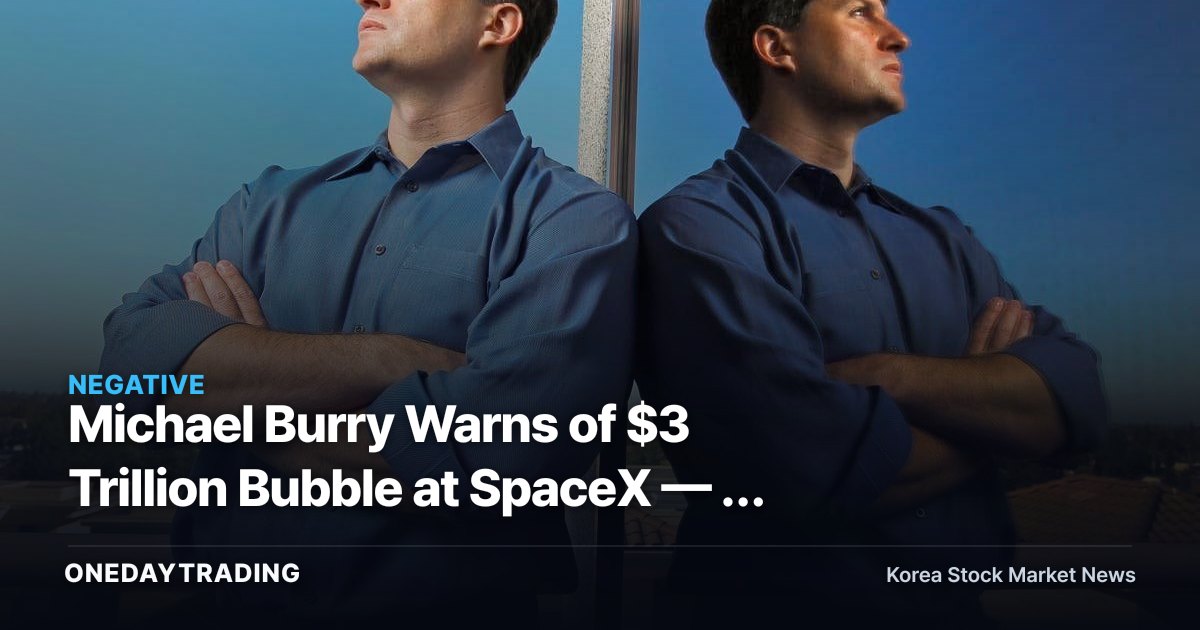
Michael Burry, famous for his bet against the financial crisis, is reported to have flagged a $3 trillion-scale concern about Elon Musk's SpaceX. While his skepticism targets a private company, it serves as a checkpoint for aerospace and satellite investors at home and abroad, as it once again questions the expected returns and valuation justification across the space industry as a whole.
What Happened
Burry cast doubt on the market's optimism surrounding SpaceX's corporate value and business outlook. At its core, the concern reads as a view that the future value assigned to the Starlink satellite internet service and the next-generation Starship launch vehicle has been excessively priced in relative to actual cash-generating power. The figure of $3 trillion points simultaneously to the scale of the rosy scenarios the market expects from the space business and the execution risk embedded within them.
Because SpaceX is a private company, ordinary investors cannot buy it directly. Even so, this debate matters because Musk's company has served as a kind of benchmark that drives expectations across the entire theme of space launch, satellite communications, and defense satellites. If the valuation of the bellwether private company is called into question, the multiples of listed space stocks (tickers) that trade with reference to it could also face repricing pressure.
Background and Context
In recent years, the commercialization of reusable launch vehicles and the spread of low-earth-orbit satellite networks have placed the space industry at the center of growth themes. However, this is a business with large variables such as massive upfront investment, long payback periods, and regulatory and launch-failure risks. Burry's point is less a denial of growth potential itself and more a valuation warning that the market's expectations for the pace of growth and the timing of monetization have run too far ahead.
Impact on the Market and Stocks
- Hanwha Aerospace: As Korea's flagship aerospace stock (ticker) building up its launch-vehicle engine and space businesses, it is a psychological reference stock directly exposed to the global space valuation debate.
- Korea Aerospace Industries (KAI): Operating satellite and launch-vehicle systems businesses, it is sensitive to shifts in space-theme sentiment.
- Intellian Technologies: A satellite communications antenna company whose earnings are structurally tied to expectations for the spread of Starlink-style low-earth-orbit satellite networks.
- Satrec Initiative: With a high weighting in satellite bodies and imaging businesses, it sits within the sphere of influence of the space-infrastructure investment cycle.
- Defense satellite value chain: If the debate over lofty space valuations spreads, volatility could transfer to the multiples of satellite-component and ground-station-related stocks as well.
Investor Checkpoints
- Check whether the multiples of domestic space stocks are excessive relative to actual order-book and revenue visibility, and review the space segment's revenue weighting and profitability trend in quarterly earnings releases.
- Examine whether new order disclosures related to launch vehicles and satellites, along with government space-development budgets and policy schedules, are translating expectations into actual cash flow.
- Monitor short-term volatility that follow-up reporting on SpaceX or changes in its after-hours trading value may bring to theme sentiment.
- Also watch the discount-rate burden that shifts in the interest-rate and liquidity environment place on the valuation of long-duration growth stocks.
Outlook
On the optimistic side, if falling reusable-launch costs and an expanding satellite-network subscriber base continue, the top-line growth of the space industry has room to persist structurally. Conversely, if, as Burry notes, expectations have outpaced the speed of monetization, then when launch delays, intensifying competition, and rising capital-raising costs overlap, the most highly valued stocks (tickers) could be the first to face correction pressure. As this is one investor's opinion on a private company, the direct impact is limited, but it calls for a discipline of verifying each quarter whether the premium assigned to the space theme is backed by earnings.
Hanwha Aerospace Through Real-Time Data
Hanwha Aerospace's latest closing price is 1,112,000 won (-1.16% versus the previous day), and the signal light combining foreign and institutional investor supply-demand (order flow) with news and momentum is 🟡 Neutral · Wait-and-See. With positive and negative signals mixed, it is a zone to watch.
- ▼ Trend alignment — Short- and medium-term downward alignment (intraday -1.2% · 1 week -6.0% · 1 month -10.9%)
- ▲ News flow — 9 positive catalysts vs. 2 negative catalysts — positive catalysts in the lead
Recent related news is favorable, with 9 positive catalysts and 2 negative catalysts.
※ Price and foreign/institutional investor supply-demand (order flow) data are provided by Korea Investment & Securities (KIS), as of the time of publication.
This article is content automatically summarized and analyzed based on the original news. View original (Yahoo Finance)