
At a Glance
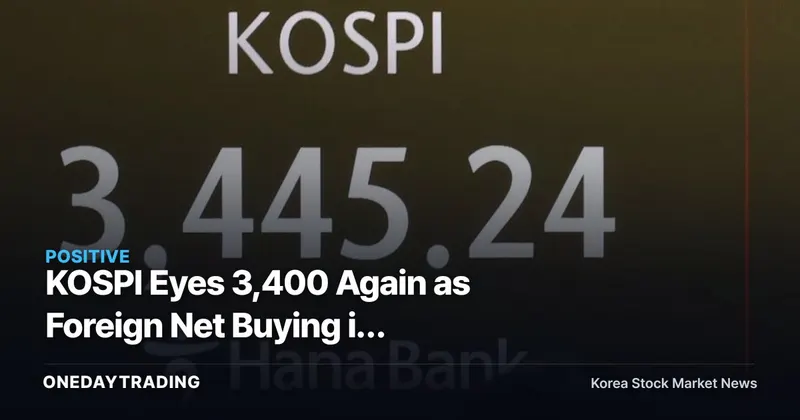
Foreign net buying concentrated in large-cap semiconductor stocks has restored upward momentum to KOSPI. This is less a simple index rebound and more a signal that global capital is returning to the core stocks (tickers) that dominate KOSPI by market capitalization.
With Samsung Electronics and SK Hynix now firmly in control of index direction, investors need to read semiconductor industry conditions and foreign investor supply-demand (order flow) together, rather than focusing on individual stocks (tickers).
Why This Matters Now
Based on Korea Exchange (KRX) data, KOSPI rose 49.7 points — approximately 1.4% — from the prior week's (15th–19th) closing price of 3,395.54. The absolute move may appear modest, but what matters is that large-cap semiconductor stocks led the advance and that foreign net buying was the driving force behind it. Because Samsung Electronics and SK Hynix together account for an outsized share of KOSPI's market capitalization, the supply-demand (order flow) dynamics of these two stocks (tickers) translate directly into index-level gains and losses.
The reason foreign investors are concentrating their buying in semiconductors is tied to expectations of a recovery in end demand. If memory prices are perceived to have bottomed and entered a recovery phase — and if demand for high-bandwidth memory for AI servers continues to push up average selling prices — the earnings leverage at SK Hynix, which depends on memory for the bulk of its revenue, and at Samsung Electronics, which holds both memory and foundry businesses, would be substantial. This expectation is the primary force attracting foreign capital.
However, the same capital's sensitivity to the exchange rate and U.S. interest rates is a double-edged sword. A weaker won improves export profitability, but it erodes the investment returns of foreign investors when converted back into dollars. Should risk appetite cool quickly in response to the trajectory of U.S. rates, the current semiconductor concentration could unwind as profit-taking supply.
Frequently Asked Questions
- Why does KOSPI move with semiconductors? Samsung Electronics and SK Hynix carry an overwhelming weight in market capitalization, so their price moves feed directly into the index calculation.
- Why are foreign investors buying semiconductors? Expectations of earnings improvement have grown on the back of a memory industry-sector recovery and expanding AI-driven demand, and the large-cap nature of these stocks (tickers) makes it easy to deploy institutional-scale capital.
- Is this a trend reversal? It is difficult to conclude so from a single week of 1.4% gains. Whether foreign net buying sustains over multiple weeks is the primary confirmation signal for a trend.
- Are other industry sectors being left behind? Sector rotation into shipbuilding and defense after semiconductors lead is also being discussed as a possibility.
Related Stocks (Tickers) & Sector Impact
- Samsung Electronics The top-weighted stock (ticker) in the index and a direct beneficiary of foreign investor supply-demand (order flow). Holding both memory and foundry businesses gives it significant earnings leverage when industry conditions recover.
- SK Hynix High revenue dependence on memory means its earnings are the most sensitive to price recovery and high-bandwidth memory demand.
- Semiconductor materials & equipment stocks (tickers) Lagging beneficiaries of higher utilization rates and capex expansion at large chipmakers. However, timing lags will vary depending on when actual equipment investment is executed.
- Shipbuilding & defense Industry sectors cited as sector-rotation candidates after semiconductor leadership. Capital inflows become justifiable when supported by independent order momentum.
- Autos and other export stocks (tickers) A weaker won raises profitability expectations, but concentrated supply-demand (order flow) into semiconductors may leave these names in the short-term cold.
Investment Considerations
- Do not treat a single week of gains as a confirmed trend; monitor whether foreign net buying continues on a daily basis.
- The more concentrated semiconductor positioning becomes, the greater the volatility risk when profit-taking sets in. Check whether valuations are entering a stretched zone.
- The USD/KRW exchange rate and the schedule of U.S. rate decisions are the key variables that can shift the direction of foreign capital flows.
- Confirm whether memory price indicators and next-quarter earnings and guidance actually support expectations with real numbers.
Overall Outlook
The bull scenario is one in which a memory industry-sector recovery and AI demand are confirmed through earnings, foreign buying continues, and sector rotation from semiconductors into shipbuilding and defense follows. In this case, the index's upside potential broadens.
Conversely, if risk appetite contracts due to U.S. rate uncertainty or a sharp move in the exchange rate, the large-cap concentration could reverse quickly. Given the heavy index weighting, the duality — that KOSPI swings with semiconductors both on the way up and on the way down — must be kept in view.
This content was automatically summarized and analyzed based on the original news article. Read the original article (Money Today Securities)