
At a Glance
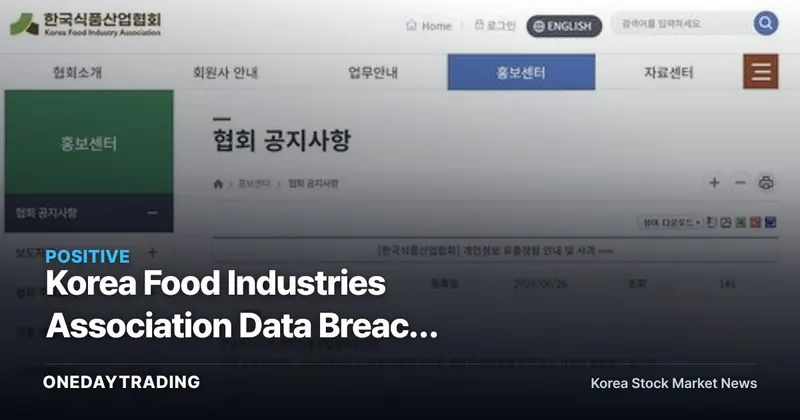
A data breach affecting approximately 113,000 individuals has been confirmed at the Korea Food Industries Association's online learning management system (LMS). While the incident itself is unlikely to have a significant direct impact on the broader market, recurring security failures at public and quasi-public institutions are reinforcing the regulatory push toward mandatory security compliance — providing structural support for information security solution demand.
Why It Matters Now
The core issue here is not a one-off hack, but the exposure of poor governance over non-core systems such as education and membership management platforms. For organizations like industry associations that handle large volumes of member data yet assign low priority to security investment, outsourced or legacy systems like LMS portals and member portals become the weakest links. From an investment standpoint, what matters is not any single incident, but the cumulative regulatory and budgetary environment these incidents create.
If the Personal Information Protection Commission (PIPC) launches an investigation and imposes penalties — triggering more rigorous security audits across public institutions — demand for security consulting, managed security services, and solution procurement could increase. However, this type of demand tends to flow through to earnings gradually over multiple quarters rather than immediately, which is why cybersecurity stocks have historically shown a pattern of short-term sharp gains (surges) on headline news followed by swift reversals.
Frequently Asked Questions
- Scale of the breach: The personal information of approximately 113,000 individuals has been confirmed as compromised, with the association's LMS identified as the point of entry.
- Why is this linked to cybersecurity stocks? Institutional security incidents tend to trigger intensified audits and pressure to adopt new solutions, increasing the pipeline of potential demand for information security firms.
- Will this translate to earnings immediately? No. There is a lag between procurement orders and revenue recognition, so near-term stock price reactions should be distinguished from actual earnings improvement.
- Are there any listed companies directly affected? The association at the center of the breach is unlisted, so direct exposure among publicly traded companies is limited.
Related Stock (Ticker) and Sector Impact
- AhnLab — The leading cybersecurity stock (ticker) with a lineup spanning antivirus, managed detection, and security operations. Typically the first name in market sentiment when institutional security tightening is in focus.
- Wins — Focused on network intrusion prevention systems (IPS) and managed security services, with a high share of public and institutional procurement. Its exposure to audit-driven demand is relatively direct.
- RaonSecure — Holds authentication and identity verification solutions, aligning well with the broader trend toward stronger personal data protection.
- SGA Solutions — A small-to-mid-cap cybersecurity stock (ticker) with an established public-sector reference base in system and data security; highly sensitive to thematic momentum.
- Information Security Sector Overall — Policy momentum around mandatory security compliance and budget expansion influences sector-wide valuation more than any individual stock (ticker).
Investment Considerations
- Sharp gains (surges) in cybersecurity stocks driven by individual incident headlines are frequently reversed. Investors should distinguish between thematic bounces and actual contract wins.
- Small-to-mid-cap cybersecurity stocks carry small market capitalizations, making them volatile and susceptible to short-term overheating driven by trading volume concentration.
- Until actual benefits are confirmed through procurement announcements and contract disclosures, stocks may already be pricing in expectations — warranting a close look at valuation risk.
- The durability of momentum will depend on the severity of PIPC sanctions and the timing of public-sector security budget allocations.
Overall Outlook
In an optimistic scenario, a series of institutional security breaches accelerates mandatory security investment and budget expansion across public and quasi-public sectors, broadening the multi-year order pipeline for information security firms. Conversely, if this incident concludes as a one-time news story without further regulatory action or policy announcements, the market reaction in cybersecurity stocks is likely to remain a short-lived thematic trade. Key indicators to watch include the PIPC's investigation outcome and penalty size, policy announcements related to public-sector security audits and budget allocation, and new order disclosures from cybersecurity companies in the next quarterly earnings cycle.
AhnLab — Live Data Snapshot
AhnLab's most recent closing price was ₩51,500 (−0.77% vs. prior day). The composite signal — incorporating foreign investor and institutional investors supply-demand (order flow) alongside news and momentum — reads 🔴 Caution. Foreign investor flows and momentum are both negative, warranting a cautious stance at this time.
- ▼ Supply-Demand (Order Flow) Continuity — Foreign investors have net sold for 6 consecutive sessions (−600 million won)
- ▼ Trend Alignment — Short- and medium-term downtrend aligned (day: −0.8% · 1 week: −7.4% · 1 month: −16.4%)
- ▼ 52-Week Position — Within 2% of 52-week low
※ Price and foreign investor/institutional investors supply-demand (order flow) data are provided by Korea Investment & Securities (KIS) and reflect the time of publication.
This content was automatically summarized and analyzed based on the original news source. Read the original article (Yonhap News — Industry)