
At a Glance
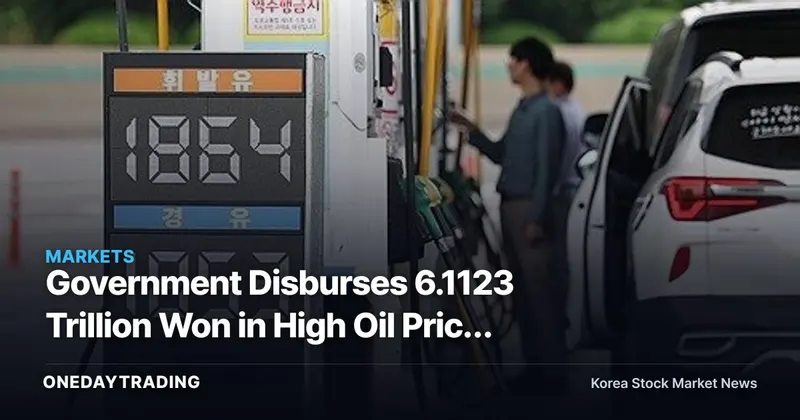
The final application rate for the government's high oil price relief payment program came in at 98%. The total amount disbursed reached 6.1123 trillion won, meaning virtually all eligible recipients claimed the support. This figure should be read not merely as an administrative performance report, but as an indicator of just how heavily households and self-employed workers are currently feeling the strain of high fuel prices and inflation.
Why It Matters Now
The fact that more than 6 trillion won in cash-equivalent funds was released from the fiscal budget is, by itself, a form of liquidity injection. But what matters most is the nature of this money: it is not a consumption-boosting coupon but compensation for the rise in fuel costs already paid. If the payment functions as a retroactive settlement of fuel expenses already incurred, rather than converting into fresh spending, its actual boost to domestic demand may fall short of what the disbursed amount alone would suggest. It would be premature for the market to read this fiscal expansion as an immediate tailwind for consumer stocks (tickers).
The 98% application rate itself also deserves scrutiny. Given that government relief programs typically see application rates below 90%, a take-up rate this close to universal implies that an unusually large share of eligible recipients felt genuine pain from high fuel costs. This can serve as evidence for the Bank of Korea as it weighs price stability against stimulating domestic demand — namely, that the cost-of-living pressure from high oil prices is far more widespread than headline statistics suggest. Market participants trying to gauge the timing of a rate cut should view this disbursement completion announcement alongside the upcoming consumer price index release.
The completion of this fiscal disbursement also means that any further support will hinge on whether a new budget is allocated. Should oil prices climb again and calls for additional relief grow louder, this could reignite the debate over fiscal soundness and lead to a higher supply of government bonds, in turn affecting bond yields.
Frequently Asked Questions
- Who received the high oil price relief payments? - The program targeted groups facing a heavier fuel cost burden due to high oil prices, with a final disbursement of 6.1123 trillion won.
- What does a 98% application rate mean? - It means nearly all eligible recipients applied for the support, which can be interpreted as a signal that the group struggling with fuel cost burdens was unusually broad.
- What impact does this relief payment have on the stock market? - Rather than directly benefiting listed companies, it functions more like compensation for household income, so its effects on the market would show up indirectly through consumption and inflation indicators rather than through individual stocks (tickers).
- What indicators should be watched next? - Investors should watch what trace this disbursement leaves in the consumer price index and retail sales data, and how it is referenced in the Bank of Korea's upcoming Monetary Policy Board announcement.
Related Stocks (Tickers) and Sector Impact
- Domestic consumption-related stocks (tickers) - If the relief payments do translate into actual spending, the retail and dining industry sectors could see a short-term boost, though given the retroactive-settlement nature of the payments, the effect is likely to be limited.
- Refining and energy industry sector - While the ongoing high oil price environment remains favorable for refiners' refining margins, this particular relief program itself is not directly tied to refiners' earnings.
- Transportation and logistics industry sector - Freight and transport workers, who have borne a heavy fuel cost burden, are likely to make up a significant share of recipients, so some easing of fuel cost pressure on operating costs could be indirectly reflected.
Investment Considerations
- The mere announcement of completed government relief disbursement provides insufficient grounds to conclude that any specific stock's (ticker's) earnings will improve.
- The actual consumption-boosting effect of the relief payments should be confirmed through upcoming retail sales and card approval amount statistics.
- Should the high oil price environment recur, the potential impact of further fiscal support discussions on government bond issuance and interest rates also warrants attention.
Overall Outlook
On an optimistic reading, with more than 6 trillion won having flowed into households, some portion could still convert into spending and act as a cushion for domestic demand indicators in the second half of the year. On the other hand, if these payments merely settle fuel cost burdens already incurred, the actual boost to consumption could fall short of expectations, leaving only the fiscal burden behind. How this fiscal disbursement is referenced in the next consumer price index release and the Bank of Korea's Monetary Policy Board announcement will offer a key clue to the path of monetary policy ahead.
This article is automatically summarized and analyzed based on the original news report. View Original (Yonhap News Securities)