
Summary
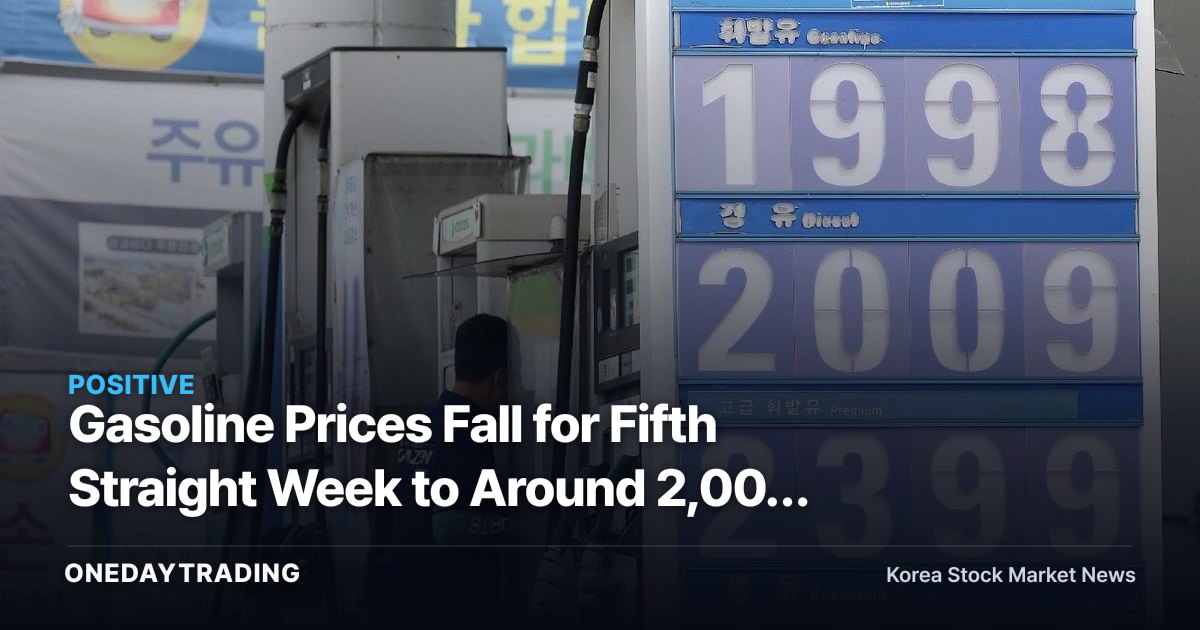
The national average retail gasoline price at service stations fell to around 2,009 won per liter in the third week of June, marking a fifth straight weekly decline. Falling domestic retail prices typically reflect global oil price trends from several weeks earlier. This is favorable for airlines and transport, where fuel makes up a large share of costs, as well as for household spending power, but the effect is double-edged for the refining sector when it comes to refining margins and inventory valuation.
For investors, the key is not the headline price statistic itself, but rather which sectors' earnings this trend reaches first by way of cost structures and the inflation pathway.
How It Unfolded
According to Opinet, the oil price information system run by the Korea National Oil Corporation, the national average gasoline price at service stations stood at around 2,009 won per liter for June 14–18. Diesel also declined over the same period, with both gasoline and diesel extending their losing streak to five consecutive weeks.
Domestic retail prices at service stations are set by adding fuel taxes and distribution costs to refiners' supply prices, and refiners' supply prices typically reflect international product prices from two to three weeks earlier. The recent softness in retail prices can therefore be seen as the earlier slowdown in global oil and refined-product prices feeding through to the pump with a lag.
The five-week run of consecutive declines may be interpreted as a signal of a trending downturn rather than a temporary fluctuation. That said, retail prices are simultaneously influenced by exchange rates and fuel tax policy, so part of the price decline may stem not only from crude prices but also from movements in the won-dollar exchange rate.
Structural Background
The direction of global oil prices is determined by an interplay of concerns over slowing global demand, the supply policies of oil-producing nations, and dollar movements. A sustained period of weak oil prices reduces the burden on Korea's import-dependent economy on both the trade balance and inflation fronts. Gasoline and diesel carry a meaningful weighting in the consumer price index, so falling fuel costs work to pull down headline inflation.
As inflationary pressure eases, monetary authorities may gain more policy room, so oil price trends are also linked—via the interest rate pathway—to investor sentiment across the financial and consumer sectors.
Stock and Sector Ripple Effects
- Airline stocks (Korean Air, Asiana Airlines): Jet fuel accounts for a large share of operating costs, so a drop in fuel unit prices translates directly into improved operating margins—the most direct beneficiary channel.
- Transport and logistics: Falling diesel prices lower fuel costs for diesel-dependent sectors such as freight and parcel delivery, which is favorable for profitability.
- Refining stocks (S-Oil, SK Innovation, GS): The effect is double-edged. Falling product prices lower per-unit revenue and raise the risk of valuation losses on inventory held, but if refining margins hold up firmly, the hit to earnings may be limited.
- Consumer and domestic-demand stocks: An easing of the fuel-cost burden partly restores households' real purchasing power, which is indirectly positive for domestic consumption such as retail and dining out.
Bull vs. Bear Scenarios
The bull-case scenario is one in which weak oil prices lead to price stability and cost savings, stimulating earnings momentum for airline, transport, and consumer stocks. As lower fuel costs feed into quarterly earnings, profitability improvements could become visible first in sectors with high cost leverage.
Conversely, if the cause of falling oil prices is not cost savings but slowing global demand itself, it could be read as a signal of economic contraction, with airline passenger and cargo volumes and overall domestic demand weakening together. In that case, the shock from weaker demand would outweigh the benefit of fuel cost savings, diluting the beneficiary thesis. For refining stocks, a combination of inventory valuation losses and shrinking margins risks amplifying short-term earnings volatility.
Investor Action Points
- Check Opinet's weekly average prices alongside international product prices and refining margins to distinguish whether the retail price decline is due to slowing demand or to supply and exchange-rate factors.
- Monitor the won-dollar exchange rate level. If the won weakens, it can offset the effect of falling oil prices and limit the extent of the retail price cut.
- At airlines' next quarterly earnings releases, check changes in fuel unit prices and operating margins to verify whether cost savings have actually translated into earnings.
- Keep an eye on the schedule for fuel tax policy changes and announcements of supply decisions by oil-producing nations to gauge whether the trend will persist.
Korean Air Through Real-Time Data
Korean Air's latest closing price was 27,950 won (-3.12% from the previous day), and the signal light combining foreign and institutional investor order flow with news and momentum reads 🟡 Neutral — Wait and See. With positive and negative signals mixed, this is a zone to watch.
- ▲ Order-flow continuity — Foreign investors net buyers for 6 consecutive days (+3.29 billion won)
- ▲ News flow — 14 positive catalysts vs. 1 negative catalyst — positive catalysts dominate
Recent related news is favorable, with 14 positive catalysts and 1 negative catalyst.
※ Price and foreign/institutional investor order-flow data are provided by Korea Investment & Securities (KIS) and are as of the time of publication.
This article is content automatically summarized and analyzed based on the original news. View original (Maeil Business Newspaper, Corporate)