
What Wang Dan’s 4.6% Forecast Means for Investors
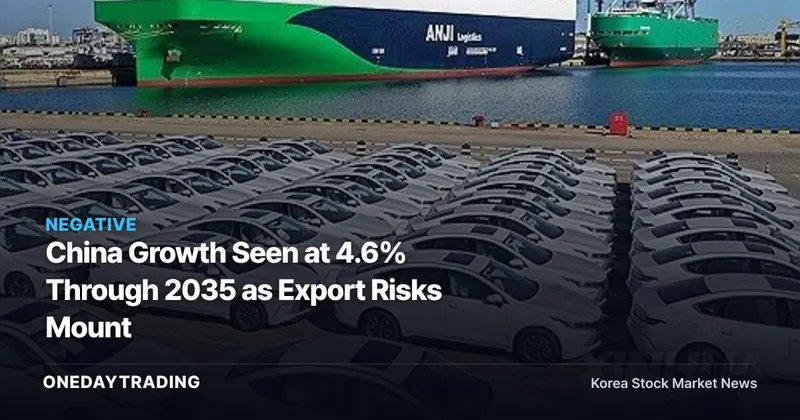
Investors assessing China’s economy should not buy into the growth forecast alone. According to a Yonhap Infomax report dated 2026-09-30, Wang Dan, China director at Eurasia Group, expects China to grow by at least 4.6% annually on average through 2035, but says the export-led model that is currently its biggest growth engine is unsustainable. For Korean investors, the more important question is not the headline growth figure, but whether the upward momentum in R&D and advanced technology can outweigh the downturns in property, investment and consumption.
K-shaped polarization refers to the divergence in growth trajectories between advanced-technology industries and the rest of the economy. Rather than assuming that China’s entire economy is recovering at the same pace, investors need to distinguish where growth is concentrated from where weakness persists.
R&D Drives Growth, but Export Dependence Sets Limits
Wang said R&D aimed at domestic substitution has become a major driver of investment in China, with long-term investment continuing despite the population decline. Her forecast that China will grow by at least 4.6% annually on average through 2035 is based on this trend. The real message is not that China has lost its growth engines, but that they have shifted toward R&D and exports.
Separating what has been established from what remains uncertain makes the picture clearer. Sustained R&D investment and exports’ contribution to growth are established assessments, but China’s actual growth rate in 2035 remains unknown. Even if export-led growth continues to support the economy’s headline expansion, Wang’s concerns about its sustainability will remain.
Shen Minggao Sees a K-Shaped Transition in China’s Economy
Shen Minggao, a professor at Zhejiang University’s School of Management, said China’s economy is undergoing “an uneven K-shaped transition.” While the upward leg led by advanced-technology industries continues to grow, it is not yet large enough to offset the impact of weak investment and consumption in the downward leg, he explained.
The key question under this structure is whether growth in advanced technology spreads to other parts of the economy, including investment and consumption. If the upward leg broadens, the case for a more balanced recovery across the economy will strengthen. Conversely, if weak investment and consumption persist, advanced-technology gains alone will not justify optimism about the overall trajectory.
Property Once Made Up One-Third of Activity—Why It May Not Have Bottomed
Shen estimated that at its peak, Chinese property and related industries accounted for about one-third of all economic activity. “If the property sector itself does not stabilize, it will be difficult for the broader macroeconomy to achieve sustained stability,” he said. This figure suggests that property should be viewed less as a standalone industry sector and more as a pillar determining the stability of China’s economy.
Wang said continued declines in home prices make it difficult to conclude that China’s property market has bottomed. Assuming the market views 2014 levels, before several property booms, as fair value, she forecasts that home prices across China will fall by at least another 15% annually from now through 2030. This is an assumption-based forecast; neither the actual scale of the decline nor the timing of the bottom has been confirmed.
How the Effects Could Reach China-Related Sectors
- Advanced-technology industries: The assessment that R&D for domestic substitution is a major driver of domestic investment supports the durability of the upward leg. Whether that growth spreads to other parts of the economy, however, is a separate question.
- Export-related areas: Exports have been identified as the biggest current engine of Chinese economic growth. At the same time, the warning that the export-led model is unsustainable means investors must consider both its contribution to growth and its structural limitations.
- Property and related industries: The estimate that they accounted for about one-third of economic activity at their peak coincides with the assessment that prices are still falling. Until a bottom is confirmed, investors should examine the conditions for continued declines before assuming a return to stability.
- Investment and consumption: The benchmark assessment is that advanced-technology growth is not yet enough to offset the impact of weak investment and consumption. A change in direction for the downward leg must be confirmed before the K-shaped structure can reverse.
Li Qiang’s Policy Review: Substance Matters More Than Announcements
Chinese Premier Li Qiang chaired a State Council executive meeting on the 28th and announced plans to study new policies aimed at stabilizing the property market, promoting employment and expanding domestic demand. Specific policy details have not yet been presented. The decision to study these measures should therefore not be interpreted as evidence that property stability or a recovery in domestic demand has already been achieved.
“The central government still expects local governments to shoulder the heavy burden of various expenditures, but local governments cannot do so, and there are no good projects either,” Wang said. The key dividing line for assessing policy will likely be not how its goals are phrased, but how Beijing addresses local governments’ spending burdens and implementation constraints.
Next Turning Points to Watch in China’s Economy
- Property: Investors should monitor whether home prices across China continue to decline or shift toward stability. The available data do not indicate when the market will actually bottom.
- Growth structure: Investors should watch whether growth in advanced-technology industries spreads to investment and consumption. If that spillover stalls, the assessment of K-shaped polarization will remain valid.
- Exports and domestic demand: As long as exports remain the biggest growth engine, the key issue will be how policies to expand domestic demand take concrete form.
- Policy implementation: The next event to monitor is whether the Chinese State Council unveils specific measures for the property stabilization, employment promotion and domestic-demand expansion policies it has said it will study.
Conditions Separating the Upside Case From Downside Risk
The optimistic scenario is one in which long-term R&D investment is sustained and advanced-technology growth expands into investment and consumption. In that case, Wang’s growth forecast and Shen’s conditions for broader economic spillovers would point in the same direction.
The downside would be driven by continued declines in property prices and persistent weakness in investment and consumption. If these factors coincide with the limitations of export-led growth, they would reinforce the assessment that the upward leg in advanced technology cannot offset the impact on the rest of the economy. The next assessment will hinge less on the forecast itself than on property stabilization, concrete domestic-demand policies and whether the K-shaped divide narrows.
This article was automatically summarized and analyzed based on the original news report. View original article (Yonhap Infomax)