
Summary
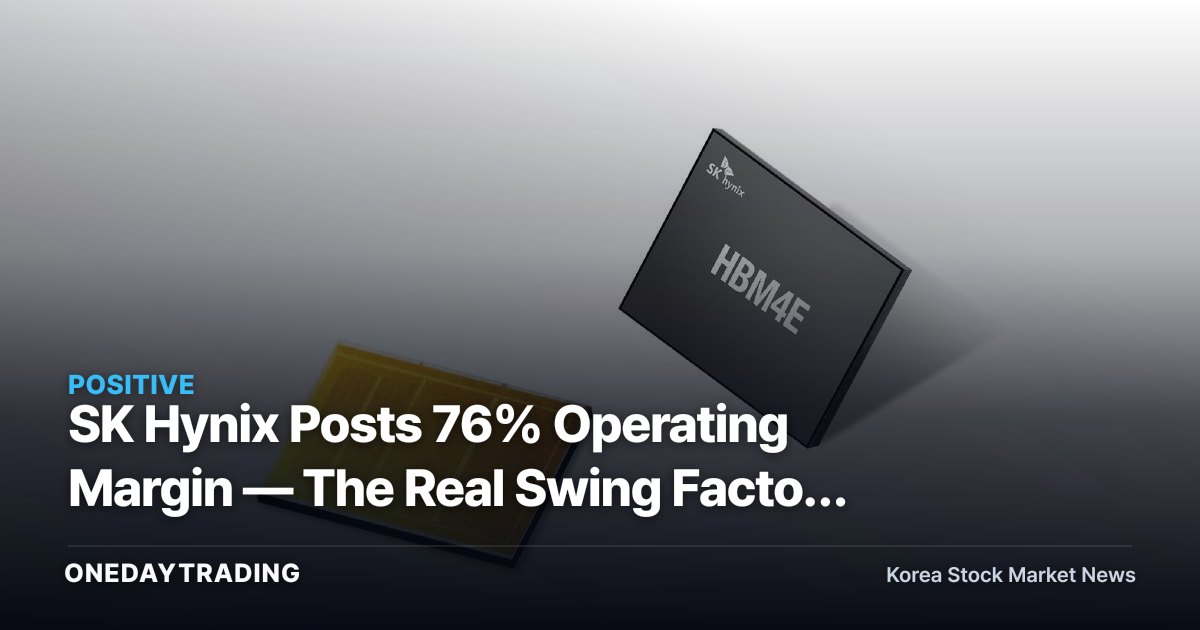
SK Hynix posted a 76% operating margin in the second quarter and topped 100 trillion won in first-half revenue for the first time. The numbers reflect a growing mix of HBM and eSSD sales, reinforced by expanded long-term supply agreements with Big Tech. Whether this margin holds into the next quarter, however, depends on how quickly the company transitions to HBM4 12-layer mass production.
What Happened
SK Hynix's 76% operating margin in the second quarter is a figure rarely seen in the semiconductor sector. Two products underpin it: HBM and eSSD. HBM is a high-value-added product supplied to AI accelerator customers including Nvidia, while eSSD is NAND-based storage for data center servers. Both carry higher selling prices and margins than commodity DRAM and NAND, and as their share of the mix has grown, the company's overall profitability has risen in tandem.
The fact that first-half revenue crossed 100 trillion won for the first time suggests this margin improvement is structural rather than a one-off spot-market bump. The evidence lies in the expanded long-term supply contracts with Big Tech. For a product with as long a production lead time as HBM, contracts that lock in volume and price ahead of time serve to sustain the supplier's bargaining power — and SK Hynix is using these agreements as a springboard to scale up HBM4 mass-production shipments.
Structural Background
HBM isn't a battle fought in logic foundries — it's a contest over the memory process itself and back-end processes, namely TSV stacking and bonding. Through HBM3E, the key variable was stacking height (8-layer versus 12-layer); from HBM4 onward, the equation also includes a shift in the base die's logic process. Bottlenecks can emerge at any stage — from the wafer material itself, through TSV stacking and bumping, to testing, packaging, and customer qualification — and how quickly these bottlenecks are resolved will determine the direction of next quarter's operating margin. The current 76% margin confirms that, at least through the HBM3E stage, yield and utilization have been managed steadily; market attention has now shifted to whether this execution capability carries over into HBM4 12-layer mass production.
Impact on Stocks (Tickers) and Industry Sector
- SK Hynix — the direct beneficiary of the growing HBM and eSSD mix. Next quarter's guidance on HBM4 revenue share and yield-related commentary will be the key confirmation point.
- Hanmi Semiconductor — supplier of TC bonders, a core piece of equipment in the HBM stacking process. Once HBM4 12-layer mass production ramps up, this will show up directly in new equipment orders and order backlogs.
- ISC (Eo Technics) — supplier of laser equipment for HBM back-end processes; the benefit path becomes clearer as SK Hynix expands HBM4-related capacity investment.
- Samsung Electronics (005930) — as an HBM competitor, the pace of its Nvidia-bound HBM4 quality certification is a key variable in whether SK Hynix can defend its market share.
- Micron — the third pole in the HBM supply race for U.S. customers, serving as a benchmark for global HBM pricing power.
Bullish vs. Bearish Scenarios
In the bullish scenario, HBM4 12-layer yield stabilizes faster than expected and Big Tech long-term supply contracts expand further. In that case, the 76% operating margin could be re-rated not as a one-time peak but as a level sustainable for some time. In the bearish scenario, yield fails to improve as expected during the HBM4 transition, delaying output relative to expansion capex. In this case, depreciation burdens would hit first and margins could visibly decline, and if Samsung Electronics' HBM4 certification clears faster than expected, share competition could also erode pricing power. The fact that the 76% figure is already largely priced in by the market remains a valuation overhang as well.
Investor Action Points
- Check HBM revenue share and HBM4 shipment guidance at the next earnings release.
- Monitor management's tone on HBM4 12-layer yield and utilization during the conference call.
- Track share shifts by comparing the timing of Samsung Electronics' and Micron's HBM4 customer certification milestones.
- Watch for new order disclosures from HBM back-end equipment makers such as Hanmi Semiconductor.
SK Hynix: A Real-Time Data Snapshot
SK Hynix's most recent closing price was 1,550,000 won (0.00% versus the prior session), and the signal combining foreign/institutional supply-demand (order flow) with news and momentum reads 🟡 Neutral / Wait-and-see. With positive and negative signals mixed, this is a range to watch closely.
- ▼ Supply-Demand (Order Flow) Continuity — Foreign investors net-sold for 3 consecutive days (−2.921 trillion won)
- ▼ Trend Alignment — Short- and medium-term downtrend alignment (same-day +0.0% · 1-week -15.6% · 1-month -42.0%)
Recent related news skews favorable, with 6 positive-catalyst items versus 5 negative-catalyst items.
※ Price and foreign/institutional supply-demand data are provided by Korea Investment & Securities (KIS) and reflect figures as of publication time.
This article is auto-summarized and analyzed content based on original news reporting. View original (Maeil Business Newspaper)