
Three-Line Briefing
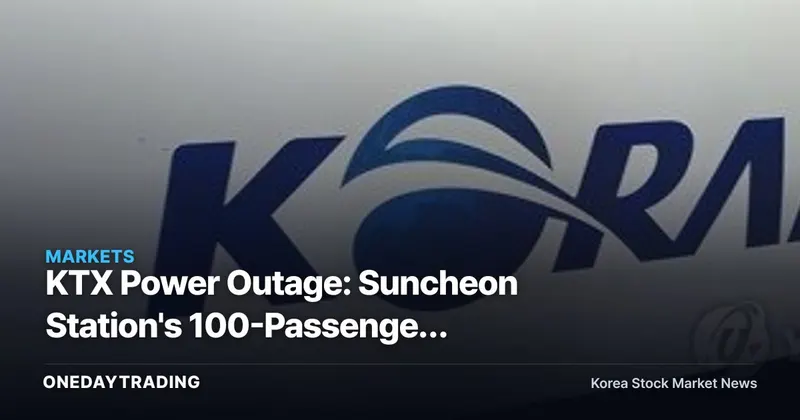
- Around 8:50 p.m. on the 28th, a KTX train stopped near Suncheon Station due to a power supply disruption, and 100 passengers transferred to another train.
- The core issue here isn't train sales volume — it's the reliability of rail power infrastructure. High-speed rail service can grind to a halt if any single link — rolling stock, power, or traffic control — falters.
- From a listed-company perspective, investors should look past rolling-stock makers and focus on power equipment, maintenance, and the investment cycle for rail systems.
What Changes Now
A single KTX train stopping near Suncheon Station is unlikely to end as a mere service disruption. What investors should watch isn't high-speed rail demand, but infrastructure bottlenecks. The figure of 100 transferred passengers may not sound large. But punctuality and safety reliability are the very essence of the high-speed rail product. With a power supply disruption cited as the cause, the center of gravity shifts away from rolling-stock manufacturers and toward the power grid and rail operating equipment.
In the mobility industry, rail isn't like automobiles, where the story ends with finished-product sales. For trains to run, tracks, power, signaling, traffic control, and maintenance all have to align simultaneously. Power supply is the least visible of these, yet a failure there leads immediately to service suspension. That's why share-price reactions among rail-related stock (ticker)s are likely to hinge less on simple thematic buying and more on government/public-enterprise maintenance budgets, aging-equipment replacement plans, and whether failures recur.
For rolling-stock makers like Hyundai Rotem, this is hard to view as a direct positive catalyst. The incident isn't news that immediately generates demand for new trains. That said, if policy pressure around rail safety and operational stability intensifies, it could open up medium-to-long-term budgets for vehicle maintenance, electronic components, power equipment, and system upgrades. There's a lag involved — until these show up in order backlogs, share prices may run ahead of earnings.
Numbers in Context
Three facts have been confirmed: the time (8:50 p.m. on the 28th), the location (near Suncheon Station), and the number of transferred passengers (100). These figures alone don't establish the scale of the damage. Still, the fact that a high-speed train stopped due to a power issue during nighttime hours clarifies the nature of the operational risk. Whether the cause was a vehicle defect, an external power-supply problem, or section-equipment failure requires further confirmation.
For rail infrastructure investments, budgets and orders matter more than the immediate post-incident share price. A single outage doesn't automatically translate into a large order. Conversely, if failures with the same root cause recur, policymakers and operators will find it hard to keep delaying inspection and replacement investment. In that scenario, the market would likely price in not just rolling-stock manufacturers but also power equipment, signaling systems, and maintenance companies.
Stock (Ticker)s to Watch: Winners and Losers
- Hyundai Rotem: The leading listed rolling-stock maker. Unless this outage is confirmed to be a vehicle issue, direct upside is limited. However, if discussion of expanded rail-safety investment gains momentum, medium-to-long-term order expectations could build.
- LS ELECTRIC: A potential beneficiary of expectations around power equipment and power infrastructure investment. If power supply disruptions become a recurring issue, demand for equipment replacement and power stabilization could draw market attention.
- Rail maintenance and signaling-system related stock (ticker)s: Order announcements and budget allocation matter more here than short-term thematic moves. Actual revenue comes from contracts, not from outage headlines.
- Transportation services broadly: Erosion of high-speed rail's reliability is a variable to weigh against demand for alternative transport modes. However, this single incident alone isn't enough evidence to call a demand shift.
Risk Check
- Cause uncertainty: The initial explanation of a power supply disruption alone doesn't pin down whether responsibility lies with the rolling stock, the equipment, or external power supply.
- Lag to earnings: Stronger safety inspections don't immediately translate into listed companies' revenue. Budgeting, bidding, and contracting all take time.
- Thematic overheating: Rail infrastructure headlines can first overheat small-cap stock (ticker)s with low float. Without actual order disclosures, pullbacks tend to come quickly.
- Policy priority: For a single outage to escalate into a large-scale investment plan, recurrence and investigation findings will be needed.
Bottom Line
The KTX power outage puts power and maintenance infrastructure risk back on the pricing radar — more so than any rolling-stock theme. Key indicators to watch next: the official cause announcement, inspection results for the same section, and rail-safety budget and related order disclosures.
Hyundai Rotem: A Look at the Real-Time Data
Hyundai Rotem's most recent closing price was 122,600 won (-7.47% versus the prior session), and the signal combining foreign investors/institutional investors supply-demand (order flow) with news and momentum reads 🟡 Neutral / Wait-and-see. With positive and negative signals mixed, this is a stock (ticker) to keep watching.
- ▼ Trend Alignment — Short- and medium-term downtrend alignment (-7.5% intraday · -16.7% over 1 week · -33.0% over 1 month)
- ▼ 52-Week Position — Bottom 1% of the 52-week range
※ Price and foreign/institutional supply-demand (order flow) data are provided by Korea Investment & Securities (KIS) and reflect the time of publication.
This article is automatically summarized and analyzed content based on the original news report. View original (Yonhap News, Industry)