
Key Takeaways
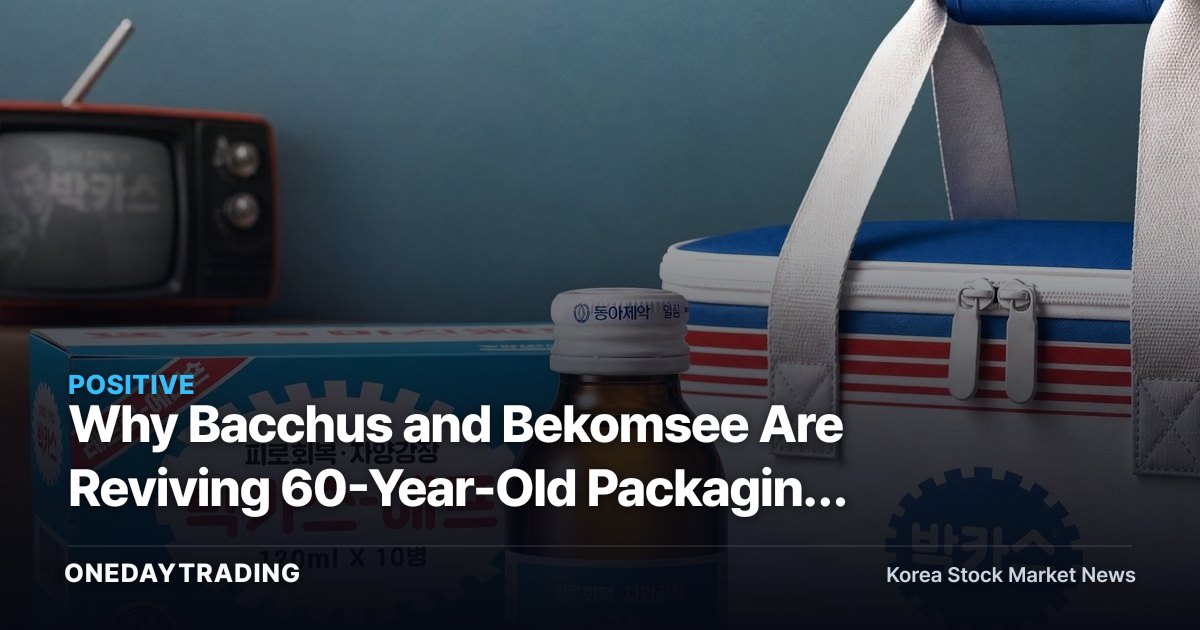
Dong-A Pharmaceutical's Bacchus and Yuhan Corporation's Bekomsee have both unveiled renewed products that restore the packaging designs from their original launches over 60 years ago. Both products share the distinction of being long-standing flagship brands in Korea's over-the-counter (OTC) drug market, and this design throwback should not be read as mere nostalgia marketing. Rather, it is a defensive strategy aimed at reaffirming brand identity in the tonic-drink market, a category that has been steadily losing ground to convenience-store energy drinks and health-functional foods.
What Happened
Dong-A Pharmaceutical launched a limited-edition (or renewed) line that reproduces Bacchus's original bottle design and logo typeface, while Yuhan Corporation applied a similarly retro package to Bekomsee. The two companies' near-simultaneous rollout of old designs reflects the so-called "newtro" (new + retro) consumption trend, under which older aesthetics are consumed as fresh content by younger generations, while functioning as an emotional trigger for repeat purchases among older, brand-loyal consumers.
That said, swapping out packaging design is not the kind of costly, time-intensive decision that R&D or clinical trials are. It is a relatively low-cost, high-visibility marketing tool that requires only new print plates and molds. Given that, it would be premature to interpret the retro sentiment the companies are promoting as a direct signal of an earnings rebound in itself. Whether the design renewal actually translates into higher sales volume is something that can only be verified by tracking OTC segment revenue trends in the companies' next-quarter earnings.
Background and Context
The tonic and vitamin drink market that Bacchus and Bekomsee belong to has, in recent years, been ceding consumers to private-label energy drinks sold at convenience stores, imported Red Bull-type beverages, and tablet- or gummy-form vitamin health-functional foods. Because both products are regulated as over-the-counter drugs sold in pharmacies and convenience stores, they have far less room to maneuver on price competitiveness or distribution-channel expansion than ordinary beverages do. In this environment, the card a brand can play is not price but identity. Restoring a 60-year-old design is a choice to re-weaponize an "original" image built on an accumulation of time that rival brands cannot replicate.
Market and Stock (Ticker) Impact
- Dong-A Socio Holdings - The holding company of Dong-A Pharmaceutical, which manufactures Bacchus. Bacchus has long served as Dong-A Pharmaceutical's flagship cash cow. If the brand renewal drives repeat purchases and buzz, it could feed through positively into the holding company's consolidated earnings.
- Yuhan Corporation - Bekomsee tends to be overshadowed by new-drug and licensing-out headlines, but it is one of Yuhan's steady-selling OTC products. The OTC segment doesn't see the volatility of a new-drug pipeline, but its growth potential is similarly limited, making it worth watching whether this renewal can inject momentum into otherwise stagnant revenue.
- Convenience-store private-label and imported energy drinks - As direct competitors for share within the tonic-drink category, a strengthening of the Bacchus and Bekomsee brands could correspondingly cap these players' growth room, creating an offsetting effect.
- Other pharmaceutical makers with similar health drinks - Rival brands such as Kwangdong Pharmaceutical's Vita500 now have a greater incentive to step up their own packaging and marketing investment, which could touch off broader marketing-spend competition across the industry.
Investor Checkpoints
- Check whether Dong-A Pharmaceutical's and Yuhan's OTC segment revenue growth rates actually improve in the next quarterly earnings release.
- Watch convenience-store and mart-channel tonic-drink sales data (POS and distribution statistics) for any change in volume following the renewal.
- Compare the income statement to see whether costs poured into the packaging swap and marketing campaign weighed on margins as a one-off rise in SG&A expenses, or were offset by higher revenue.
- Whether competitors respond with similar retro marketing campaigns is also a gauge of how durable this brand-differentiation effect will be.
Outlook
On the optimistic side, newtro sentiment is a consumption trend that has repeatedly proven itself across the food, beverage, and alcohol industries in recent years, and already-well-known brands like Bacchus and Bekomsee are well positioned to generate buzz at relatively low cost. If that buzz translates into repeat purchases at convenience-store and pharmacy shelves, it could provide a mild rebound catalyst for stagnant OTC sales. But the risk is also clear: retro design can generate a few days of online buzz, yet if that doesn't convert into repeat purchases, the sales impact will prove short-lived. Until this renewal is confirmed by actual sales figures, it is reasonable to view an unverified gap as still existing between the reported design-restoration news and its real impact on the companies' bottom line.
Dong-A Socio Holdings by the Numbers
Dong-A Socio Holdings' most recent closing price was 88,200 won (+2.80% from the previous day), and the composite signal combining foreign and institutional investor supply-demand (order flow) with news and momentum reads 🟢 Buy-leaning. Foreign investor flows and momentum are positive, making it worth watching.
- ▲ Trend Alignment — Short- and medium-term uptrend alignment (+2.8% today · +5.4% over 1 week · +8.1% over 1 month)
※ Price and foreign/institutional investor supply-demand (order flow) data are provided by Korea Investment & Securities (KIS) and reflect figures as of publication.
This article was automatically summarized and analyzed based on the original news source. View original (Yonhap News Agency, Industry)