
Key Takeaways
The damage from torrential rain in Geoje affects farm-product inflation, disaster-recovery budgets, and the pace of local consumption recovery before it affects any listed agricultural stock (ticker).
According to a Yonhap News report dated August 22, 2026, farms in Geoje, South Gyeongsang Province, still had not finished clearing mud six days after the damage occurred, and it remains undecided whether roughly 20,000 bunches of grapes will have to be discarded. What this story tells investors isn't simply flood damage — it's the pathway by which climate risk spreads into farm-product prices, local government finances, and food input costs.
What Happened
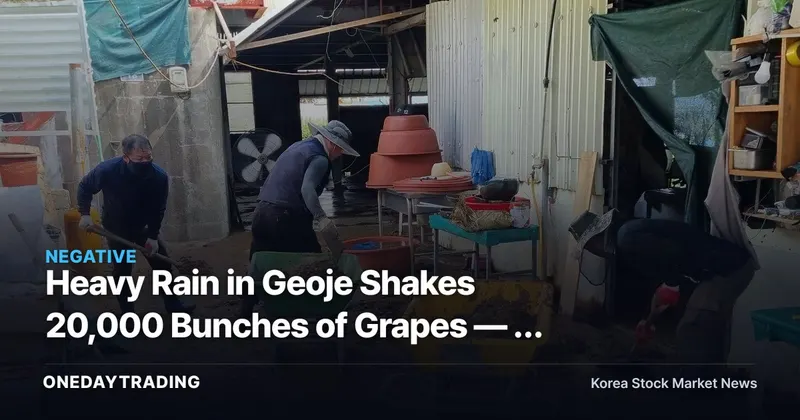
The torrential rain was a local disaster in which a river overflowed across the Geoje area during the August 2026 Liberation Day holiday, submerging farmland, storage sheds, and vineyards. At one rice farm in Eonyang Village, Sadeung-myeon, both the paddy and two farm-supply storage buildings were swamped with muddy water, damaging farm machinery along with last year's harvested rice, green onions, sesame, and garlic.
The affected farmer estimated the combined loss of machinery and crops at tens of millions of won. He said he had filed damage reports with the township office three times but was told housing and road repairs were the priority, and that he is still waiting. The bottleneck in disaster recovery isn't just funding — it's the allocation of manpower and equipment.
The situation is even more sensitive for grape farms in Dundeok-myeon. During the heavy rain, water in the vineyard rose to the height of an adult man, and mud remained on grape bunches that were nearly ready for harvest. The day before, around 30 agricultural cooperative workers from the Daegu area helped remove protective netting, but the work of deciding whether to wash and save roughly 20,000 bunches of grapes with water sprayers — or discard them — had barely begun.
Background and Context
Farm-product prices don't move on national output alone. Damage that occurs right before harvest hits marketability before it hits supply volume. For crops like grapes, where appearance and grading determine price, the longer the decisions on washing, drying, and disposal are delayed after exposure to muddy water, the more the shippable volume shrinks.
What the market has already priced in is summer weather volatility. What it hasn't fully priced in is the delay in recovery. With roughly 100 meters of mud and debris piled around the fields, the farmers' next task isn't harvesting — it's waste disposal, damage reporting, and securing equipment. That lag is the real channel pushing up local farm-product prices.
Impact on Markets and Stocks (Tickers)
- Agricultural Distribution: It's unlikely that the Geoje damage alone will move nationwide prices. But if fruit damage right before harvest overlaps with heavy rain in other regions, the gap between wholesale market inflows and grade-based pricing will widen.
- Food Manufacturing: Raw materials such as grapes, garlic, and sesame are far from being core cost items for major food companies. So the impact shows up indirectly — through farm-product inflation expectations feeding into pricing and consumer sentiment — rather than as a direct hit to earnings.
- Farm Machinery and Supplies: Flooded machinery and shed damage could create replacement demand, but affected farmers' cash flow and compensation timelines come first. Even as demand emerges, revenue recognition will be pushed back until after recovery support and insurance claims are processed.
- Local Government Finances and Construction Equipment: Once priorities are set for repairing roads, homes, and farmland, demand for excavators and waste-disposal services will rise. In the short term, the benefit flows first to local equipment operators and service providers rather than to any specific listed company.
- Inflation and Policy: If farm-product prices stoke cost-of-living inflation, the government will respond with reserve-stock releases, discount subsidies, and disaster relief funds. Investors should watch the CPI's detailed line items before food-stock margins.
Investor Checkpoints
- Late-August farm-product wholesale prices: Inflow volumes and grade-based price gaps for grapes and vegetables will reveal the actual supply shock.
- Geoje City and South Gyeongsang Province damage tallies: Once official figures for machinery, storage sheds, and crop losses are confirmed, the scale of disaster relief and the pace of recovery can be gauged.
- Statistics Korea's September consumer price index: The fresh-food index and the rate of increase in fruit prices will show whether the weather damage is spreading nationwide.
- Forecasts for additional rainfall: If rain recurs before recovery is complete, disposal volumes and disease risk will grow.
Outlook
The optimistic scenario is one where recovery equipment and manpower are deployed quickly enough that a significant portion of the roughly 20,000 grape bunches can be washed and shipped. In that case, losses for local farms remain, but the pressure spreading into nationwide farm-product prices stays limited.
The trigger for the pessimistic scenario is confirmed disposal combined with additional heavy rain. If the marketability of crops right before harvest collapses, farmers' losses will exceed the amounts reported, and consumers will feel the impact later at the retail level than at the wholesale level. This time, it isn't interest rates or the exchange rate but water and mud that are compressing the multiple on the cost of living. The next checkpoints to watch are late-August wholesale market prices and the September fresh-food index.
Frequently Asked Questions
Does the heavy rain in Geoje affect farm-product prices?
It's hard to say the heavy rain in Geoje alone is driving up farm-product prices nationwide. However, based on the report dated August 22, 2026, with roughly 20,000 bunches of grapes still at risk of disposal, there is pressure on local fruit prices and grade-based wholesale market pricing.
Which stocks (tickers) are directly tied to the grape damage in Geoje?
There is no clearly identifiable listed company directly tied to the grape damage in Geoje. Investors would do better to track the indirect impact through agricultural distribution, food input costs, and fresh-food inflation indicators rather than any specific agricultural stock (ticker).
What is the most important indicator in recovering from torrential rain damage?
The key indicators for recovery from torrential rain damage are the official damage estimate, the speed of equipment deployment, and the volume of crops disposed of. As in the August 2026 Geoje farm case, when machinery and crop damage is estimated in the tens of millions of won, the timing of compensation and reinvestment affects production through the next growing cycle.
This article was automatically summarized and analyzed based on the original news report. View original (Yonhap News Industry)