
At a Glance
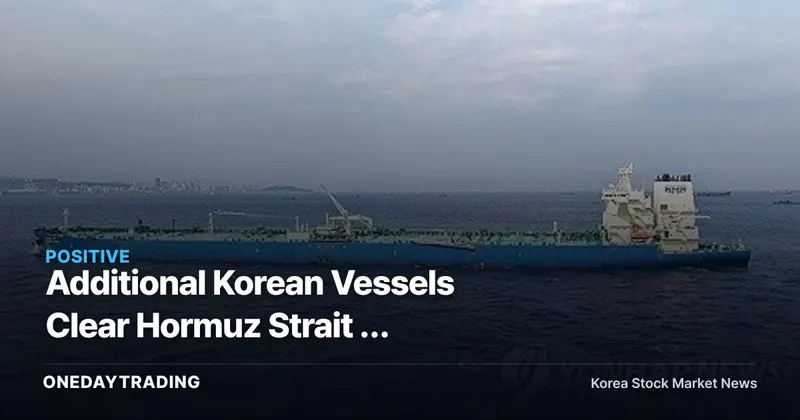
Two more Korean vessels that had been stranded in the Strait of Hormuz due to the Middle East conflict have successfully cleared the strait, reducing the number of ships still remaining to three. While this may appear to be a routine shipping update, it signals instability along a chokepoint through which a significant share of global seaborne crude oil passes — making it a development that warrants a close look at international crude prices, maritime freight rates, and the profit-and-loss dynamics of Korea's domestic refining, shipping, and airline industry sectors.
Why This Matters Now
The Strait of Hormuz is a narrow chokepoint and the critical passage through which crude oil and LNG exported by major producers such as Saudi Arabia, Iraq, and the UAE must flow. Korea relies on the Middle East for the vast majority of its crude oil imports, meaning any disruption to transit through this corridor directly affects import costs and delivery schedules. The fact that vessels held up in the strait have managed to pass through offers some reassurance that transit remains possible — but it simultaneously underscores the persistent uncertainty surrounding the route.
From an investment standpoint, there are two key variables to watch. The first is international crude oil prices. If supply disruption fears intensify, oil prices rise — and refiners stand to benefit in the short term from inventory valuation gains and improved refining margins. The second is maritime freight rates and war-risk insurance premiums. When ships are forced to take longer alternative routes or war-risk surcharges are applied, freight rates increase — a positive for shipping companies carrying cargo, but a cost headwind for airlines that consume jet fuel.
That said, this particular development is closer to a normalization signal — ships are getting through — so it is premature to conclude that crude prices and freight rates are headed for a one-directional sharp gain (surge). The direction of events will ultimately depend on how the broader Middle East situation evolves.
Frequently Asked Questions
- Why does a Hormuz blockage hurt Korea? A large portion of Korea's crude oil imports are sourced from the Middle East and transit through this strait, meaning any disruption translates directly into higher import costs and supply delivery delays.
- Does a rising oil price always benefit refining stocks? In the short term, inventory valuation gains and wider refining margins act as a positive catalyst. However, if oil prices rise excessively, end-user demand can contract, ultimately compressing margins instead.
- Are shipping stocks beneficiaries? Rising freight rates and surcharges represent an upside to revenues, but rerouting around the strait increases operating costs and transit time — a double-edged dynamic.
- Are the three remaining ships the key focus? The number of individual vessels matters less to the market than whether transit is possible at all, and whether the conflict escalates further.
Related Stock (Ticker) and Industry Sector Impact
- Refining: S-Oil, SK Innovation, and GS could see inventory valuation gains and improved refining margins in a rising oil price environment, though higher crude import costs represent a cost burden.
- Shipping: HMM and Pan Ocean stand to benefit on the revenue side from higher freight rates and war-risk surcharges, but increased operating costs from alternative routing remain a variable.
- Airlines: Korean Air and Asiana Airlines face a direct hit, as higher jet fuel prices translate immediately into higher operating costs — making them the representative negative catalyst industry sector in this scenario.
- Gas and Energy: Concerns over disruptions to Middle East LNG transit amplify uncertainty around import costs and supply-demand (order flow), adding a broad cost variable across related energy industry sectors.
Key Considerations for Investors
- This news is closer to a normalization signal — ships are clearing the strait — so chasing momentum with aggressive buying on the assumption of surging crude prices or freight rates warrants caution.
- The oil price benefit is largely a short-term inventory effect; investors should separately track refining margin trends as they flow through to quarterly earnings.
- Middle East geopolitics is an event-driven catalyst with day-to-day volatility, and investors should account for the risk of sharp short-term price swings in either direction.
- The profit-and-loss direction diverges meaningfully by industry sector — refining and shipping (potential beneficiaries) versus airlines (cost pressure) — and these exposures are worth separating out within a portfolio.
Outlook
If the Middle East conflict prolongs or escalates, rising crude prices and maritime freight rates could generate short-term momentum for refining and shipping industry sectors, while intensifying cost pressure on airlines. Conversely, if — as in this case — vessel transit resumes and tensions ease, risk premiums could unwind quickly, reversing any near-term strength in related stocks. Key indicators to monitor include Brent crude price movements, war-risk surcharge levels, container and tanker freight rate indices, and the schedule of official announcements related to Middle East developments.
S-Oil — Real-Time Data Snapshot
S-Oil's most recent closing price was ₩93,200 (−5.09% vs. the prior day). The composite signal integrating foreign investors and institutional investors supply-demand (order flow) alongside news and momentum reads 🟡 neutral / wait-and-see. Positive and negative signals are mixed, suggesting a period of observation is warranted.
- ▲ Supply-Demand (Order Flow) Continuity — Foreign investors have net bought for 11 consecutive sessions (+16.9 billion won)
- ▼ Trend Alignment — Short- and medium-term downtrend alignment (day: −5.1% · 1 week: −11.5% · 1 month: −13.8%)
- ▲ News Flow — Positive catalysts 10 vs. negative catalysts 2 — positive catalyst bias
Recent related news comprises 10 positive catalyst items and 2 negative catalyst items, reflecting a broadly favorable tone.
※ Price and foreign investors/institutional investors supply-demand (order flow) data are provided by Korea Investment & Securities (KIS) and are current as of the time of publication.
This content has been automatically summarized and analyzed based on the original news source. View original article (Yonhap News)