
Key Takeaways
With momentum slowing in Samsung Electronics and SK Hynix, the next market leaders may emerge from industry sectors that respond to interest rates before earnings. Persistently high U.S. long-term government bond yields and increased global equity-market volatility weigh on growth-stock multiples while enhancing the relative appeal of sectors with immediately visible cash flows, such as financials and energy.
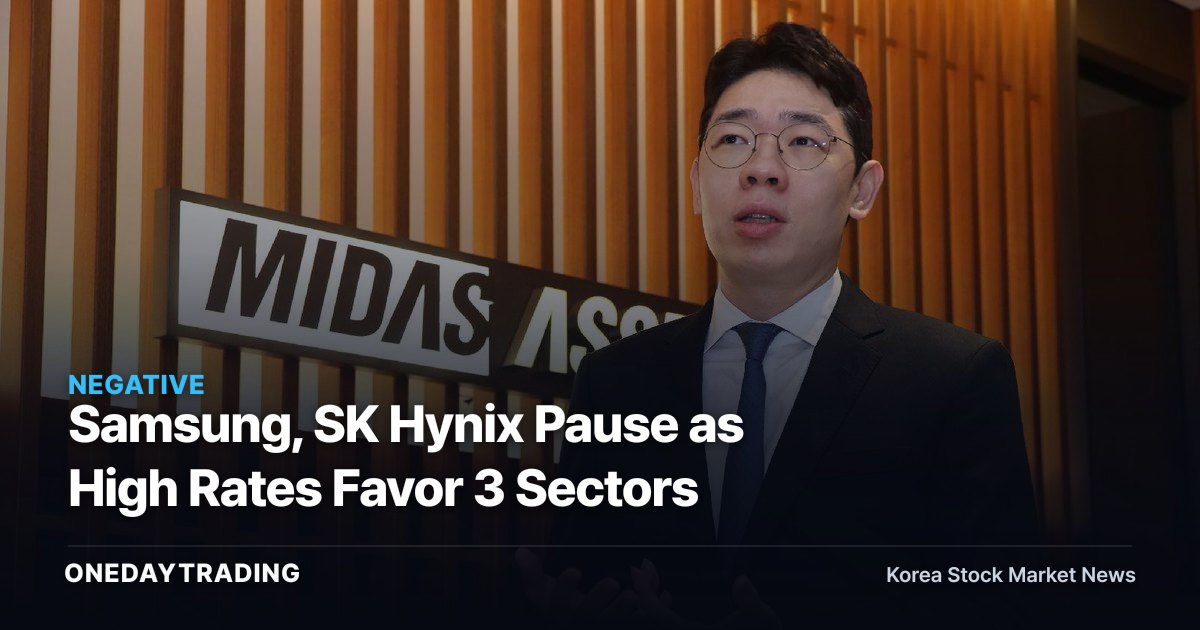
In an interview with Maeil Business Newspaper, Midas Asset Management portfolio manager Lee Ho-young identified three industry sectors for investors to watch in this environment. However, the published article did not name the sectors or provide specific target figures. The key, therefore, is not to chase a particular theme but to screen candidates based on interest rates, valuations, and earnings visibility, in that order.
What Happened
This issue challenges the assumption that large-cap semiconductor stocks will lead the market indefinitely. When U.S. long-term yields remain elevated, the discount rate used to convert future earnings into present value rises. Even with unchanged earnings forecasts, fair values for high-PER growth stocks decline, potentially increasing profit-taking pressure on Samsung Electronics and SK Hynix after their substantial gains.
Greater global volatility accelerates capital rotation between industry sectors. When foreign investors pull out of semiconductors, alternative buying targets tend to be sectors where earnings estimates remain relatively stable and cash flows can be explained by dividends or commodity prices. The market has already priced in AI-related expectations and strong earnings growth for semiconductors. What remains less fully reflected is how persistently high interest rates could alter the relative valuations of other sectors.
Background and Context
Long-term yields reflect not only central banks’ short-term policy rates but also fiscal deficits, government bond supply, and inflation expectations. Even if expectations for short-term rate cuts remain intact, the equity market’s discount rate stays elevated if long-term yields do not decline. In that environment, relative performance between industry sectors becomes more important than gains in the broader index.
In the Korean market, the won-dollar exchange rate also affects this dynamic. Continued won weakness increases exporters’ revenue when converted into won, but supply-demand (order flow) may weaken as foreign investors grow concerned about currency losses. Conversely, if the exchange rate stabilizes and long-term yields turn lower, growth-stock multiples may have room to expand again.
Market and Stock Impact
- Samsung Electronics and SK Hynix: Even if demand for AI memory remains intact, high long-term yields put pressure on forward multiples. Next quarter’s shipments and memory prices would need to exceed market expectations to justify further share-price gains.
- KB Financial Group and Shinhan Financial Group: Rising long-term yields may support net interest margins, but higher credit costs resulting from an economic slowdown could offset that benefit. Investors should examine loan-loss provisions and capital ratios alongside interest rates.
- S-Oil and SK Innovation: These are cash-flow-driven businesses whose earnings depend on oil prices and refining margins. However, a sharp gain (surge) in crude prices may generate inventory valuation gains before leading to weaker demand and higher costs, so they should not be viewed as straightforward beneficiaries of rising oil prices.
- Hyundai Motor: A weaker won supports export profitability, but rising U.S. long-term yields could slow local demand for auto financing. Incentives and the regional product mix, rather than sales volume alone, are central to margins.
Investor Checklist
- Watch whether the valuation burden on growth stocks increases if the U.S. 10-year government bond yield resumes its rise and exceeds its previous peak.
- At the next earnings releases from Samsung Electronics and SK Hynix, assess whether memory prices, HBM shipments, and capital expenditure plans exceed consensus expectations.
- Check whether quarterly loan-loss provisions and net interest margins improve simultaneously at Korean financial stocks.
- If the won-dollar exchange rate stops surging and remains stable, use trading value to assess whether foreign-investor supply-demand (order flow) is broadening beyond semiconductors.
Outlook
In the optimistic scenario, U.S. long-term yields decline while semiconductor shipments remain robust. Upward revisions to earnings estimates for Samsung Electronics and SK Hynix could then prompt the market to assign growth stocks a premium again. Conversely, if interest rates remain elevated and memory-price gains lose momentum, semiconductor leadership may weaken and the defensive characteristics of financials and energy could become relatively more prominent.
The key is not to follow the three industry sectors mentioned by the portfolio manager without further analysis. Investors should compare how much each sector’s share prices already reflect interest rates and improving earnings. The durability of the sector rotation can be assessed when the direction of long-term yields becomes clearer following the next U.S. inflation report, Federal Reserve remarks, and the Bank of Korea Monetary Policy Board meeting.
Frequently Asked Questions
Will the KOSPI fall if Samsung Electronics and SK Hynix pause?
Because the two stocks account for a large share of market capitalization, the index’s short-term momentum could slow. However, if capital rotates into financials, autos, and energy, the market could remain stable while performance gaps between industry sectors widen.
Why do U.S. long-term yields reduce equity valuations?
Long-term yields serve as a benchmark for the discount rate used to convert future cash flows into present value. When rates rise, the present value of high-PER companies whose earnings are weighted further into the future declines more sharply.
How can investors confirm the next sector rotation?
Investors should monitor the U.S. 10-year yield, the won-dollar exchange rate, foreign net buying, and changes in earnings estimates by industry sector. Falling rates accompanied by sustained foreign-investor supply-demand (order flow) could signal a growth-stock recovery, while renewed rate increases would shift the emphasis back toward cash-flow sectors.
Samsung Electronics Key MetricsAs of 2026-09-05
| Period Returns | 1 Week -0.58% 1 Month +3.86% |
|---|---|
| Trading Value · Trading Volume | 3.5861 trillion won · 14,031,862 shares |
| Supply-Demand (Order Flow) | Foreign Investors −28.6 billion won net selling Institutional Investors +635.9 billion won net buying |
| Recent News Tone | 8 positive catalysts · 5 negative catalysts |
Price and supply-demand (order flow) data are real-time figures from Korea Investment & Securities (KIS), while supply-demand (order flow) and news-tone aggregates are calculated independently by One Day Trading.
Supply-Demand (Order Flow) and Momentum Assessment🟡 Neutral · Wait and See
Mixed positive and negative signals suggest a period for monitoring.
- ▲News Flow8 positive catalysts vs 5 negative catalysts — positive catalysts lead
Upcoming Events to Watch
- 09.10Futures and Options ExpirationMediumQuadruple witching — watch for volatility and supply-demand (order flow) disruptions
- 09.16FOMC Policy Rate DecisionHighFederal Reserve monetary-policy announcement — direction of interest rates and the dollar
- 10.08Index Options ExpirationLowKOSPI 200 options expiration
- 10.22Bank of Korea Monetary Policy BoardHighBenchmark interest rate decision meeting
This article was automatically summarized and analyzed from the original news report. View the original article (Maeil Business Newspaper Securities)