
At a Glance
Large-cap semiconductor stocks have lifted KOSPI above 9,000 for the first time ever, with half of the top 10 stocks by market capitalization now dominated by Samsung affiliates. This is not merely a record high — it is a signal that the engine behind the index's rise is concentrated in a narrow set of themes: memory cycle recovery and artificial intelligence (AI) demand. For investors, this moment represents both an opportunity to increase exposure to Samsung Electronics and SK Hynix, and a juncture at which concentration risk and the volatility it brings must be carefully assessed.
Why This Matters Now
At the core of this rally are memory price recovery and high-bandwidth memory (HBM) demand. As AI data center investment accelerates, DRAM and NAND inventories have normalized, and HBM supply is struggling to keep pace with demand. In this environment, average selling prices (ASPs) for memory manufacturers are rising, and operating leverage is kicking in — meaning operating profit improves rapidly even on flat shipment volumes. This is the backdrop behind the synchronized strength of Samsung Electronics and SK Hynix, the so-called "SamHynix" phenomenon, which has become the primary driver of the index.
The fact that half of the top-10 stocks by market capitalization are Samsung affiliates means the index itself has become more sensitive to the semiconductor cycle. When passive funds and foreign net buying concentrate in large-caps, the index looks strong — but conversely, if the sector turns, those same stocks can sell off simultaneously, amplifying the drawdown. This is precisely why investors need to distinguish between broad-based strength and a rally propped up by a handful of names.
Frequently Asked Questions
- How did KOSPI reach 9,000? With semiconductor heavyweights commanding a larger share of market capitalization, improving memory sector conditions and foreign net buying converged to push the index to this level.
- Is the Samsung-Hynix rally supported by earnings? The ongoing recovery in HBM and DRAM prices is a positive catalyst, but the actual magnitude of earnings improvement will need to be confirmed through quarterly results.
- Is it too late to enter? Sector momentum remains intact, but after a sharp gain (surge) in the short term, valuation risk has accumulated — a staged, time-diversified entry approach is the more prudent path.
- Why is index concentration dangerous? When gains are concentrated in a handful of semiconductor names, a sector slowdown could trigger a broad index-wide correction simultaneously.
Related Stocks and Sector Impact
- Samsung Electronics The key beneficiary spanning memory, HBM, and foundry — ASP increases feed directly into earnings.
- SK Hynix Its HBM competitiveness is in the spotlight; a higher mix of premium products translates into significant earnings leverage.
- Hanmi Semiconductor A materials/parts/equipment stock (sobuljang) that stands to directly benefit from expanding back-end process demand, including HBM bonding equipment.
- Samsung Electro-Mechanics · Samsung SDI Linked to the broader re-rating of Samsung affiliates as well as trends in automotive and packaging demand.
- Semiconductor materials and equipment sector Rising utilization rates could lead to increased orders for materials and components.
Key Investment Considerations
- The short-term sharp gain (surge) may have already priced in earnings expectations, so valuation risk warrants careful scrutiny.
- Memory prices are highly cyclical — if inventory trends or contract prices reverse, the pullback can be swift.
- An index rally driven by a small number of stocks can widen the performance gap between large-caps and small/mid-caps.
- Changes in the exchange rate and foreign investors' supply-demand (order flow) can act as immediate variables for large-cap export stocks.
Overall Outlook
If AI demand persists and HBM supply shortages continue, improving memory ASPs should be reflected in next quarter's earnings, reinforcing the bull case. Conversely, if signals emerge of moderation in data center investment or a slowdown in memory price gains, the high degree of concentration means any correction could be equally sharp. A disciplined approach — tracking HBM revenue mix in the next quarterly earnings release, monthly DRAM contract prices, whether foreign net buying is sustained, and the USD/KRW exchange rate level — will be essential in calibrating response intensity.
Samsung Electronics — A Real-Time Data Snapshot
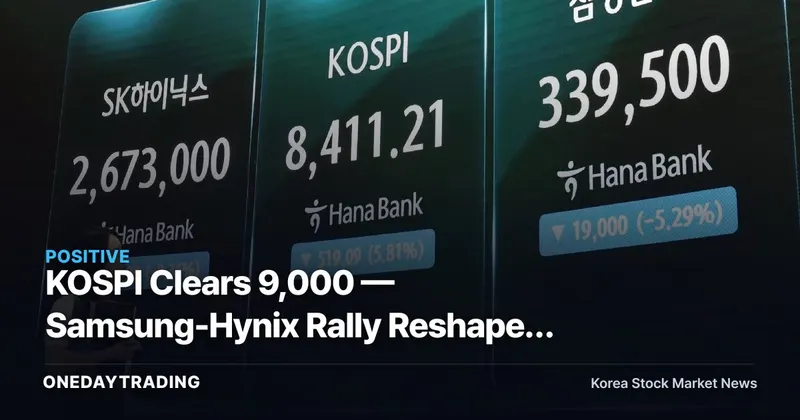
Samsung Electronics' most recent closing price is ₩339,500 (−5.30% vs. the prior day). The composite signal integrating foreign investors/institutional investors supply-demand (order flow) and news momentum reads 🔴 Caution. Foreign investors, institutional investors, and momentum are all negative, warranting heightened vigilance at this time.
- ▼ Supply-Demand (Order Flow) Continuity — Foreign investors have net sold for 6 consecutive sessions (−2,014.2 billion won)
- ▼ Dual-Sided Selling — Foreign investors −2,014.2 billion won · Institutional investors −1,209.4 billion won selling in tandem
- ▲ 52-Week Position — 89% of 52-week range — approaching all-time high territory
- ▲ News Flow — Positive catalysts 29 vs. negative catalysts 14 — positive catalysts lead
Recent related news counts 29 positive catalyst items and 14 negative catalyst items, reflecting a broadly favorable tone.
※ Price and foreign investors/institutional investors supply-demand (order flow) data are provided by Korea Investment & Securities (KIS) and are current as of the time of publication.
This content has been automatically summarized and analyzed based on the original news article. View original article (Maeil Business News — Securities)