
Key Takeaways
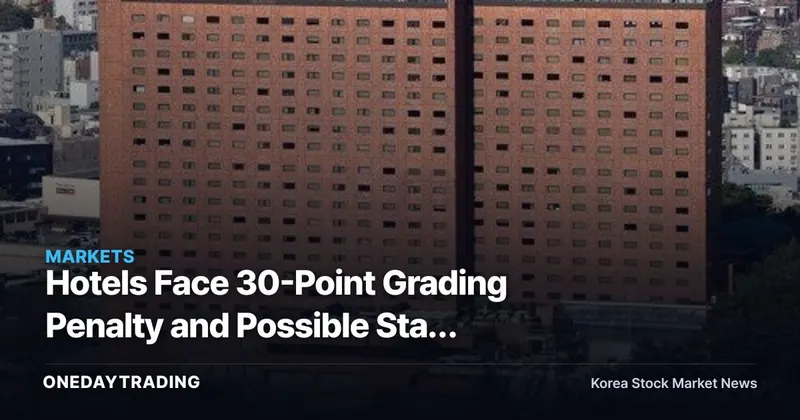
This overhaul of the hotel grading system is less a near-term earnings variable than a regulatory issue that touches the tourism and leisure sector's credibility and pricing practices. The core change is that a hotel caught levying unjustified charges will now lose 30 points — three times the standard deduction — enough to knock its star rating down a notch. Because the rating is directly tied to room rates and group/incentive-tour demand, it indirectly affects operators' pricing power and brand value.
The Gist
Small and mid-sized operators that lean on their star rating for marketing will feel the impact more acutely than large listed hotels focused on premium rooms. From an investment standpoint, this is hard to frame as a direct negative catalyst capable of shaking the fundamentals of listed hotel stocks.
What Happened
Under the government's hotel grading assessment, a proposal has surfaced to deduct 30 points whenever a hotel is caught collecting unjustified fees. That's roughly three times the deduction typically applied for other violations — meaning a single infraction could be enough to drop a hotel's star rating by a full level.
Hotel ratings range from one star to five stars and are determined by the sum of scores across evaluation categories. A deduction as large as 30 points could therefore actually push a hotel's cumulative score below a rating threshold. "Unjustified charges" broadly covers practices such as billing guests for additional costs that were not disclosed in advance.
Background and Context
Since the pandemic, the recovery in foreign tourist arrivals and domestic "hotel-cation" demand has pushed up room rates, and complaints have piled up over some operators charging excessive add-on fees. Because star ratings serve as a benchmark for exposure on travel platforms, for attracting foreign group tours and corporate incentive trips, and for setting room rates, a downgrade could weaken an operator's revenue channels. The move appears aimed at boosting price transparency and reinforcing trust across the industry as a whole.
Impact on the Market and Individual Stocks
- Hotel Shilla — As the operator of its own brands, including The Shilla and Shilla Stay, the company maintains a high level of pricing discipline and standardization, leaving it relatively less exposed to unjustified-fee risk. If tighter regulation lifts industry-wide trust, the relative competitiveness of premium brands could actually stand out more.
- Lotte Tour Development — As the operator of the Jeju Dream Tower integrated resort, its room and casino demand is closely tied to its rating and brand image. Greater price transparency is a neutral-to-positive factor for attracting foreign group tours.
- Paradise and Grand Korea Leisure (GKL) — With business models combining foreigner-only casinos and hotels, these operators are less directly exposed and more indirectly affected by shifts in overall trust in tourism infrastructure.
- Small and mid-sized unlisted hotels — These operators rely more heavily on rating-based marketing and have weaker pricing control, leaving them relatively more exposed to revenue-channel contraction risk if downgraded. This is where the impact diverges most from that on large listed names.
Investor Checkpoints
- Whether and when the rule is finalized — check the Ministry of Culture, Sports and Tourism's timeline for the revised grading notice and whether the 30-point deduction item is ultimately adopted.
- Trends in foreign arrivals, occupancy (OCC), and average daily rate (ADR) — demand recovery, not regulation, is the key variable driving hotel stocks' earnings.
- In quarterly earnings releases, changes in revenue and operating margin for the hotel, duty-free, and resort segments, and any mention of rating-related costs.
- The won-dollar exchange rate and the pace of recovery in group tourism from China and Japan — check these as leading indicators of inbound demand.
Outlook
On the optimistic side, stronger price transparency could bolster confidence in Korea's tourism infrastructure, supporting the recovery of inbound demand and benefiting the brand value of premium operators. Large listed companies with standardized pricing policies stand to gain more from a trust premium than they lose from compliance costs. That said, the change to the grading system itself is not a driver that will reshape listed hotel stocks' revenue or earnings structure in the near term, and share prices remain more sensitive to macro variables such as the exchange rate, foreign tourism demand, and the duty-free business climate. Rather than treating the regulatory burden outright as a positive catalyst, it is more reasonable to confirm the picture through demand indicators and actual earnings.
Hotel Shilla: A Real-Time Data Snapshot
Hotel Shilla's most recent closing price was 57,800 won (unchanged from the previous session, 0.00%), and the sentiment signal — which combines foreign/institutional investor supply-demand (order flow) with news and momentum — reads 🟡 neutral / wait-and-see. With positive and negative signals mixed, this is a stock to watch.
Recent related news shows 1 positive catalyst and 0 negative catalysts, a favorable mix.
※ Price and foreign/institutional investor supply-demand (order flow) data are provided by Korea Investment & Securities (KIS) and reflect the time of publication.
This article is automatically summarized and analyzed based on the original news report. View original (Yonhap News Agency, Industry)