
Key Takeaways
Biotech stocks react fastest when policy funding translates into actual supply-demand (order flow). This KOSDAQ surge looks less like a reassessment of new-drug value and more like an event in which the push for a 1 trillion won policy fund and a 170 billion won clinical-trial-specific fund revived risk appetite.
The fact that the KOSDAQ rose 21% over three trading days and triggered a buy-side sidecar for three consecutive sessions for the first time ever is both evidence of a bull run and a warning sign of volatility. What the market bought was not confirmed earnings, but the possibility of capital inflows.
What Happened
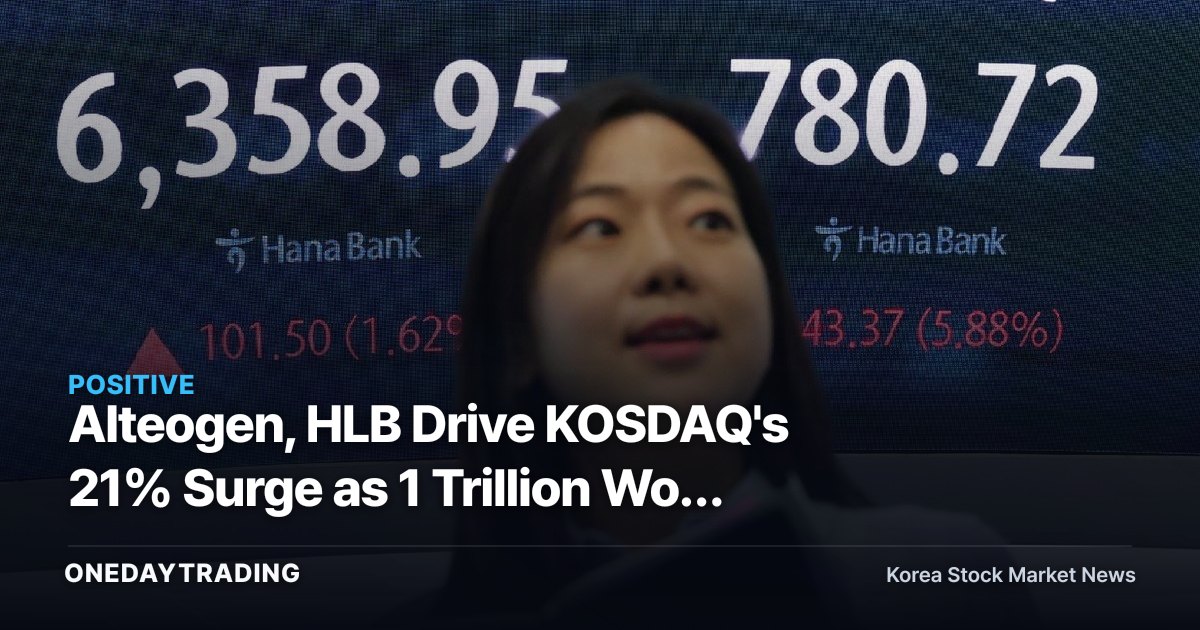
On the KOSDAQ, large-cap biotech stocks (tickers) such as Alteogen and HLB moved sharply higher, leading the index rebound. According to reports, the KOSDAQ surged 21% over the past three trading days, and a buy-side sidecar — which temporarily suspends program buy orders in response to sharp futures price swings — was triggered for three consecutive sessions.
Institutional investors were at the center of the supply-demand (order flow). They bought a net 543 billion won, driving the rebound. Biotech stocks are highly sensitive to news given their large retail investor base, but this move differs from a simple thematic rotation in that it combined expectations for the policy fund with institutional buying.
The rationale for the policy funding is also clear. Momentum built around the 1 trillion won policy fund, and separately, plans for a 170 billion won clinical-trial-specific fund were raised. For biotech companies, cash burn during clinical trials is a bigger bottleneck than R&D spending itself. That is why policies that lower the cost of financing clinical trials affect the discount rate applied to share prices.
Background and Context
In biotech investment, government funds do not immediately boost revenue. The effect shows up first in the cost of capital. Costs rise as trials progress through Phase 2 and Phase 3, and the probability of failure remains. In this stage, improved access to outside funding changes licensing-negotiation leverage, the ability to sustain a pipeline, and pressure for additional capital raises — all at once.
That said, the fact that share prices moved first should be viewed soberly. Bellwether biotech stocks like Alteogen and HLB tend to amplify index beta when policy expectations attach to them. But the value of an individual company ultimately comes down to clinical trial endpoints, approval timelines, partnership contract terms, and cash balances. The direction suggested by a press release and the outcome the data will show are not yet the same sentence.
Market and Stock Impact
- Alteogen: As a strong KOSDAQ biotech sector bellwether, it tends to be the first to price in expectations for the policy fund. A re-rating of its platform technology's value will require follow-on contracts and development progress.
- HLB: Highly sensitive to clinical trial and approval events. The push for a clinical-trial-specific fund is favorable for the financing environment, but what matters most is the regulatory outcome and the potential for commercialization.
- KOSDAQ biotech: Institutional net buying of 543 billion won could create a short-term liquidity-driven market. However, the three consecutive days of sidecar triggers also signal that speed outpaced price discovery.
- Clinical-stage companies: The 170 billion won clinical-trial-specific fund could extend the runway for late-stage clinical companies. Conversely, companies left out of the fund selection could see relative underperformance widen.
- Brokerage and ETF products: If the biotech rally continues, trading value for the KOSDAQ 150 and healthcare ETFs could rise. However, chasing the rally after a sharp index gain (surge) means accepting volatility costs.
Investor Checkpoints
- Fund disbursement structure: Investors should check when, under what criteria, and to which stage of companies the 1 trillion won policy fund and the 170 billion won clinical-trial-specific fund will be allocated.
- Persistence of institutional supply-demand (order flow): Whether the institutional buying of 543 billion won was a one-off short-covering event or a genuine increase in biotech allocation should be distinguished by tracking net buying and trading value on subsequent sessions.
- Individual clinical trial timelines: Any re-rating of Alteogen's and HLB's share prices will ultimately be confirmed by company-specific events — clinical trial results, regulatory reviews, and licensing deals — rather than by policy alone.
- Volatility indicators: After a three-day 21% surge, both counter-trend selling and profit-taking tend to increase in tandem. Watch for repeat sidecar triggers as well as any widening of intraday declines.
Outlook
The optimistic scenario is one in which the policy funding moves beyond talk and into actual disbursement. If clinical trial financing is genuinely released and institutional buying continues, biotech stocks could see a further narrowing of their valuation discount. The effect of a lower cost of capital would be especially pronounced for companies that previously faced significant cash-burn concerns.
The risk is speed. The 21% surge has already priced in a considerable amount of expectation. If the fund's detailed plans are delayed or the scope of support proves limited, the market is likely to once again separate genuine policy beneficiaries from stocks that simply rode along with the rally. Key items to watch next are the disclosure of the fund's operating criteria, whether institutional net buying persists, and the individual clinical trial and regulatory timelines for Alteogen and HLB.
Alteogen in Real-Time Data
Alteogen's most recent closing price was 347,000 won (+9.29% from the previous day), and the signal combining foreign/institutional supply-demand (order flow) with news and momentum reads 🟢 Buy-Leaning. Foreign investors, institutional investors, and momentum are all positive, making it worth watching.
- ▲ Dual buying — foreign investors +14.3 billion won and institutional investors +35.1 billion won bought together
Recent related news shows 0 positive catalysts and 1 negative catalyst, a negative skew.
※ Price and foreign/institutional supply-demand (order flow) data are provided by Korea Investment & Securities (KIS) and reflect figures as of publication time.
This article is automatically summarized and analyzed content based on the original news source. View original (Maeil Business Newspaper Securities)