
3-Line Briefing
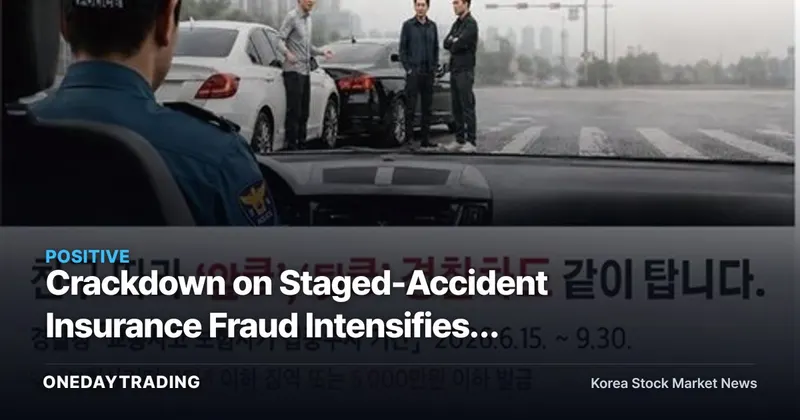
- Four agencies, including the Financial Supervisory Service, announced an intensive push on education and public awareness to root out staged-accident insurance fraud.
- Plugging insurance-fraud leakage is directly linked to auto insurance loss ratios, forming a structure that affects non-life insurers' profitability.
- Enforcement and outreach alone won't immediately change short-term earnings, but they read as a policy-environment signal for medium- to long-term loss-ratio stabilization.
What's Changing
The crux of this announcement is not the toughening of penalties itself, but the fact that the regulator and related agencies have pinned staged-accident-type insurance fraud as a priority target for enforcement and outreach. Collusive accidents involving friends or passengers, and repeated-claim patterns, are textbook leakage channels that inflate auto insurance claim payouts. If such leakage shrinks, non-life insurers' incurred losses come under control, ultimately creating room for loss ratios to decline.
The key variable in non-life insurers' profits is the combined ratio — the sum of the loss ratio (the ratio of claims paid to premium income) and the expense ratio. Because auto insurance is mandatory, its top-line scale is large, but it is a sensitive line of business that swings between profit and loss depending on loss-ratio movements. Stronger fraud detection and prevention curbs improper claims, working favorably to defend the loss ratio.
Reading the Numbers and Context
This announcement did not present specific figures on detection volume or savings; the weight falls on the policy direction of strengthened education and outreach by four agencies including the Financial Supervisory Service. As such, rather than linking it to immediate earnings changes, this is an issue whose effects must be confirmed after the fact through the trajectory of auto insurance loss ratios and the quarterly combined ratio.
Beneficiary and Affected Stocks
- Samsung Fire & Marine: As a top-tier player in auto insurance market share, it has large profit leverage when loss ratios stabilize. It sits in a zone of direct benefit from reduced insurance-fraud leakage.
- DB Insurance · Hyundai Marine & Fire: With a high auto insurance weighting, a drop in staged-accident claims is favorable for controlling incurred losses.
- Meritz Fire & Marine: With long-term and auto loss-ratio management directly tied to the combined ratio, there is room for cost defense in an environment of stronger enforcement.
- Loss-adjustment and insurance IT services: If demand for fraud detection (FDS) and data analytics rises, an indirect benefit channel opens for related solution businesses.
Risk Check
- Education and awareness campaigns do not guarantee immediate loss-ratio improvement, and there is a long lag before effects show up in the numbers.
- Auto insurance loss ratios are driven more heavily by other variables, such as repair-cost hikes, seasonality (cold snaps, heavy rain), and pressure to freeze premiums.
- Expectations of loss-ratio stabilization are already partly priced into non-life insurance stock valuations, making it hard to expect additional upside from campaign news alone.
- Non-auto variables such as interest-rate and dividend policy, and the loss ratio on indemnity health insurance, could reverse the overall earnings direction.
One-Line Conclusion
Tougher insurance-fraud enforcement is a favorable policy environment for non-life insurers' loss ratios, but it is closer to a medium- to long-term cost-control signal than a short-term earnings catalyst. The effect should be confirmed through quarterly auto insurance loss ratios and combined ratios.
Samsung Fire & Marine Insurance in Real-Time Data
Samsung Fire & Marine Insurance's latest closing price is 662,000 won (-3.36% from the previous day), and the traffic-light signal — combining foreign and institutional supply-demand (order flow) with news and momentum — is 🟡 Neutral · Wait-and-See. With positive and negative signals mixed, it's a zone to watch.
Recent related news is mixed, with 1 positive catalyst and 1 negative catalyst.
※ Price and foreign/institutional supply-demand (order flow) data are provided by Korea Investment & Securities (KIS), as of the time of publication.
This article is content automatically summarized and analyzed based on the original news. View original (Yonhap News Securities)