
At a Glance
Oil prices aren't moving on war headlines alone. What this issue really signals is that the Ukraine war and the Middle East front have begun to overlap on the same supply chain.
The Caspian Sea is a military-logistics axis linking Russia and Iran, while the Red Sea and the Bab-el-Mandeb Strait are chokepoints that reset freight rates for crude and product tankers. For Korean investors, this translates into refining margins, jet fuel costs, shipping freight rates, and downward pressure on the won.
Why It Matters Now
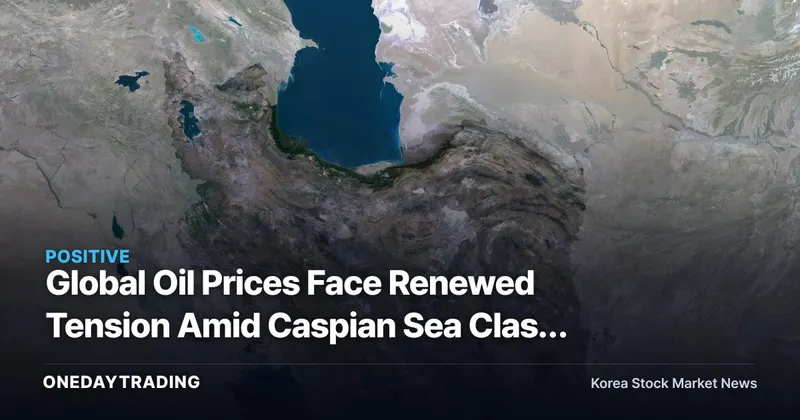
Iran said Ukraine attacked an Iranian commercial vessel in the Caspian Sea, killing one crew member and injuring another. Tehran summoned a Ukrainian diplomatic official to protest, calling the act a hostile and criminal attack. Ukrainian President Zelensky referenced the results of long-range strikes targeting vessels and warships in the Caspian Sea carrying Iran-related military cargo.
What markets are pricing in first isn't the casualty count but the nature of the shipping route. The Caspian Sea isn't a major artery for international crude transport, but it is a back channel for Russia-Iran military cooperation. Add to this the Houthis' missile and drone strikes on Jizan and Yanbu, sites tied to Saudi Aramco facilities — the Jizan refinery is known to have a processing capacity of 400,000 barrels per day. When the front lines touch both the Caspian Sea and the Red Sea simultaneously, oil prices tend to price in a risk premium before any actual supply disruption is confirmed.
Translated into interest-rate terms, the picture gets more complicated. Rising oil prices slow the pace of U.S. inflation cooling and dampen expectations for rate cuts. If rates don't come down, multiples on growth stocks get compressed, while refiners — which stand to benefit from inventory valuation gains and refining margins — hold up relatively well. Airlines and chemical makers, by contrast, see costs rise first. What the KOSPI is really pricing isn't a "war windfall," but the gap between companies that can pass costs on to prices and those that cannot.
Frequently Asked Questions
- Is this a crude oil supply disruption? For now, it's more of a risk premium than a direct disruption. That said, if the Red Sea, Saudi facilities, and the Iran logistics axis are all shaken at once, insurance premiums and freight rates will react first.
- Are all refiners set to benefit? A short-term rise in oil prices and inventory valuation gains are a positive catalyst. But if crude prices rise while product demand stays weak, refining margins won't keep pace.
- Why is this a burden for airlines? Jet fuel makes up a large share of airline costs. When global oil prices and the exchange rate rise together, both fuel costs and dollar-denominated expenses increase at the same time.
- What indicators should Korean market watchers track first? WTI and Brent crude, Singapore refining margins, the won-dollar exchange rate, and Red Sea diversion freight rates should all be watched together.
Related Stocks (Tickers) and Sector Impact
- S-Oil. In a rising oil price environment, expectations build for inventory valuation gains. Crude procurement from the Middle East and the direction of refining margins are the key drivers of earnings.
- SK Innovation. Its refining segment is sensitive to short-term oil price gains. However, mixed in with pressure from its battery segment, the stock's reaction will hinge on how sustainable the refining margin improvement is.
- GS. Expectations for its refining subsidiary's earnings could grow. The key question is whether product margins keep pace with the rise in oil prices.
- Korean Air. Rising oil prices and a stronger won-dollar exchange rate are a cost burden. Even with strong passenger demand, margins get squeezed if higher fuel costs can't be passed on through fares.
- HMM. Red Sea instability is a factor pushing up diversion routes and freight rates. That said, investors should confirm the time lag before higher freight rates actually feed into contracted rates.
Investment Considerations
- Buying refiner stocks purely on a sharp gain (surge) in oil prices is risky. If refining margins don't move in tandem, the scope for earnings improvement will be limited.
- The war-risk premium can evaporate on a single line of negotiation news. Whether the U.S. halts military action against Iran and whether the maritime blockade holds are key factors to watch.
- For airlines and chemical makers, the exchange rate matters as much as oil prices. If won weakness compounds the situation, the cost burden effectively doubles.
- Watch whether Houthi attacks on Saudi facilities recur, and whether damage to Aramco infrastructure actually translates into operational disruptions.
Overall Outlook
The optimistic scenario is a contained conflict. If the Caspian Sea strike stays confined to disrupting military logistics, and damage to Saudi refining facilities is limited to storage infrastructure, oil prices are likely to spike briefly, with refiners mainly reflecting an inventory effect.
The risk scenario is simultaneous instability across shipping routes. The Caspian Sea touches the Russia-Iran axis, while the Red Sea touches Saudi Arabia and global shipping. If the U.S. maintains its blockade posture on Iran on top of that, markets will price in a shift in the inflation and rate-cut path before any supply disruption is even confirmed. The next triggers to watch are whether WTI settles in the $80s, Singapore refining margins, and whether the won-dollar exchange rate approaches 1,400 won. If all three move together, strength in refiner stocks will shift from a simple theme trade into an actual earnings-estimate revision.
This article was automatically summarized and analyzed based on the original news report. Read the original article (CNBC)