
At a Glance
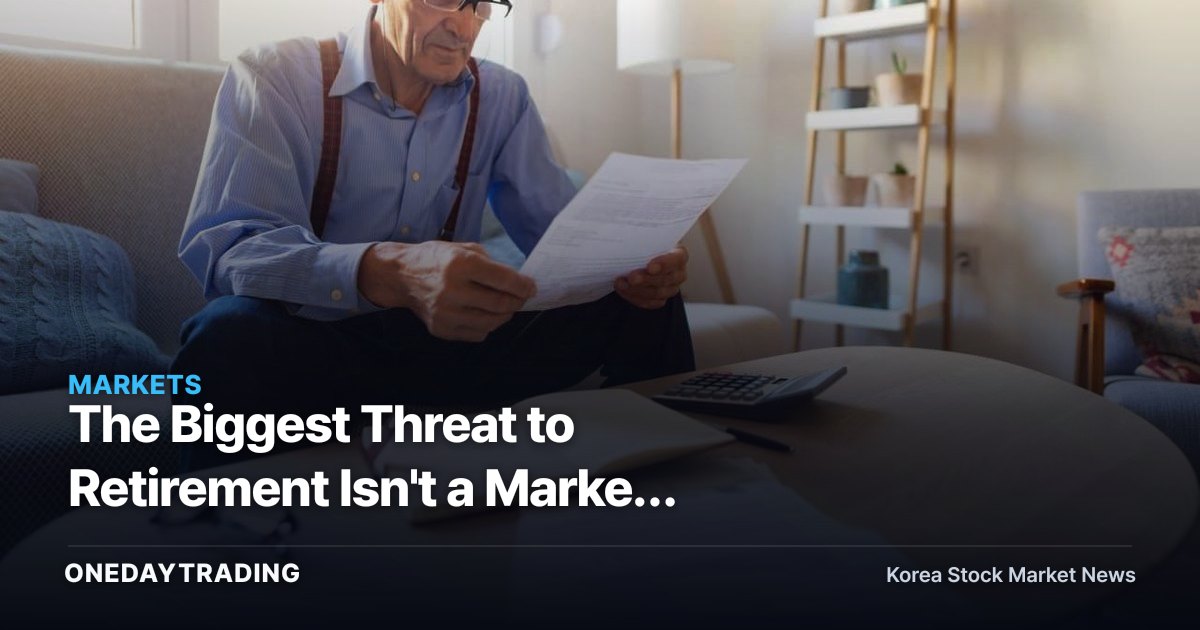
The biggest variable eating away at retirement assets is not a stock-price crash, but medical and long-term care costs whose timing and scale are hard to gauge. This goes beyond simple retirement-planning advice — it also shows how the revenue base of insurers and healthcare companies shifts in an environment where long-term medical and care demand structurally rises.
Why It Matters Now
Market volatility tends to recover over time, but a serious illness or long-term care creates not recovery but cumulative spending. Once it occurs, cash drains out on a fixed monthly basis, and assets must be liquidated to cover it — shaking the very foundation of retirement funds that should be compounding. This is the backdrop against which health-related financial risk has been identified as the number-one threat to retirement security in the U.S.
In Korea, this problem is approaching even faster. As the share of the elderly population climbs steeply, demand for indemnity medical insurance, nursing-care and dementia insurance, and long-term care services is in a phase of structural expansion. From an investment standpoint, this reads two ways. One is a positive factor: rising demand for coverage supports insurers' new-contract growth and premium income. The other is a double-edged cost side: rising loss ratios and the burden of insurance payouts.
Frequently Asked Questions
- Why are medical costs riskier than a market crash — a crash, on average, has a recovery window, but medical and care costs are fixed monthly outflows with no recovery, permanently accelerating the pace of asset withdrawal.
- What does this imply for Korean investors — aging is structurally increasing demand for protection-type insurance and healthcare, so it is worth examining the long-term revenue base of the related sectors.
- Is this an unconditional positive catalyst for insurers — growth in new contracts is positive, but if loss ratios rise on greater medical utilization, profitability actually comes under pressure.
- How can individuals prepare — checking for gaps in indemnity and nursing-care coverage and maintaining a cash buffer for emergency medical costs is as important as asset allocation.
Impact on Related Stocks and Sectors
- Life insurance — expanding demand for retirement, whole-life, and nursing-care coverage boosts new-contract capacity. That said, liability burdens and loss ratios driven by low rates and aging are variables.
- Non-life insurance — demand to enroll in and renew indemnity medical insurance is the revenue base, but rising loss ratios on greater medical utilization will determine profitability.
- Pharma and bio — rising demand to treat chronic and age-related diseases broadens the addressable market. Drug-pricing policy and clinical uncertainty are separate risks.
- Healthcare services and medical devices — candidates to benefit from a structure where demand for diagnostics, monitoring, and care infrastructure rises over the long term.
Key Points for Investors
- More demand does not automatically mean more profit — for insurance, loss ratios decide margins; for healthcare, drug-pricing and reimbursement policy do.
- Watch the direction of interest rates — rates directly affect insurers' asset-management returns and liability valuations.
- Check the policy calendar — the timing of indemnity-insurance system reform and long-term-care and national-health-insurance reimbursement decisions are earnings variables.
- Valuation burden — the aging theme tends to price in expectations early, so it needs to be validated against quarterly earnings and loss-ratio trends.
Overall Outlook
The long-term trend of aging is likely to work in the direction of broadening the revenue foundation of insurance and healthcare. As demand for both coverage and medical services rises simultaneously, room opens up for top-line growth at related companies. Conversely, rising loss ratios, drug-pricing and reimbursement regulation, and interest-rate swings are constraints that keep top-line growth from translating directly into profit. A reasonable approach is to check insurers' loss ratios and new-contract trends next quarter alongside the medical-policy decision calendar, separating structural beneficiaries from cost burdens in your judgment.
Samsung Life Through Real-Time Data
Samsung Life's latest closing price is 425,500 won (+0.59% from the prior day), and the signal light combining foreign-investor and institutional-investor order flow with news and momentum is 🟡 Neutral — Wait and See. With positive and negative signals mixed, it is a stretch to watch.
- ▲ Trend alignment — short- and mid-term upward alignment (day +0.6% · 1 week +8.3% · 1 month +28.9%)
Recent related news is negative, with 0 positive catalysts and 1 negative catalyst.
※ Price and foreign/institutional order-flow data are provided by Korea Investment & Securities (KIS), as of the time of publication.
This article is content automatically summarized and analyzed based on the original news. View original (MarketWatch)