
Key Takeaways
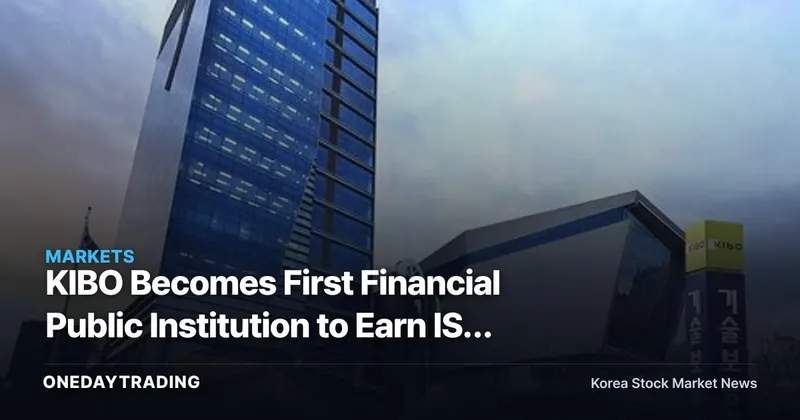
The Korea Technology Finance Corporation (KIBO) has received ISO/IEC 42001 certification, the international standard for AI management systems, from the Korea Management Registrar (KMR) — the first financial public institution to do so. While this is not a matter directly tied to any individual listed company's earnings, it can be read as a signal that the public and financial sectors are beginning to standardize governance and risk management at the AI adoption stage.
From an investment standpoint, the key point is not the use of AI itself, but rather that systems for managing and validating AI are being institutionalized. This is a structural trend that could translate into future demand for compliance, certification, and security software.
What Happened
KIBO is a financial public institution that provides guarantees to technology-based small and medium-sized enterprises and venture firms, and it has now secured ISO/IEC 42001 certification. This standard is an international specification that requires organizations to put in place policies, risk assessments, data management, and monitoring systems in order to develop and operate AI systems responsibly.
KIBO has been incorporating AI into its technology evaluation and guarantee review processes, and this certification formalizes the fact that its operational framework meets external benchmarks. As the first such case among financial public institutions, it has the potential to serve as a precedent that prompts other public and financial institutions to follow suit.
Background and Context
ISO/IEC 42001 is a relatively new standard established in late 2023, aligned with the trend of regulators around the world demanding reliability and transparency in AI as generative AI proliferates. The financial sector carries a relatively heavy AI governance burden, as it has many areas — such as credit scoring and loan underwriting — where accountability for decision-making is critical.
In Korea as well, financial authorities are increasingly tightening AI usage guidelines, so obtaining certification is closely tied to the practical motive of regulatory compliance. While a single institution's certification will not move the market on its own, it is significant in that it illustrates the early phase of standard adoption across the industry as a whole.
Impact on the Market and Stocks
- AI compliance and governance software: As standard adoption increases, demand for AI model monitoring and risk management solutions could expand. However, Korea lacks a clearly dominant large listed company specializing in this area, so the benefits are limited and dispersed.
- Information security and data management firms: Because AI governance is intertwined with data quality and access control, it could create new project opportunities for security SI and data management companies.
- Financial IT and systems integration (SI): If the build-out of AI frameworks in the public and financial sectors becomes standardized, related implementation and consulting orders could gradually increase.
- Certification and testing institution ecosystem: Rising demand for certification translates into expanded activity for assessment and review bodies, but as this is mostly an unlisted domain, the direct effect on the stock market is weak.
Investor Checkpoints
- Watch the AI usage guidelines and regulatory timelines of the Financial Services Commission and the Financial Supervisory Service for any signals of mandatory certification and governance.
- Observe whether subsequent ISO/IEC 42001 cases at other banks and public institutions accumulate, to gauge how quickly the theme is spreading.
- Check whether mentions of AI governance- and compliance-related revenue increase in the quarterly earnings reports and order disclosures of security and SI companies.
- Since this issue offers little catalyst for individual stocks, approach it through the broader trend of policy and order flow rather than any single news item.
Outlook
On the positive side, the standardization of AI governance is an early stage in creating structural demand in the financial and public sectors, and it could provide medium- to long-term growth opportunities in the security, compliance, and data management areas. On the other hand, this development itself amounts to no more than a single public institution obtaining certification, making it hard to view as short-term share-price momentum, and the areas expected to benefit are dispersed among unlisted and small-scale firms — a limitation that leaves few clear targets to translate into investment. Until standard adoption is confirmed to lead to actual orders and revenue, it is reasonable to keep this as a theme-level item to watch.
This article is content automatically summarized and analyzed based on an original news report. View original (Yonhap News)