
Summary
In restaurant startups, good taste is an entry requirement, not a survival condition. Display and space design have emerged as variables that directly determine repeat-visit rates and average spend per customer, and this trend is structurally reinforcing the competitive advantage of large franchises equipped with standardized space design manuals. Conversely, for independent founders, the lack of capacity to invest in space design has begun to function as a new barrier to entry.
What Happened
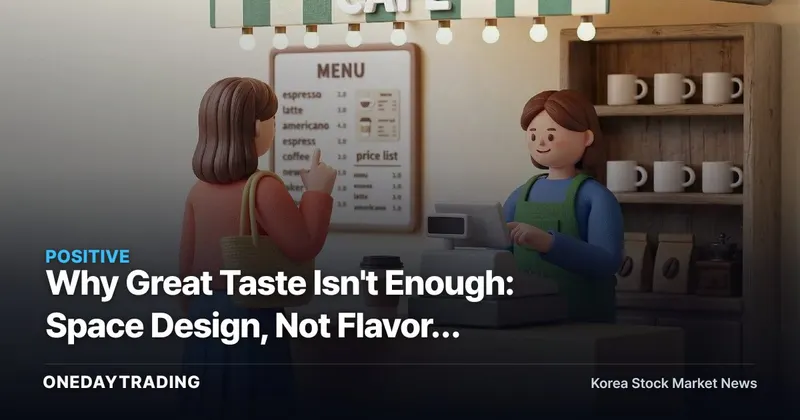
The long-held conventional wisdom in the startup scene is simple: if the food tastes good, customers will come. But the pattern repeatedly observed on the ground in restaurant consulting tells a different story. Industry insiders and outside observers alike are increasingly converging on a diagnosis: what closed-down restaurants had in common was not a failure of taste but a lack of spatial strategy. In short, they failed to generate initial foot traffic in the first place.
The crux of the issue lies in the path consumers take to choose a restaurant. Now that Instagram and Naver Map reviews serve as the first filter, it is increasingly photos of the space—not the food—that shape a customer's decision before they even set foot inside. Interior lighting, color scheme, and product display function as content in their own right, and that content is what determines whether someone visits at all.
Display was once a concept native to fashion, cosmetics, home goods, and convenience stores. That concept has now migrated into the restaurant business. A store with deliberately designed displays guides customer flow to encourage additional purchases and extend dwell time. Longer dwell time translates into higher average spend per customer. By contrast, a store without display design ends in a simple order-eat-leave cycle, and no matter how tightly food costs are managed, total revenue remains capped.
Structural Background
Underlying this shift is a change in the standard for designing consumer experience. Food is now part of the experience, not the whole of it. Among consumers in their 20s and 30s in particular, using a store as a place to produce content has become commonplace, and once space is understood as something that gets reprocessed and redistributed on social media, the marketing efficiency of investing in space design can end up exceeding that of investing in ingredient quality.
As rent, labor costs, and raw material costs all climb in tandem, the efficiency of initial capital allocation at startup has become more critical than ever. Should founders concentrate on menu development, or invest in space strategy? The answer the market keeps producing tilts toward space. By this measure, the side that already has a system in place is not the independent founder, but the large franchise.
Stock & Sector Impact
- Kyochon F&B (339770): Already operates a standardized space design manual across its Kyochon Chicken franchise business. The more the restaurant industry trend reorients around space design, the more attractive franchise affiliation becomes relative to independent startups, which could translate into net franchise store growth and expanded royalty income.
- SPC Samlip (005610): A listed affiliate of the SPC Group, which operates Paris Baguette and Baskin Robbins, and maintains a leading position in café-style space design and display standardization. The revenue contribution of renovated stores serves as a verification metric for this trend.
- Shinsegae Food (031440): Operates a range of restaurant brands including No Brand Burger and treats premium space experience as a core strategic pillar. The more independent founders struggle with space design, the more franchise demand is expected to flow toward large operator brands.
- Restaurant-specialized interior and space consulting: A direct beneficiary sector, though pure-play listed beneficiaries are limited. Rising demand for F&B store remodeling translates into more orders for related small-scale firms, but the impact on the stock market is not large.
- Delivery platforms: As space-centered offline consumption strengthens, the relative competitiveness of restaurant models heavily reliant on delivery could weaken. This represents a structural headwind for platform operators dependent on delivery commission revenue.
Bull vs. Bear Scenarios
Bull-case scenario: As the shift toward space strategy accelerates, large franchises with systematized interior and display manuals gain a stronger competitive edge in recruiting new franchisees. Franchise fee income and brand premium strengthen for listed companies such as Kyochon F&B and SPC Samlip, and if this coincides with a recovery in domestic consumption, rising average spend per customer could translate into improved profit margins.
Bear-case scenario: Space investment increases upfront capital burden. If disposable income falls amid an economic downturn, consumers may shift their selection criteria from space experience toward value for money. In that case, a decline in visitors would directly translate into a fixed-cost burden for brands that made large-scale investments in premium space. Rising rents also remain a live structural pressure that makes space investment itself more difficult.
Investor Action Points
- Check net new franchise store openings and franchise contract rates in the quarterly earnings of Kyochon F&B and Shinsegae Food. This is the most direct data point for verifying whether space strategy actually boosts franchise preference.
- Track SPC Samlip's number of renovated Paris Baguette stores and the revenue growth rate at those locations. This is an indicator of whether reinvestment in space translates back into revenue.
- Monitor the quarterly restaurant closure rate and franchise new-signing trends published by the Korea Small Enterprise and Market Service (SEMAS). If a trend of declining independent startups alongside rising franchise affiliation is confirmed, it can serve as a leading indicator of the degree of benefit to large listed franchise operators.
- Cross-check the retail sales index alongside restaurant industry revenue trends. Space strategy only matters when it is backed by actual traffic, so if consumption itself is in a contraction phase, the real ROI of space investment remains limited.
Kyochon F&B in Real-Time Data
The latest closing price for Kyochon F&B is KRW 3,685 (0.00% vs. previous day), and the traffic-light signal combining foreign/institutional investor order flow with news and momentum reads 🔴 Caution. Foreign investors and institutional investors are both negative, so caution is warranted right now.
- ▼ Dual-side selling — foreign investors −KRW 0 · institutional investors −KRW 0, selling in tandem
- ▼ 52-week position — near the 52-week low, at the 7% level
※ Price and foreign/institutional investor order-flow data are provided by Korea Investment & Securities (KIS) and are current as of the time of publication.
This content was automatically summarized and analyzed based on the original news article. View original article (Maeil Business Newspaper)