
At a Glance
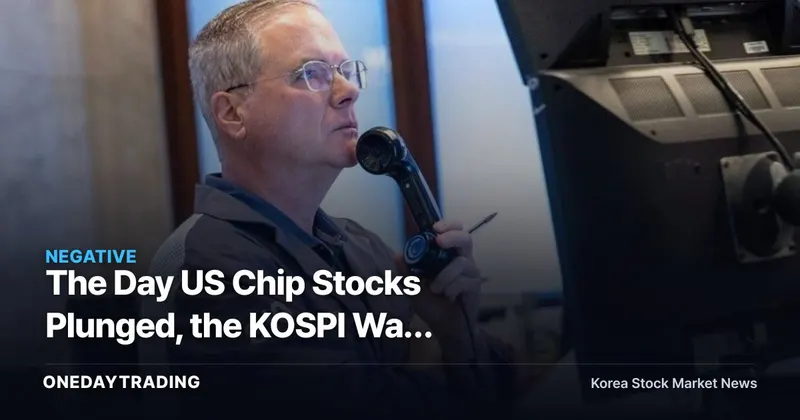
On the one day Korea's market was closed for Constitution Day, the Philadelphia Semiconductor Index plunged in New York. Online communities were full of relief that the holiday had spared local investors, but that's an illusion. A day off doesn't erase the drop that originated in New York — it simply piles up and hits all at once at the next session's opening quote.
Why It Matters Now
Stock prices are a function of how fast information gets absorbed. The information that US chip stocks plunged has already been released into the market, and there is no Korean investor who is unaware of it. It's just that while the KOSPI was closed, there was no channel to reflect that information in prices. For stocks like Samsung Electronics and SK Hynix (000660), whose valuations are effectively tied to the US semiconductor industry cycle, all that happened is a time lag between when the information became known and when the price reflects it — the reflection itself hasn't been avoided.
Two scenarios diverge from here. One is that US chip stocks partially recover their losses during the one-day closure, in which case the shock to the Korean open is cushioned. The other is that the decline holds or even deepens, in which case Korea's large-cap chip stocks absorb a full day's worth of adjustment in a single gap-down at the open. The relief seen in online communities assumes the former — it is an expectation, not a confirmed outcome.
FAQ
- Did the market holiday really save the KOSPI? No. It only delayed the reflection by a day — the information itself, the New York-driven decline, doesn't disappear.
- Which stocks (tickers) will react first? Samsung Electronics (005930) and SK Hynix (000660), which have high correlation with the US semiconductor cycle and valuations, are likely to determine the index's direction at the next open.
- Could the one-day closure actually work in Korea's favor? It's possible if US chip stocks recover their losses in the meantime, reducing the shock to the Korean open. But that outcome is conditional.
- Should investors rush to buy or sell right now? The key variables to check first are the order book at the next open and foreign/institutional investor supply-demand (order flow).
Related Stocks (Tickers) and Sector Impact
- Samsung Electronics (005930) — Because its memory business cycle is tied to US semiconductor valuations, it is likely to be the first index bellwether to have the New York decline priced in once the market reopens.
- SK Hynix (000660) — With a large share of revenue coming from high-value memory such as HBM, it is highly sensitive to sharp drops in the share prices of US semiconductor customers and competitors.
- Semiconductor equipment and materials stocks — When large-cap supply-demand (order flow) turns unstable, smaller equipment and materials makers tend to see liquidity pull out first, experiencing greater volatility.
- The KOSPI index itself — Given the index's heavy weighting in semiconductors, a gap-down in the sector bellwethers tends to be amplified into a broader decline across the entire index.
Points to Watch for Investors
- First check whether the decline in US chip stocks held or reversed during the market closure. This is the variable that determines the direction of the first opening quote.
- Watch foreign and institutional investor supply-demand (order flow) trends at the next open. Unlike domestic retail investor sentiment, if foreign net selling is layered on top, the decline could deepen.
- Relying on the narrative that the holiday "protected" the market and rushing into reassured buying is weak reasoning. The information is already waiting to be priced in.
- It's important to distinguish whether this reflects a genuine change in semiconductor industry fundamentals (demand, inventory, pricing) or simply a sentiment-driven sharp drop, as the appropriate response differs accordingly.
Overall Outlook
The optimistic scenario is that US chip stocks recover their losses through bargain-hunting during the one-day closure, limiting the shock to the Korean open to a modest adjustment. The risk scenario, conversely, is that US-driven selling continues, causing Samsung Electronics and SK Hynix to open with a gap-down and the entire index to absorb a full day's decline in compressed form. The first 30 minutes of trading at the next open, the intensity of foreign net selling, and the next closing move in the New York semiconductor index will determine which path plays out.
Samsung Electronics: A Real-Time Data Snapshot
Samsung Electronics' most recent closing price was 255,000 won (-8.77% versus the previous day), and the signal derived from combined foreign/institutional supply-demand (order flow) and news/momentum data is 🔴 Caution. With foreign investors, institutional investors, and momentum all reading negative, caution is warranted right now.
- ▼ Dual selling pressure — foreign investors sold a net −211.4 billion won and institutional investors sold a net −1,168.3 billion won
- ▼ Trend alignment — short- and medium-term downtrend alignment (-8.8% today · -8.3% over 1 week · -26.4% over 1 month)
Recent related news is mixed, with 3 positive catalysts and 3 negative catalysts.
※ Price and foreign/institutional supply-demand (order flow) data are provided by Korea Investment & Securities (KIS) and reflect figures as of publication.
This article was automatically summarized and analyzed based on the original news source. View original article (Maeil Business Newspaper)