
What SEMIFIVE’s Order Surge Means for Investors
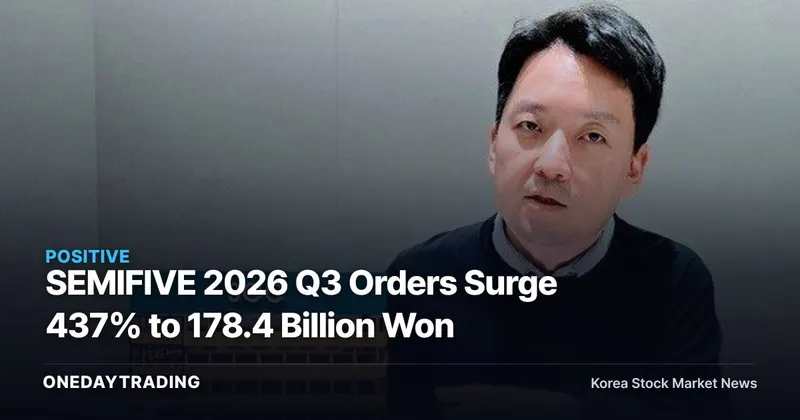
In SEMIFIVE’s earnings for the third quarter of 2026, announced on the 13th, the figure investors should focus on first is not revenue of 51.4 billion won but new orders of 178.4 billion won. The earnings reported by The Elec show that the scale of contracts in the global AI ASIC business has expanded rapidly. However, the operating loss of 9.7 billion won also draws a clear line against treating order growth and improved profitability as the same development.
The picture becomes clearer by separating what has been confirmed from what has not. SEMIFIVE’s revenue in the third quarter of 2026 rose 23.2% year over year and exceeded 50 billion won for the first time on a quarterly basis. At the same time, new orders increased 437% year over year to an all-time high. Top-line growth and contract expansion have been confirmed, but the company remains in the red.
How Far Have AI ASIC Orders Progressed?
An ASIC, or application-specific integrated circuit, is a semiconductor designed for a particular customer and use case. New orders in SEMIFIVE’s ASIC development business totaled 136.9 billion won in the third quarter of 2026, up 705% year over year. The company said it secured global leading-edge process turnkey projects, including a major high-performance computing (HPC) project in North America.
This figure reflects more than general optimism about AI: development contracts have translated into booked orders. From an investment perspective, the key point is that the narrative around the company’s design capabilities has progressed into actual contracts. CEO Myung-Hyun Cho also described the results as indicating that SEMIFIVE has entered a phase of accelerating growth in the global AI ASIC market.
The next stage after new orders is the order backlog. SEMIFIVE’s backlog reached an all-time high of 245.5 billion won at the end of the third quarter of 2026, up 75% from the previous quarter. This means new contracts have accumulated in the backlog, so investors should monitor not only the scale of additional orders but also how effectively the existing backlog converts into actual revenue.
Why Revenue Growth and the Operating Loss Must Be Assessed Together
Cumulative figures showed both top-line expansion and a narrowing loss. SEMIFIVE’s cumulative revenue through the third quarter of 2026 totaled 146.1 billion won, up 62.7% year over year. Its cumulative operating loss over the same period narrowed 41.7% year over year to 20.6 billion won.
Nevertheless, the operating loss of 9.7 billion won in the third quarter of 2026 means a return to profitability has not yet been confirmed. The order backlog indicates the scale of contracts to be fulfilled in the future, but it is not itself revenue or profit that has already been recognized. Therefore, when assessing the positive catalyst of record orders, investors should separately examine how closely profitability is keeping pace with top-line growth.
The conditions separating the potential outcomes are also clear. Continued conversion of the order backlog into revenue would improve growth visibility. However, if the operating loss persists even as revenue rises, order growth alone would be insufficient to demonstrate profitability. The disclosed information does not identify the customer for the North American HPC project, individual contract values and signing dates, or a detailed revenue-recognition schedule.
SEMIFIVE’s Key Inflection Points in the Next Earnings Report
- Backlog conversion into revenue: The first item to monitor is whether the 245.5 billion won backlog at the end of the third quarter of 2026 translates into higher revenue in the next earnings report.
- Direction of the operating loss: If the operating loss of 9.7 billion won narrows alongside quarterly revenue growth, it would indicate that top-line expansion is beginning to improve profitability.
- Sustainability of ASIC development orders: Investors should watch whether the ASIC development business, which recorded 136.9 billion won in orders, continues to secure additional contracts. A one-off large order warrants a different assessment from sustained contract growth.
- More detailed project disclosures: Disclosure of the customer, individual contract values, and revenue-recognition schedule would provide a stronger basis for assessing the quality of the current backlog and how quickly it will flow into earnings.
CEO Myung-Hyun Cho cited the record order backlog and mass-production pipeline as growth drivers. For investors, the key inflection point lies not in the strength of management’s wording but in the sequence of the actual figures. Contracts must first accumulate in the backlog, then convert into revenue, and ultimately lead to a narrowing operating loss for the AI ASIC growth narrative to be fully reflected in earnings.
This article was automatically summarized and analyzed based on the original news report. View original article (The Elec)