
Summary
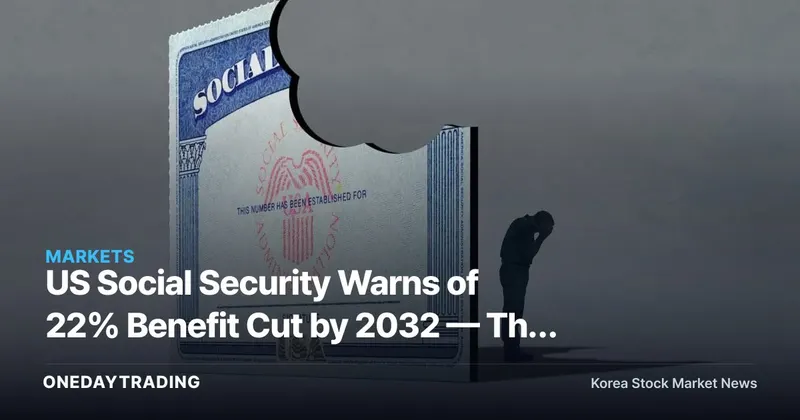
The latest trustees' report from the US Social Security Administration warns that, absent any action, the trust funds could be depleted around 2032 and benefit payments could be cut by roughly 22%. This is not merely a statistic — it is an issue that directly affects the real income of tens of millions of retirees and the structure of the private pension market. It also offers Korean investors insight into global retirement-finance trends and the design of retirement assets.
The Full Story
US Social Security is a pay-as-you-go system in which the payroll taxes paid by the working generation fund the benefits of the retired generation. The trust funds accumulated over the years have made up the shortfall, but as spending outpaces revenue ever faster amid an aging population and slowing birth rates, the point of fund depletion has moved closer.
The key figures presented in the latest report are fund depletion around 2032 and the possibility of an automatic cut of roughly 22% immediately thereafter. Unless Congress takes legislative action such as raising tax rates or adjusting benefits, payments will be limited to the tax revenue legally collected — making the cut a reality.
The impact on individuals can be calculated by applying the cut rate to the expected benefit amount. For example, a retiree expecting $2,000 a month would see roughly $440 trimmed under a 22% cut, leaving about $1,560. The felt impact varies greatly depending on the timing of retirement and the share of other income sources.
Structural Background
The root of this problem is demographic change. As the elderly population receiving benefits grows while the share of the working-age population paying contributions shrinks, the sustainability of pay-as-you-go pensions is shaken. This is not a problem unique to the US, but a structural challenge commonly faced by the public pension systems of major countries, including Korea's National Pension.
The greater the uncertainty surrounding public pensions, the more the role of individuals' private pensions and self-directed retirement savings comes to the fore. This is a variable that reshapes the demand base of the long-term asset-management market and the retirement-finance industry.
Stock and Sector Ripple Effects
- Life insurance and pension sector: If demand for private pensions and annuity insurance rises to fill the public-pension gap, there is potential for long-term benefit.
- Asset management: An expanding share of self-managed retirement funds supports demand for long-term installment funds and ETFs.
- Healthcare and silver industry: Declining retirement income heightens sensitivity to medical-cost burdens, stimulating structural demand and policy debate in related industries.
- Dividend and income assets: Retirement funds seeking stable cash flows have a stronger incentive to shift toward high-dividend stocks and income-type products.
Bull vs. Bear Scenarios
On the bull side, public-pension anxiety could structurally grow demand for private pensions, asset management, and insurance, becoming a long-term growth driver for the related industries. There is also room for individuals' demand for retirement-focused asset allocation to translate into steady fund inflows into global investment markets.
On the bear side, if an actual benefit cut materializes, the spending power of the retired generation would contract, potentially weighing on domestic demand and the economy. That said, 2032 leaves ample time and there is a strong chance of mitigation through legislation, so the direct impact on share prices at this point is limited.
Investor Action Points
- Do not rely on public pensions alone; diversify and build up self-directed retirement assets such as private pensions and ETFs.
- Review the share of dividend and income-type assets for stable cash flow after retirement.
- Track the debate over Korea's National Pension reform as well, and review long-term retirement-planning scenarios.
- Rather than overreacting to specific policy headlines, maintain a diversification strategy grounded in long-term demographic trends.
This article is content automatically summarized and analyzed based on the original news. View original (MarketWatch)