
Key Takeaways
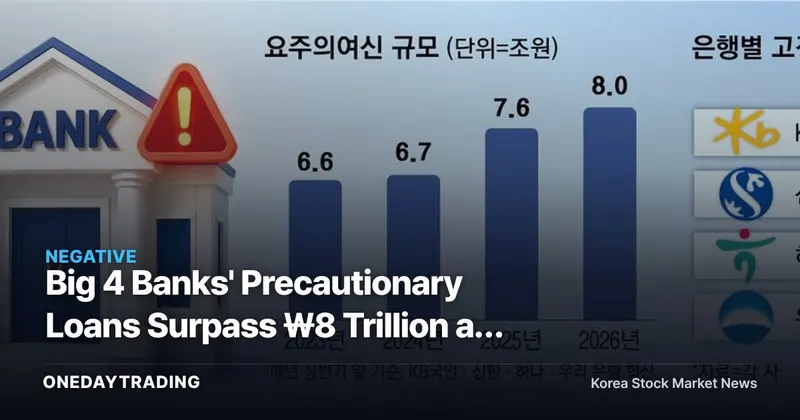
Precautionary loans at KB Kookmin, Shinhan, Hana, and Woori — Korea's four major commercial banks — rose by 705 billion won in just three months, pushing the total above 8 trillion won. That pace is six times faster than the growth in total lending over the same period. Substandard-or-below loans also increased 11%. On the surface, bank stocks are still viewed as beneficiaries of the high-rate environment, but these figures signal that a bill for credit costs is quietly building up beneath that profit structure.
What Happened
Precautionary loans are the second tier in the five-stage asset-quality classification system (normal, precautionary, substandard, doubtful, estimated loss), covering loans with short delinquency periods or early warning signs about repayment capacity. They haven't yet been confirmed as substandard-or-below loans — the category that constitutes actual non-performing loans (NPLs) — but they are the segment most likely to migrate into NPL status next quarter. The 705 billion won increase in precautionary loans at the four major banks over three months means potential bad debt is accumulating six times faster than the growth in total lending.
Substandard-or-below loans — loans already confirmed as non-performing — also rose 11%. Precautionary loans and substandard-or-below loans rising simultaneously suggests that some bad debt has already begun migrating into NPL status, with the next wave waiting in line. That's why analysts say the repayment capacity of corporate and self-employed borrowers has visibly weakened.
Background and Context
This trend didn't emerge overnight. As high interest rates have persisted, the share of companies with an interest coverage ratio below 1 has steadily grown, and delinquency rates on self-employed business loans have also crept up as pandemic-era loan maturity extensions and repayment deferrals have been phased out one by one. For banks, rising benchmark interest rates had until now masked this burden by widening net interest margins. The problem is the timing mismatch now emerging: as expectations for rate cuts grow, net interest margins are set to narrow, while the bad debt that has built up in the meantime remains on the books.
Market and Stock Impact
- KB Financial Group, Shinhan Financial Group, Hana Financial Group, Woori Financial Group: The rise in precautionary loans translates directly into pressure for additional provisioning for loan losses going forward. If the credit cost ratio comes in higher than expected in third-quarter earnings, net profit expectations could be revised down.
- Savings banks, capital firms, and card companies: These lenders have a higher share of vulnerable borrowers than commercial banks, so the same trend could appear faster and more severely there. Commercial bank indicators are, if anything, a lagging signal.
- Construction and real estate PF-related stocks: Deteriorating corporate repayment capacity is linked to real estate project-financing (PF) feasibility assessments. Bad debt in self-employed and corporate loans often moves in tandem with PF loan defaults.
- Sentiment toward high-dividend bank stocks: A great deal of capital has flowed into bank stocks on the basis of dividend yield. If asset-quality indicators keep deteriorating, pressure could build to reassess banks' capacity to sustain dividends.
Investor Checkpoints
- Check how much the four financial holding companies' provisioning for loan losses and credit cost ratios increased from the prior quarter when third-quarter earnings are released.
- Watch whether the increase continues or proves to be a temporary blip when the substandard-or-below loan ratio and precautionary loan ratio are disclosed next quarter.
- Keep an eye on the Monetary Policy Board's schedule for benchmark interest rate decisions. The sooner rate cuts begin, the shorter the window in which narrowing net interest margins overlap with rising bad-debt burdens.
- Watch for any announcements from financial regulators regarding loan maturity extensions for self-employed and small business borrowers.
Outlook
In the optimistic scenario, rate cuts begin sooner than expected, easing the interest burden on vulnerable borrowers, and the rise in precautionary loans stabilizes within the third quarter. In that case, bank stocks could retain their high-dividend appeal without added valuation pressure. Conversely, if loan maturities for self-employed borrowers cluster in the second half and the pace of bad-debt migration accelerates further, the increase in credit costs that the market hasn't yet priced in could surface all at once in fourth-quarter earnings. In that scenario, bank stock prices are likely to react more sensitively to asset-quality indicators than to valuation.
KB Financial Group: Real-Time Data
KB Financial Group's most recent closing price was 172,600 won (0.00% versus the previous day), and the signal combining foreign investor and institutional investor supply-demand (order flow) with news and momentum is 🟡 Neutral — Wait and See. With positive and negative signals mixed, this is a stock (ticker) to watch closely.
- ▲ News Flow — Positive catalysts 3 vs Negative catalysts 0 — Positive catalysts lead
Recent news related to this stock (ticker) shows 3 positive catalysts and 0 negative catalysts, a favorable mix.
※ Price and foreign/institutional investor supply-demand (order flow) data are provided by Korea Investment & Securities (KIS) and reflect the time of publication.
This article is automatically summarized and analyzed based on the original news report. Read Original (Maeil Business Newspaper Economy)