
Three-Line Briefing
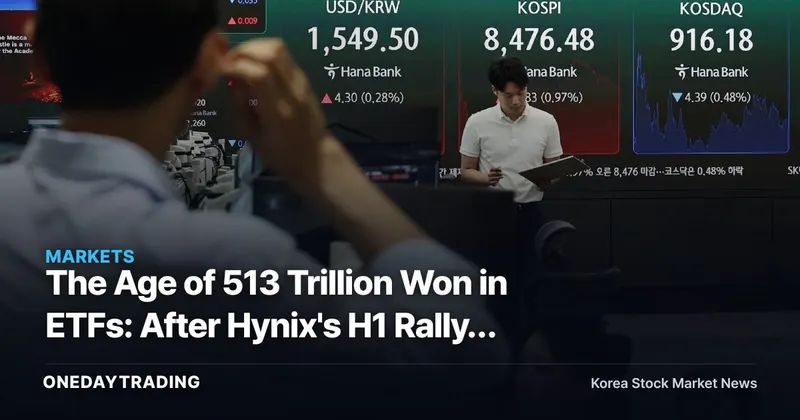
- Korea's total ETF net assets reached 513 trillion won, and related thematic fund inflows surged 72% in the first half alone, pushing concentration to an extreme
- The SK Hynix/HBM value chain that drove the first-half rally has now entered a phase of digesting that concentration
- The second half hinges on the HBM4 generational transition as the inflection point, with capital shifting its center of gravity toward equipment makers and U.S. AI power construction stocks, while strategies that build layered downside protection through covered-call active ETFs are gaining traction
What's Changing
More noteworthy than the fact that Korea's ETF net assets have swelled to 513 trillion won is the 72% surge in thematic fund inflows during the first half. What this really signals is that the market has already priced in the SK Hynix and HBM rally quite heavily, and that it's now time either for that concentration to reverse or for the next leading theme to emerge. The fact that first-half inflows piled up so heavily into a handful of stocks (tickers) and themes means valuation pressure is likewise concentrated in specific segments. If a correction hits, it won't be the broader index that wobbles first — it will be the areas where that concentration built up.
The key variable for the second half is the HBM4 generational transition. The shift from HBM3E to HBM4 is not a simple product changeover — it's a phase in which leadership across the value chain is being reshuffled. Memory makers' earnings outlook is already well known to the market, but the equipment order cycle needed for the processes that generate those earnings has not yet been fully priced in. The shift of ETF capital from finished-product sector bellwethers toward equipment makers can be seen as an attempt to capture this timing gap.
At the same time, overseas, U.S. construction stocks tied to AI data center power infrastructure have emerged as new candidates for inclusion. The logic is that AI server expansion drives not only semiconductor demand but also investment in power grids — but as with the domestic semiconductor concentration, this theme carries the same risk that capital will first crowd into a small number of stocks (tickers) in its early phase.
Numbers in Context
Placing the 513 trillion won net-asset figure alongside the 72% growth rate paints a picture of a Korean ETF market whose growth was concentrated in specific segments rather than broad-based. The fact that thematic fund growth far outpaced total net-asset growth means a significant portion of new capital went into directional bets rather than safe assets. Under this kind of capital structure, the moment industry sector leadership changes, capital rotation accelerates as well. The fact that products combining covered-call and income-generating active strategies are being floated as a second-half combination reflects a design intended to lay down dividend income as a cushion and partially offset downside risk amid this volatility.
Stocks (Tickers) to Watch: Winners and Losers
- SK Hynix (000660) — Its attempt to carry HBM3E leadership over into HBM4 is the key variable for second-half earnings and valuation; if the generational transition is delayed, it could become the epicenter of a reversal in the current concentration
- Hanmi Semiconductor (042700) — Orders for HBM back-end bonding equipment tend to rise first in the early stage of the HBM4 transition, putting it at the front line of beneficiaries from the generational shift
- Wonik IPS (240810) — As part of the semiconductor deposition and etching equipment supply chain, it serves as a gauge for whether order growth from the new HBM4-related investment cycle materializes
- Samsung Electronics (005930) — A benchmark for comparison: if its market share shifts in the HBM4 competitive landscape, capital allocation across the entire value chain could be shaken up again
- Small- and mid-cap semiconductor equipment and component stocks broadly — direct beneficiaries of the shift of ETF capital from finished-product bellwethers toward equipment makers, though there is also a risk that, without earnings to back it up, this proves to be nothing more than a short-term concentration
Risk Check
- If the HBM4 mass-production timeline or yield falls short of market expectations, the very logic behind capital rotation into equipment makers could be undermined
- If concentration into thematic ETFs fails to persist at the same pace as in the first half, the growth in net assets could slow as well
- Covered-call products are structured to give up part of the upside in a rising market, so if the rebound is strong, they could actually end up with relatively inferior returns
- The U.S. AI power infrastructure theme is still an unfamiliar area for domestic investors, so volatility stemming from information asymmetry could be significant
Bottom Line
Given how pronounced the first-half concentration was, the second half is likely to bring both a reversal and sector rotation together, and until the HBM4 generational transition is confirmed through actual orders and yields, the equipment-maker beneficiary thesis should be treated as a narrative that still needs to be verified.
This article is auto-summarized and analyzed content based on the original news report. View original (Maeil Business Newspaper - Securities)