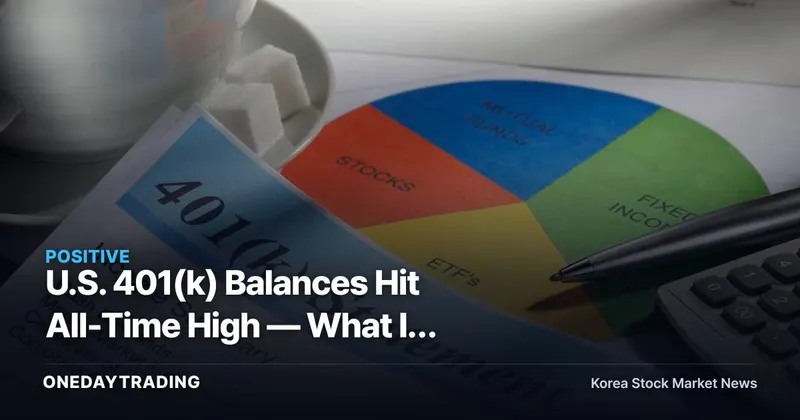

The news that U.S. workers' 401(k) retirement balances have hit an all-time high is more than a retirement statistics headline — it is a signal that the revenue base of asset management and brokerage industry sectors, which earn fees tied to assets under management (AUM), has grown meaningfully stronger. The two drivers behind the balance increase are unrealized gains from equity market appreciation and monthly contribution inflows. Crucially, contributions flow in regardless of market conditions, providing fund managers with a stable, recurring fee base that is structurally insulated from the economic cycle. For Korean investors, this is a moment to examine the nature of the massive pool of capital flowing steadily into U.S. equities on a long-term, regular basis — and to identify which companies are collecting fees from that flow.
3-Line Briefing
- According to the Vanguard report, U.S. 401(k) retirement balances reached a record high last year.
- The result reflects the simultaneous impact of equity market strength driving unrealized gains and steady contribution inflows.
- This suggests a favorable environment for asset management and brokerage stocks (tickers) operating on an AUM-based fee model.
What Changes from Here
Record-high balances mean U.S. households have increased their exposure to risk assets by a corresponding amount. A significant portion of 401(k) assets is automatically allocated into index funds and target-date funds, a structure that creates a virtuous cycle: as equity prices rise, the fees asset managers receive — tied to AUM — rise proportionally.
The key is the stickiness of the capital. Contributions automatically deducted from paychecks flow in every month regardless of market volatility, which means revenue for asset managers is structurally less volatile than that of conventional fund businesses. Even when the U.S. market pulls back, fresh contributions continue to flow into equity funds, functioning as a structural source of buying support that underpins index lows.
From a Korean perspective, this trend illustrates the depth of long-term capital committed to U.S. equities, while also suggesting that domestic retail investors steadily accumulating U.S. stocks and retirement pension default-option assets are moving in the same direction.
By the Numbers
When reading reports like this, it is important to look at both the mean and the median. Average balances tend to be skewed upward by high-income, long-tenure participants, meaning the balance experienced by the typical participant — the median — is generally significantly lower than the average. A record-high average does not equate to broad-based retirement security for most workers; the figure reflects the outcome of a strong equity market, not a signal that households across the board have completed their retirement preparation.
Stocks (Tickers) to Watch — Beneficiaries and Risks
- BlackRock: The quintessential AUM-linked fee model. As more retirement assets flow into index funds and ETFs, BlackRock's management fee base expands accordingly.
- Charles Schwab / Morgan Stanley: Both operate retirement plan platforms and wealth management (WM) divisions, meaning higher balances translate directly into higher custody and advisory fees.
- Mirae Asset Securities: A domestic leader in retirement pension management and overseas equity brokerage, well-positioned to benefit directly from growing retail investment in U.S. equities.
- Samsung Securities: Its wealth management-centric revenue model means fee leverage kicks in as default-option and overseas investment assets flow in.
Risk Check
- Record-high balances are a lagging outcome of equity market strength; a correction in U.S. indices could rapidly reverse unrealized gains.
- The concentration into index funds and low-cost ETFs puts downward pressure on management fee rates, creating a risk that AUM growth does not translate into margin expansion.
- In a high-rate, high-valuation environment, risk-asset allocations themselves remain exposed to volatility.
- The growing concentration of domestic Korean retirement assets in U.S. markets amplifies exchange rate risk as a profit-and-loss variable.
Bottom Line
The steady nature of contribution-based capital is a structural positive catalyst for asset management and brokerage industry sectors — but since record-high balances are themselves a product of equity market strength, investors must weigh both sides of the equation: the risk of a market correction and the ongoing pressure on fee rates.
This content was automatically summarized and analyzed based on the original news article. Read the original article (MarketWatch)