
At a Glance
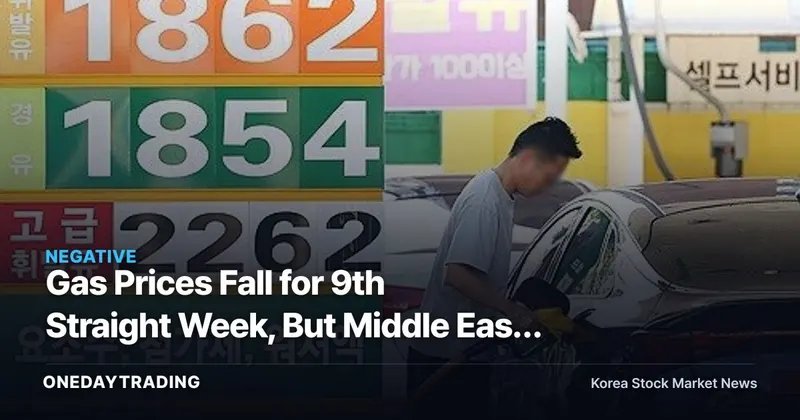
Gasoline and diesel prices at gas stations nationwide fell for a ninth consecutive week. This week, however, the decline narrowed noticeably. The cause is a geopolitical risk premium being added to international crude oil prices as military tensions in the Middle East escalate again. From a consumer's standpoint, prices are still falling, but the fact that the pace itself has begun to slow could mark the early stage of a turning point.
Why It Matters Now
Looking only at the nine straight weeks of declines, it may seem like the oil price stabilization phase is continuing. But the assumption the market had already priced in was a sustained downward stabilization in international crude prices, and this week's narrower decline should be read as a signal that assumption is starting to wobble. Domestic gas station prices typically reflect international crude prices with a lag of two to three weeks, meaning today's slowdown indicates a risk premium had already begun building in the international crude market weeks ago.
The key question is whether this premium holds or expands, or settles down at the level of a localized conflict. An escalation scenario — for instance, one that spreads to threats against crude oil shipping routes — and a scenario that ends as a limited military clash would send international oil prices down completely different paths. It's precisely this probability distribution that the market has not yet fully priced in. Whether domestic gas prices turn upward next week, or the decline widens again, will be the first signal for gauging that probability.
FAQ
- Why have gas prices kept falling for nine weeks straight? — A downward stabilization in international crude prices combined with slowing demand, and the resulting cost declines were reflected sequentially in domestic prices.
- So why did prices fall less this week? — Because instability in the Middle East added a risk premium to international crude prices, offsetting the pace of decline.
- Will gas prices rise next week? — If Middle East risk persists or escalates, there is a possibility of a turn toward higher prices; if the situation calms, the downtrend could resume.
- What effect does this have on consumer prices? — Fuel costs carry a large weighting in the consumer price index, so a prolonged oil price rebound would weigh on inflation stabilization.
Related Stocks (Tickers) and Sector Impact
- S-Oil, SK Innovation, GS — If the rebound in international crude prices continues, there are hopes for improved inventory valuation gains, but refining margins are driven by supply-demand (order flow) independent of oil price direction, so this doesn't directly translate into higher profits.
- Korean Air — Fuel costs are a major cost variable for airlines, so an extended oil price rebound could once again increase the cost burden.
- Chemical industry sector names like Lotte Chemical — Feedstock costs such as naphtha are linked to oil prices, so rising oil prices act as a cost pressure factor.
- Transportation and logistics industry sector — Fuel surcharge burdens could increase, potentially affecting profitability.
Investment Considerations
- Since domestic gas prices reflect international crude prices with a two-to-three-week lag, it's premature to conclude a trend reversal from just one week's narrower decline.
- Middle East risk is a binary variable whose outcome depends heavily on whether the conflict escalates. Rather than betting on a specific scenario, it needs to be approached through conditional probabilities.
- Refiner stock prices are driven not just by oil price levels but also by refining margins, i.e., crack margins. A rise in oil prices does not automatically mean higher profits for refiners.
- The KRW/USD exchange rate is another variable affecting crude import costs and should be monitored alongside oil prices.
Overall Outlook
If the Middle East situation settles at a localized level, the downtrend in domestic gas prices is likely to regain momentum, and the inflation stabilization trend is likely to continue as well. Conversely, if the risk expands and the rise in international crude prices becomes entrenched, cost burdens will accumulate in the airline, chemical, and transportation industry sectors, and for refiner stocks, the trajectory of refining margins will have a greater impact on profits than the oil price increase itself. The next checkpoints to watch are next week's gas station price statistics, released alongside international crude price trends, and whether additional military clashes occur related to the Middle East situation.
This article was automatically summarized and analyzed based on the original news report. View original (Yonhap News Securities)