
Three-Line Briefing
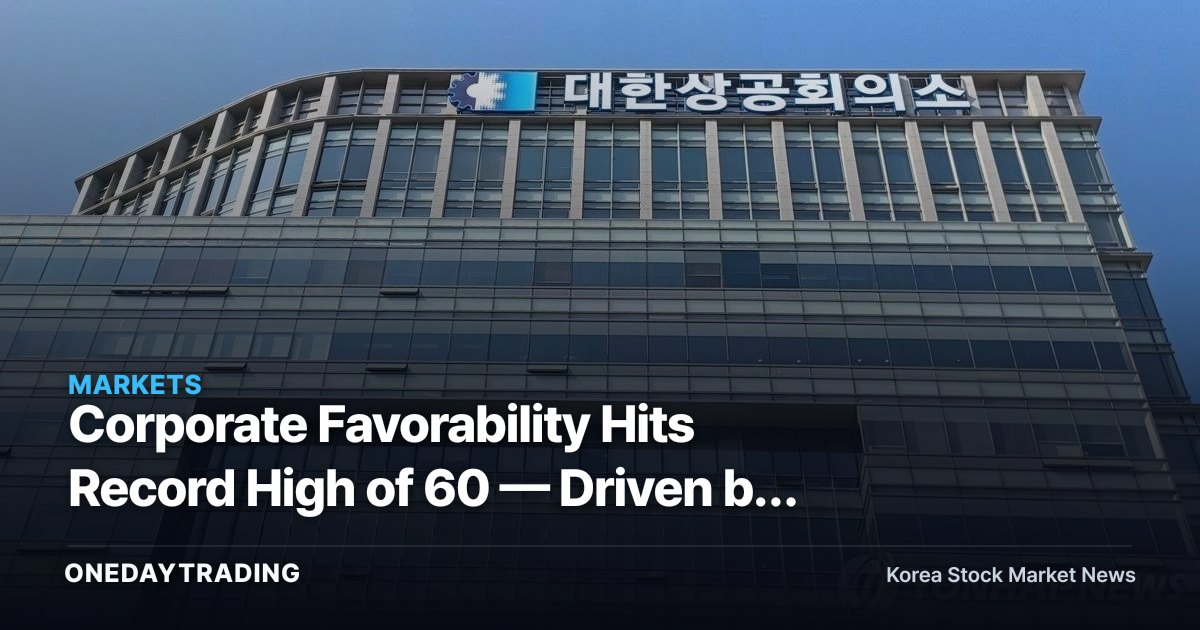
- In a survey of 1,000 citizens conducted by the Korea Chamber of Commerce and Industry, corporate favorability came in at 60 — the highest level since the survey began.
- Among the individual categories, the assessment of corporations' contribution to economic growth scored relatively high.
- While this is not a catalyst that directly lifts any specific stock (ticker), the easing of anti-corporate sentiment can serve as a favorable backdrop for governance reform and value-up policy.
What Is Changing
The key point of this survey is not simply that the score rose, but that the category driving favorability higher was contribution to economic growth rather than qualitative factors such as jobs or social contribution. This can be read as a signal that the yardstick the public uses to evaluate corporations is shifting toward performance and productivity. It dovetails with a trend in which the social legitimacy of the very act of corporations turning a profit and increasing investment is growing stronger.
From an investment standpoint, the meaningful aspect is that the easing of anti-corporate sentiment becomes a channel for changing the policy environment. Discussions of corporate-related institutions — inheritance tax, regulation, labor, and shareholder returns — are strongly influenced by public opinion. The higher favorability rises, the more political room there is to pursue business-friendly institutional reform or value-up incentives. Conversely, when favorability is low, the justification for tighter regulation grows.
That said, rising favorability does not translate directly into earnings or share prices. Public-opinion indicators are lagging and highly volatile, and their causal link with corporate earnings is not direct. Accordingly, it is more reasonable to view this figure not as a catalyst but as a background indicator for gauging the medium-to-long-term policy and sentiment environment.
Reading the Numbers and Context
In this survey, favorability came in at 60 out of a possible 100 — the highest value since the Korea Chamber of Commerce and Industry began the survey. In absolute terms, 60 is a level that has only just crossed the line between favorable and unfavorable, but the fact that the trend is sloping upward is significant. That is because distrust of governance and shareholder returns has been cited as one pillar of the Korean market's chronic undervaluation — the so-called Korea Discount.
A trend in which the public more readily acknowledges the economic role of corporations could also influence the formation of social consensus around how corporations distribute the profits they earn. The point to watch is whether the ground is being laid for shareholder returns — such as expanded dividends and share buyback-and-cancellation — to grow without social resistance.
Beneficiary and Affected Stocks
- Large holding companies and financial stocks: As direct subjects of governance reform and value-up discussions, the easing of anti-corporate sentiment is a favorable backdrop. However, it will only be reflected in share prices if accompanied by actual disclosures of expanded shareholder returns.
- Companies expanding shareholder returns: The more a company raises its dividend payout ratio and share buyback-and-cancellation, the more room it has to benefit from strengthened social and policy legitimacy.
- Regulation-sensitive industry sectors: If an improved public-opinion environment leads to a softening of regulatory intensity, there could be an indirect effect of reduced cost and uncertainty burdens.
- There is no clear single stock (ticker) that benefits directly. This issue is closer to the market-wide sentiment and policy backdrop than to individual-company momentum.
Risk Check
- A score of 60 sits at the favorable/unfavorable boundary, and a single-year rebound does not guarantee a trend reversal.
- The causal link between public favorability and actual earnings or share prices is weak and lagging.
- Whether institutional changes such as value-up and tax reform actually lead to legislation and implementation is a separate political variable.
- An economic slowdown or a major corporate misconduct scandal could quickly reverse favorability.
Bottom Line
The record-high corporate favorability is a sentiment backdrop favorable to resolving the Korea Discount and to the value-up trend, but it is not in itself a catalyst that moves share prices — so it should be interpreted while also tracking progress on actual shareholder-return disclosures and institutional reform.
This article is content automatically summarized and analyzed based on the original news. View original (Maeil Business Newspaper, Corporate)