
Three-Line Briefing
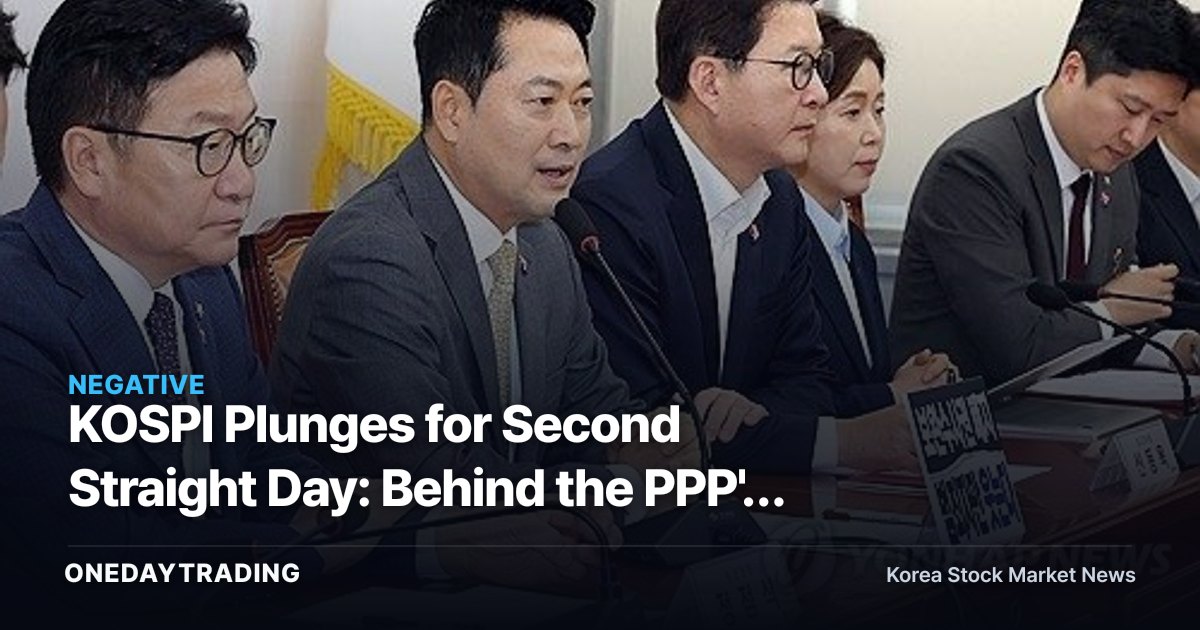
- The People Power Party (PPP) has demanded that the government launch a parliamentary inquiry and appoint a special counsel over the KOSPI's sharp drop for two straight days.
- The phrase "gambling den" is nothing more than a political frame — it does nothing to explain the macro variables, foreign investor supply-demand (order flow) and the exchange rate path, that actually drove the decline.
- What investors need to check is not the outcome of the political blame game, but the tone of the next Monetary Policy Board statement, the exchange rate level, and whether foreign net selling continues.
What Changes
Politics has never identified the true cause of a market move — data does that. At this point, with the KOSPI down for a second straight day, what the opposition has offered is not a diagnosis of what drove the decline but a pointing of fingers over responsibility. The parliamentary inquiry and special counsel cards both require a National Assembly vote and legal procedures, and even if they are triggered, reaching a conclusion typically takes months. In the meantime, the market opens every day and prices are set anew every day.
The decline itself is already being priced in, regardless of any political interpretation. What matters is whether this correction is a one-off pullback or the early stage of a trend reversal. The question splits into two paths: has valuation become cheap enough for foreign investors to take profits and then buy back in, or has confidence in won-denominated assets itself been shaken, putting the market in a phase of structural, further outflows? The political rhetoric about a "gambling den" offers no answer to which of the two it is.
Numbers in Context
The phrase "sharp drop for two straight days" is already the talk of the market, but the exact decline rate and the absolute size of the drop are not specified in this report. The first thing to check is whether this decline is unique to the KOSPI, or whether overseas indices such as the Nasdaq or the Hang Seng also underwent a parallel correction over the same period. If the correction was shared across markets, the case for political blame weakens; if the KOSPI alone sold off, more weight falls on domestic factors such as the resumption of short selling or concerns over a retreat in value-up policy. It's also worth checking which direction the KRW/USD exchange rate moved over the same stretch. If the exchange rate jumped along with the sell-off, that signals foreign investors were exiting in tandem; if the exchange rate stayed calm, domestic supply-demand (order flow) factors likely played the bigger role.
Stocks to Watch: Winners and Losers
- Samsung Electronics (005930) and SK hynix: With large weightings in KOSPI market capitalization, both stocks (tickers) take a direct hit from foreign net selling, but they are also typically the first to lead a rebound once supply-demand (order flow) turns.
- Large brokerage stocks such as Mirae Asset Securities and Samsung Securities: A plunge accompanied by a surge in trading value can boost brokerage commission income, but these stocks also carry a dual risk, as forced-liquidation selling triggered by margin-call shortfalls on credit loans can deepen the sell-off further.
- Bank stocks such as KB Financial Group and Shinhan Financial Group: If policy uncertainty drags on through a prolonged parliamentary-inquiry-and-special-counsel phase, it adds one more valuation discount factor.
- Export-oriented stocks such as Hyundai Motor and Kia: If the won weakens during this phase, these stocks (tickers) gain relative defensiveness through FX translation gains.
Risk Check
- A parliamentary inquiry and special counsel both require procedural steps such as a National Assembly vote, so whether and when they will actually materialize remains uncertain.
- If the decline is driven by an overseas risk-off move rather than domestic policy variables, a political response alone will struggle to reverse the supply-demand (order flow) trend.
- The longer the political feud drags on, the more a policy-uncertainty premium could be layered onto KOSPI valuations.
- If follow-up measures such as resuming short selling or tightening regulations are introduced, they could end up amplifying short-term volatility rather than calming it, contrary to their intent.
Bottom Line
The political blame game will not reveal what actually caused the two-day sharp drop. A more practical approach is to first check the tone of the next Monetary Policy Board statement, whether the KRW/USD exchange rate settles in the 1,300-won range, and whether foreign net selling extends into a third day.
This article is automatically summarized and analyzed based on the original news report. View original (Yonhap News Agency, Markets)