
Key Takeaways
The real number to watch isn't the headline claim that a home pension pays 5 million won a month — it's the guarantee structure that makes such payouts possible. Because the state absorbs the loss if home prices fall or beneficiaries live longer than expected, only three countries in the world operate this type of lifetime home-equity pension (reverse mortgage). That scarcity itself is a useful gauge of the program's sustainability and the potential burden on the financial institutions involved.
What Happened
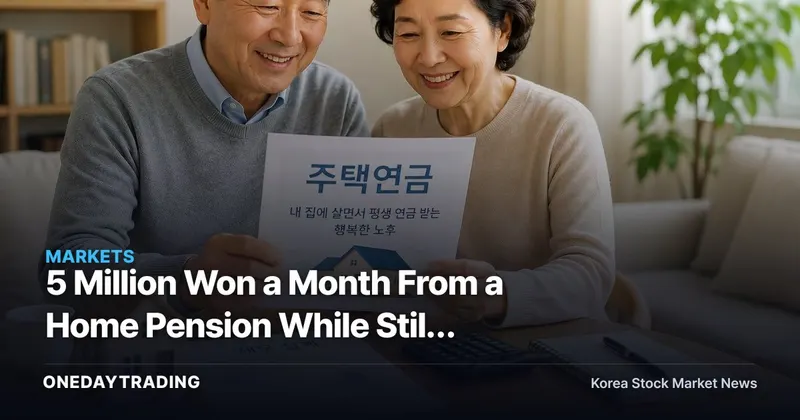
Maeil Business Newspaper's series "How to Get a 5-Million-Won Monthly Pension," episode 7, profiled a couple surnamed Kim in their 70s who own a single apartment worth over 1 billion won in Seoul. With that one home — built up over a lifetime of work — being nearly their only asset in retirement, the article explores how they found a way to receive a monthly annuity without selling it, through the home pension (reverse mortgage) program.
The key point is that homeowners can keep living in their house without selling it and still receive a lifetime pension backed by a state guarantee. In a typical reverse mortgage, financial institutions bear growing risk if home prices decline or beneficiaries live longer than projected, which is why most countries offer only stingy terms or run the product cautiously. The article's core point is that only three countries in the world have the state directly guarantee this risk, running the program on a lifetime, non-recourse basis (meaning there's no repayment obligation even if the home's value falls below the cumulative pension paid out).
Background and Context
Since Korea Housing Finance Corporation (HF) introduced the home pension in 2007, enrollment wasn't especially attractive during the low-rate era, but it has grown steadily as interest rates have risen and the asset structure of elderly single- and couple-households has become increasingly concentrated in real estate. The state guarantee on payouts is a safety net for enrollees, but conversely, it also means that if home prices stagnate or decline over the long term, the government (HF) is ultimately the one left covering the shortfall.
Market and Stock Impact
- Banks and financial holding companies: They handle home pension consultations, partial lump-sum withdrawals, and related loan services, affecting fee income and net interest margins; a growing enrollee base also broadens their deposit base
- Insurance industry: Similar annuity insurance products that compete with the home pension — where the state absorbs longevity and low-rate risk — may become relatively less attractive
- Senior housing and real estate resale markets: As more elderly households choose to annuitize their home while continuing to live there rather than selling, the resulting decline in sell-offs from older households affects the supply of listings
- Institutional investors in Korea Housing Finance Corporation bonds (such as MBS): As the guaranteed balance grows, fiscal soundness and credit-rating concerns come into sharper focus
Investor Checkpoints
- Whether Korea Housing Finance Corporation's annual criteria for calculating home pension monthly payouts (applied interest rate, life-expectancy tables) change
- Government announcement schedules related to program changes, such as the cap on eligible home value or the minimum enrollment age
- The trajectory of the benchmark interest rate — the structure is such that the higher the rate, the lower the monthly payout for the same home value
- Korea Housing Finance Corporation's disclosures on outstanding guarantee balances and annual fiscal requirements (budget proposals, National Assembly audit data)
Outlook
The optimistic scenario is that, amid accelerating population aging and real-estate-heavy household assets, enrollee numbers are likely to keep growing structurally, with the rarity of a state guarantee actually reinforcing confidence in the program. On the other hand, factors to watch include the structural disadvantage that new enrollees' monthly payouts are set lower in the current relatively high-rate environment, and the risk that the guarantor's fiscal burden could grow if home prices stagnate over the long run.
This article was automatically summarized and analyzed based on the original news report. View Original (Maeil Business Newspaper Economy)