
Three-Line Briefing
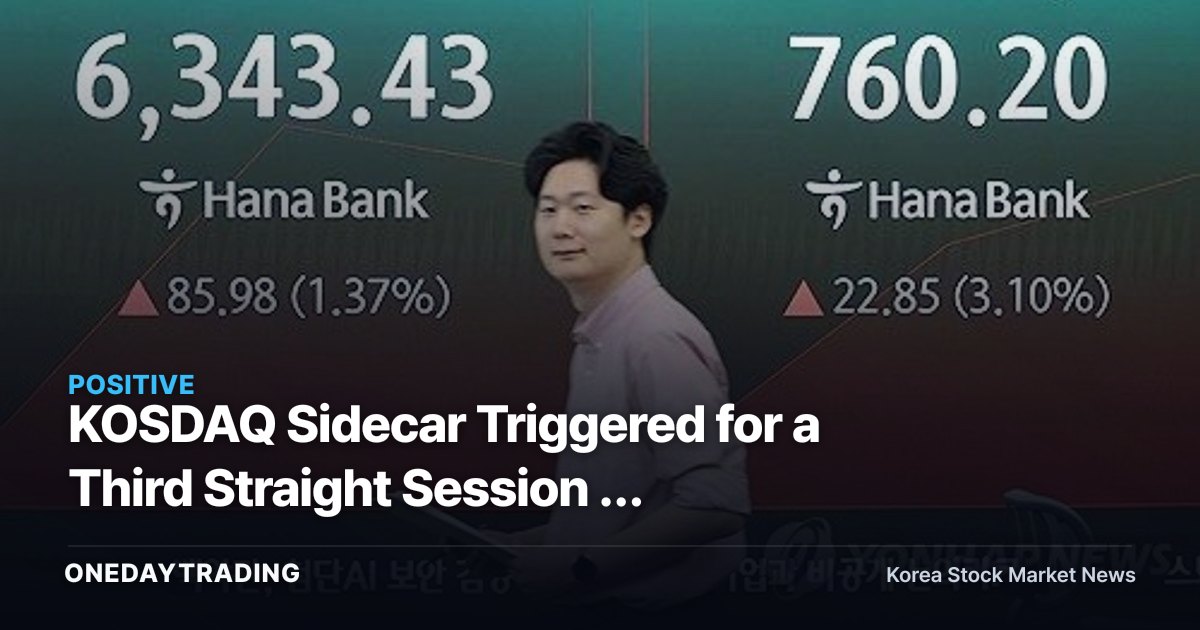
- On August 4, the KOSDAQ index surged more than 5%, triggering a program buy-order sidecar (temporary suspension) — an unusual streak marking three consecutive trading days of activation.
- The sidecar is an indicator of how strongly program trading is pushing the index. Three straight days of activation suggests the buying may reflect a structural inflow of funds rather than a one-off rebound.
- Still, the sharper the surge, the greater the valuation burden and pullback risk. The key question is whether this buying reflects genuine demand or a mechanical reaction such as arbitrage trading or short covering.
What's Changing
A sidecar is a system that suspends the effect of program trading orders for five minutes when the KOSPI 200 futures price moves beyond a certain threshold from the base price and that swing persists for more than a minute. This safeguard, which typically triggers only a handful of times a year, has now sounded for three straight days. That points to a force pushing the index as a whole, rather than news tied to individual stocks (tickers).
Separating what the market has already priced in from what it hasn't, the sidecar itself doesn't answer how much further prices will rise — it raises the question of who is buying, and why. If program buying has pushed the index higher for three consecutive days, it likely reflects institutional investors' and foreign investors' futures-linked cash trading, or short covering, rather than retail investor order flow (supply-demand). KOSDAQ has a higher share of retail investor participation than KOSPI and greater volatility, so once program money sets a direction, trends tend to become excessively lopsided over a short span.
The point of divergence now is whether this money represents an entry for valuation re-rating or short-term, rotational trading. If it's the former, any correction should be shallow and quickly absorbed; if it's the latter, the moment the sidecar stops triggering, the resulting supply-demand (order flow) vacuum could translate directly into a decline.
Numbers in Context
A sidecar is a procedural measure that merely suspends the effect of program orders for five minutes — it is not a circuit breaker that halts trading altogether. Even so, the fact that it has triggered for three straight days is itself newsworthy, because the frequency far exceeds the normal range. Typically, a KOSDAQ sidecar appears concentrated around specific events that shake the index sharply — a policy announcement, a sudden swing in global equity markets, or a heavy tilt toward a major theme stock. The persistence of three consecutive days lends more weight to a structural shift in fund flow than to a single isolated event.
Stocks to Watch: Beneficiaries and Losers
- Large-cap KOSDAQ growth stocks (secondary battery, biotech, AI-related growth names): given their heavy weighting in determining index direction, they are the first to reflect the direct benefit of program buying.
- Indices and ETF products centered on blue-chip KOSDAQ stocks: when index-tracking funds flow in, they receive upward pressure across the board without regard to individual stock (ticker) selection.
- Small- and mid-cap theme stocks with high margin-loan and unsecured-credit exposure: this is the segment where volatility expands most sharply if short-term profit-taking floods in during a sharp gain (surge) phase.
- Brokerage divisions of securities firms tied to KOSDAQ: a surge in trading value translates directly into higher brokerage commission income.
Risk Check
- Valuation burden after the sharp gain — given the large cumulative rise over three trading days, short-term overheating signals could intensify pullback pressure.
- Uncertainty over the persistence of program buying — if the buying is arbitrage- or short-covering-driven, a supply-demand (order flow) vacuum could emerge once the buying force fades.
- Exposure to macro variables — depending on the direction of the KRW/USD exchange rate and U.S. equities and interest rates, foreign investor order flow could reverse within a single day.
- Rising share of retail investor margin trading — if leveraged buying increases during the rally, forced-liquidation selling could amplify the decline during any correction phase.
Bottom Line
Three straight days of sidecar activation signal that the money flowing into KOSDAQ is unusual in both direction and scale, but whether it represents genuine demand or a mechanical reaction has yet to be proven by price action itself. The next Monetary Policy Board meeting, the KRW/USD exchange rate level, and the trend in foreign and institutional investors' program trading will be the next checkpoints determining whether this rally has staying power.
This article was automatically summarized and analyzed based on the original news report. View original (Yonhap Infomax)