
At a Glance
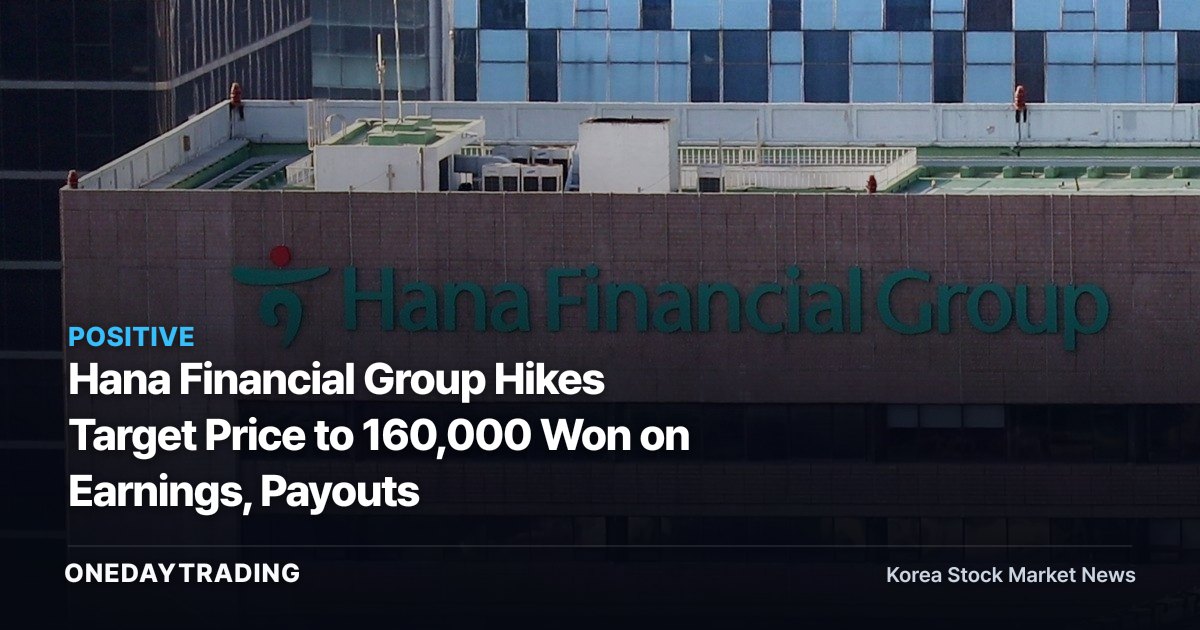
Hana Financial Group's target price rising from 150,000 won to 160,000 won isn't just a number tweak — it signals that bank stocks are once again being valued on earnings and shareholder returns. Shinhan Investment & Securities kept its Buy rating on the 2nd, judging that improving net interest margin and expectations for a larger payout could work together.
The key point is that the stock is moving past the phase where it simply tracks rate direction. The market has already priced in some probability of rate cuts, but if the scale of earnings improvement is confirmed and buybacks and dividends continue, bank stock multiples could expand further.
Why It Matters Now
Bank stocks don't simply weaken whenever rates fall. Differences in the adjustment speed between lending and funding rates, the lag in asset repricing, and the size of capital buffers all play a role together. For a stock (ticker) like Hana Financial Group, where earnings power holds up, dividend and buyback expectations work to narrow the P/B discount while net interest margin stays resilient.
This upgrade matters because it considered earnings and shareholder returns together. The market prices in rate cuts themselves fairly quickly, but the impact of expanded shareholder returns deepens only once actual disclosures come out. So if earnings rise and payout size grows, bank stocks could be reclassified from simple cyclical plays into stable-cash-flow, high-dividend assets.
Conversely, if rates fall faster than expected, the pace of NIM improvement slows. In that case, the scale of earnings estimate upgrades shrinks, and target price hikes may amount to little more than numerical adjustments rather than genuine multiple expansion.
Key Points
- Shinhan Investment & Securities kept its Buy rating on Hana Financial Group and raised the target price from 150,000 won to 160,000 won. The 6.7% hike reflects both earnings and shareholder-return expectations.
- The key variable is net interest margin improvement. When NIM improves, interest income is protected and the discount rate applied to bank stocks falls.
- Shareholder returns are the second pillar of valuation. Even if dividends alone aren't enough, adding share buybacks and cancellations can quickly change per-share value.
- However, expanding shareholder returns is constrained by capital ratios and regulatory headroom. Even with strong earnings, if capital buffers shrink, the pace of returns could slow more than expected.
Related Stocks and Sector Impact
- Hana Financial Group: The direct beneficiary of this report. With both earnings upgrades and shareholder-return expectations attached at the same time, it sits at the center of the stock's re-rating.
- KB Financial Group: Among large financial holding companies, it is likely to move on the same logic. If earnings stability and shareholder-return policy are highlighted together, multiples across bank stocks as a whole tend to move in tandem.
- Shinhan Financial Group: The first stock (ticker) investors compare when rate expectations and return expectations overlap. Hana Financial Group's target price hike also serves as a benchmark for other large bank stocks.
- Woori Financial Group: A stock (ticker) that could follow suit once the pace of expanding returns is confirmed. However, its capital ratio and earnings strength need to be checked first.
Investment Considerations
- Watch whether NIM actually improves in next quarter's earnings. If the numbers turn down first, return expectations will cool quickly too.
- Check CET1 and capital headroom. For share buybacks to continue, the capital ratio needs to stay stable.
- Watch the direction of market rates after the Bank of Korea's Monetary Policy Board meeting. If rates fall faster, bank margin improvement could slow.
- Check whether dividend and buyback disclosure schedules actually follow through. Shareholder returns are reflected in the stock price through execution, not expectation.
Overall Outlook
The favorable picture for Hana Financial Group is clear. As earnings rise and the scale of shareholder returns grows, the essence of bank stocks moves closer to cash-generating assets than cyclical plays. At that point, the market recalculates not just the dividend yield but also P/B normalization.
However, this scenario is conditional. If rates fall faster than expected, credit costs rise, or capital headroom shrinks, return expectations weaken immediately. Ultimately, the core question in this report isn't whether Hana Financial Group is a good bank, but whether NIM and shareholder returns both hold up next quarter too.
Frequently Asked Questions
What is the key driver behind Hana Financial Group's target price hike to 160,000 won?
The key is that earnings and shareholder returns were considered together. Shinhan Investment & Securities raised the target price from 150,000 won to 160,000 won, reflecting the potential for net interest margin improvement and expectations for expanded shareholder returns.
For bank stocks, these two factors drive valuation. When earnings hold up and shareholder returns are added, the market-accepted price range changes even for the same level of earnings.
Why can bank stocks stay strong even during a rate-cutting cycle?
Rate cuts don't immediately translate into weaker bank stocks. Because there's a lag in how funding rates and lending rates respond, a window opens where margins hold up, and shareholder-return expectations can support the stock price during that time.
However, if rates fall quickly, NIM improvement slows. That, in turn, weakens the stock's defensive strength.
What should investors watch for next?
Investors should check NIM, credit costs, and the capital ratio at next quarter's earnings release. If share buyback or dividend-related disclosures follow, the market is likely to interpret the target price hike as a trend rather than a one-off earnings event.
Bank stocks react to numbers, not words. So the checklist is always the same: earnings, capital, and shareholder returns.
Hana Financial Group Key MetricsAs of 2026-09-02
| Period Returns | 1 Week +4.74% 1 Month +9.25% |
|---|---|
| Trading Value · Trading Volume | 7.8 billion won · 57,101 shares |
| Supply-Demand (Order Flow) | Foreign Investors −19.2 billion won net selling (8 straight days) Institutional Investors +25.7 billion won net buying |
| Recent News Tone | Positive catalyst 1 · Negative catalyst 1 |
Price and order-flow data are real-time figures from Korea Investment & Securities (KIS); order-flow and news-tone aggregates are OneDayTrading's own calculations.
Order-Flow and Momentum Signal🟡 Neutral · Wait-and-See
Positive and negative signals are mixed, making this a watch-and-wait phase.
- ▼Order-Flow ContinuityForeign investors net-sold for 8 straight days (−19.2 billion won)
- ▲52-Week Range Position91% of 52-week range — near 52-week-high territory
Upcoming Events to Watch
- 09.10Futures/Options Quadruple WitchingMediumQuadruple witching — watch for volatility and order-flow disruption
- 09.16FOMC Policy Rate DecisionHighU.S. Federal Reserve monetary policy announcement — rate and dollar direction
- 10.08Index Options ExpirationLowKOSPI 200 options expiration
- 10.22Bank of Korea Monetary Policy BoardHighBenchmark interest rate decision meeting
This article is automatically summarized and analyzed content based on the original news report. View Original (Maeil Business Newspaper)