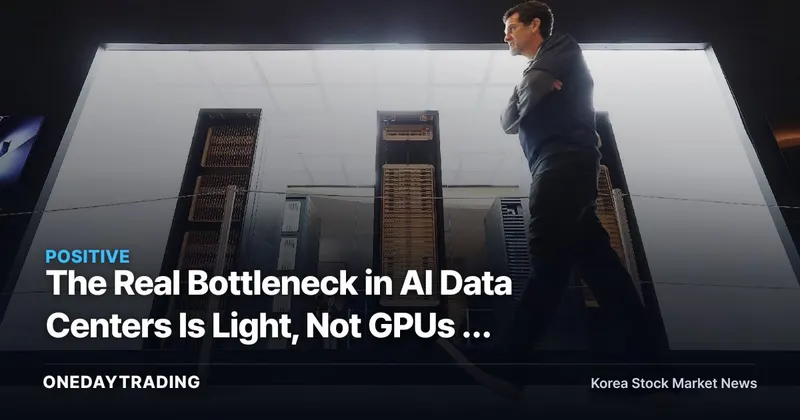

The narrative driving AI investment is shifting in subtle but meaningful ways. Markets have long priced in raw GPU unit counts, but as data center scale has grown to tens of thousands of accelerators, the real constraint is no longer compute capacity — it is data movement between chips, between racks. Electrical signaling suffers sharply rising power loss, heat, and latency as distances increase. As the transition to optical interconnects to solve this bottleneck accelerates in earnest, the beneficiaries will extend well beyond a single GPU sector bellwether to encompass an adjacent component ecosystem spanning optical transceivers, silicon photonics, and co-packaged optics (CPO). For Korean investors, this signals a moment to broaden their view from a single GPU sector bellwether to the entire optical infrastructure value chain.
3-Point Briefing
- The new bottleneck in AI data centers is not compute but inter-chip data transmission — the shift from electrical to optical signaling has emerged as the defining variable.
- Demand for optical transceivers and CPO scales in lockstep with GPU capacity additions, structurally expanding front-end demand for optical component makers.
- However, technology standard competition, average selling price pressure, and elevated valuations are simultaneous risks investors must carry.
What Is Changing
Traditional data centers handled only short intra-server links optically and relied on copper wiring for everything else. Large-scale AI training, however, requires thousands of accelerators to function as a single unified system, causing communication traffic between accelerators to surge dramatically. Copper-based transmission degrades in power efficiency sharply beyond certain distance and speed thresholds, pushing the adoption of optical connectivity closer and closer to the chip package itself — no longer just external to the server.
The culmination of this trend is CPO, which integrates compute chips and optical engines within a single package. This architecture reduces signal path length to simultaneously address power consumption and latency, concentrating value-added opportunities among the handful of vendors that command laser sources, optical waveguide, and advanced packaging technologies. Optical connectivity is being elevated from an optional add-on to an essential design element that determines overall system performance.
By the Numbers
The key insight is that GPU capacity additions and optical component demand are linked by a roughly fixed multiplier. Each additional accelerator requires a corresponding set of optical transceiver channels and interconnects to bind it into the network, meaning that as AI accelerator shipments steepen, optical component volumes grow at a leveraged rate — potentially more than proportionally. The rapid migration of transmission speed specifications from 800G to 1.6T-class standards further lifts average selling prices and compresses replacement cycles.
Stocks (Tickers) to Watch — Beneficiaries and Risks
- Broadcom: Holds data-center switch chips alongside silicon photonics and CPO capabilities, positioning it to set the design standard for the optical transition and absorb expanding front-end demand most directly.
- Marvell: Custom silicon paired with an optical DSP and interconnect lineup broadens its order pipeline as hyperscalers expand their proprietary chip programs.
- Coherent: As a supplier of optical transceivers, laser sources, and optical components, it stands to benefit from both higher unit volumes and improved average selling prices as adoption of 800G-and-above high-speed optical modules accelerates.
- NVIDIA: Rather than the GPU itself, NVIDIA serves as the origination point for optical component demand by reinforcing the interconnect ecosystem that binds its accelerators — driving adoption of optical connectivity across the stack.
- OE Solutions · Lighthouse (Raytron): Domestic Korean optical transceiver and component makers that could capture trickle-down demand from the global capacity expansion cycle by increasing their share of high-speed data-center modules — though verification of customer exposure and front-end revenue mix is a prerequisite.
Risk Check
- Next-generation technologies such as CPO remain in active standards competition; which architecture wins could materially reshuffle which stocks (tickers) benefit.
- Optical module pricing faces persistent downward pressure even as volumes scale, meaning revenue growth does not automatically translate to margin improvement.
- A deceleration in the AI investment cycle or a pullback in hyperscaler capital expenditures could expose optical component demand to greater volatility than GPU demand itself.
- Many optical-theme stocks (tickers) already trade at elevated valuations, leaving them vulnerable to sharper corrections if earnings fail to meet expectations.
Bottom Line
The shift in AI infrastructure's bottleneck from compute to data movement opens a structural opportunity across the optical communications value chain — but given technology standard competition, average selling price headwinds, and capital expenditure volatility, a disciplined approach that tracks front-end customer exposure alongside quarterly earnings and order announcement disclosures is the rational way to gauge actual benefit intensity before committing.
This content was automatically summarized and analyzed based on the original news article. View original article (Maeil Business Newspaper)