
At a Glance
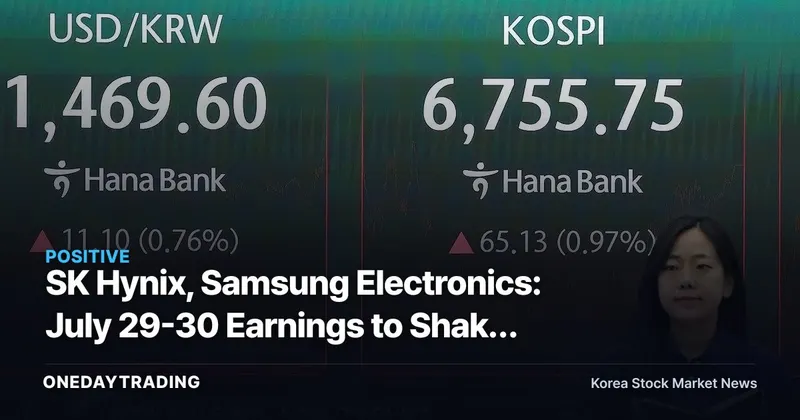
KOSPI closed at 6755.75. The index rose 0.97% on the 27th, but after spiking to 6806.27 early in the session, it reversed direction repeatedly. What this really signals isn't an uptrend — it's a market waiting for confirmation.
This week's key checkpoints are clear: SK Hynix's earnings on the 29th, Samsung Electronics' on the 30th, and the Q2 report cards from Microsoft, Meta, Amazon and Apple in the same window. Semiconductor stocks are set to be re-tested not by the AI narrative, but by their customers' actual capex figures.
Why It Matters Now
HBM's strength can't be captured by simply saying "it sells well." It's a long process running from materials and equipment through DRAM wafer input, TSV stacking, packaging, and final customer qualification. What the market wants to see in SK Hynix's and Samsung Electronics' upcoming earnings isn't just a revenue figure, but second-half utilization rates, yields, and the strength of long-term supply agreements (LTAs).
The reason KOSPI leans so heavily on these two semiconductor giants is that downstream demand has become narrower but deeper. Rather than smartphone and PC replacement demand, profits are now being driven by AI server memory, HBM, and enterprise SSDs. As long as hyperscalers keep up their data center investment pace, both memory pricing and product mix improvement work in the industry's favor. Conversely, if capex growth slows, order visibility deteriorates quickly.
The U.S. earnings calendar is another piece of the same puzzle. Microsoft and Meta report on the 29th, and Amazon and Apple on the 30th, revealing cloud growth rates and AI infrastructure spending. Even if Korean chipmakers post strong earnings, a weak ordering tone from customers will compress valuation multiples. Earnings are a report card for the quarter that's already passed; capex is the shipment order for the next two to three quarters.
Frequently Asked Questions
- Why is SK Hynix's earnings date more market-sensitive than Samsung Electronics'? SK Hynix reports first, on the 29th. Because its commentary on HBM's revenue share and customer demand comes out first, it can set the tone for semiconductor investor sentiment ahead of Samsung Electronics' report on the 30th.
- What should investors watch for in Samsung Electronics' earnings? Focusing only on the memory recovery tells half the story. Investors also need to confirm the pace of HBM market entry, commodity DRAM pricing, and whether foundry losses are narrowing.
- Why do U.S. Big Tech earnings move Korean stock prices? The ultimate buyers of AI server investment are hyperscalers like Microsoft, Meta and Amazon. Only if their capex plans hold up can Korean memory makers' LTAs and pricing power stay intact.
- How is the FOMC meeting related to semiconductors? The July FOMC meeting, concluding early on the 30th, affects the discount rate. If rate-cut expectations weaken, growth stock multiples compress, and the stock reaction to the same earnings results could be shorter-lived.
Related Stocks & Sector Impact
- SK Hynix. HBM and server DRAM demand sit at the center of its earnings and guidance. More important than beating consensus profit estimates is how specific the company is about second-half supply volumes and LTA details.
- Samsung Electronics. Its report on the 30th will be judged on both the memory market recovery and the pace of HBM competitiveness recovery. A rise in commodity memory prices alone may not be enough to restore its valuation premium.
- Hanmi Semiconductor. Continued HBM capacity expansion translates into demand for back-end packaging equipment. The key question is whether actual customer orders and equipment delivery timing keep pace with stock price expectations.
- Semiconductor materials and parts stocks. Higher memory utilization rates increase materials consumption. The benefit may show up later than for equipment makers, but volume growth tends to be confirmed before price gains.
- KOSPI. The 65.13-point gain on the 27th doesn't confirm a directional trend. The index needs semiconductor earnings and Big Tech capex to align before the odds of holding above the 6755 level improve.
Investment Considerations
- Strong earnings and a strong stock reaction are not the same thing. If share prices already reflect the HBM boom, guidance needs to be more specific than expected to justify an additional valuation multiple.
- Easing concerns over an AI spending slowdown are a positive, but if Big Tech companies signal any pullback in capex pacing this week, the semiconductor supply chain's re-rating could stall quickly.
- Long-term supply agreements need to be assessed on price, volume, and duration together. If volume grows while unit prices fall, top-line size increases but margin improvement stays limited.
- Watch the dollar and rate reaction following the FOMC meeting as well. If won weakness intensifies, foreign investor flows may respond to the exchange rate before they respond to semiconductor earnings.
Overall Outlook
The optimistic scenario is straightforward. SK Hynix confirms robust HBM and server memory demand on the 29th, and Samsung Electronics convinces the market of its memory recovery and HBM entry pace on the 30th. If Microsoft, Meta, Amazon and Apple also maintain their AI capex expansion stance, KOSPI's market leadership could narrow back down to semiconductors.
The risk comes from the same source. If customers' investment tone weakens even a notch, or if Korean chipmakers' explanations of second-half profitability stay vague, the market will price in peak-out risk ahead of the actual results. The next checkpoints are the guidance language in the July 29-30 earnings reports, Big Tech's capex commentary, and the rate and won-dollar exchange rate reaction following the FOMC decision early on the 30th. The semiconductor rally can be extended by the numbers — and shaken by a single sentence.
SK Hynix: Real-Time Data Snapshot
SK Hynix's most recent closing price was 1,816,000 won (+3.24% versus the previous day), and the composite signal combining foreign/institutional supply-demand (order flow) with news and momentum reads 🟡 neutral / wait-and-see. With positive and negative signals mixed, this is a period to watch closely.
- ▲ News Flow — 8 positive catalysts vs. 3 negative catalysts — positive catalysts lead
Recent related news skews favorable, with 8 positive catalysts versus 3 negative catalysts.
※ Price and foreign/institutional supply-demand (order flow) data are provided by Korea Investment & Securities (KIS) and reflect figures as of publication time.
This article is automatically summarized and analyzed based on the original news report. View Original (Maeil Business Newspaper, Securities)