
Summary
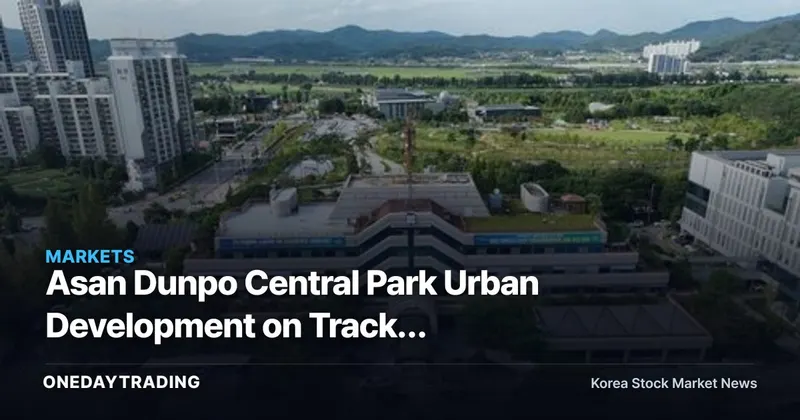
The Asan Dunpo Central Park urban development project, being driven by the City of Asan in South Chungcheong Province across the Dunpo-ri area of Dunpo-myeon, has moved into the district designation and development planning stage, putting the project on a tangible track. Because every administrative milestone an urban development project clears brings the timeline for land compensation, groundbreaking, and unit sales into sharper focus, investors can read this as a signal for gauging shifts in regional construction volume and underlying property demand.
The Full Story
This stage is significant in that it advances both the district designation, which fixes the boundaries of the project site, and the development plan, which sets out what will be built and how. An urban development project typically progresses from district designation to implementation plan approval, land compensation, site preparation, and then the supply and sale of residential housing land. Clearing this procedure is therefore not the finish line but rather a starting point, just ahead of the full-scale deployment of capital and construction volume.
That said, the information disclosed at this point is limited to the progress of administrative procedures. Key figures such as total project cost, the number of housing units to be supplied, and the groundbreaking date are variables that will be firmed up during the subsequent approval process. Investors should approach this with a clear recognition that the numbers usable for direct investment decisions are still thin.
Structural Background
Although Dunpo-myeon falls within Asan administratively, it sits on the border directly adjoining Pyeongtaek in Gyeonggi Province. The Pyeongtaek area is a region where employment and housing demand have steadily grown as large-scale semiconductor production lines have taken root, and the northern parts of Cheonan and Asan have absorbed spillover demand as its residential hinterland. The Dunpo Central Park development sits atop this broader demand flow, leaving room to expect support from underlying settlement demand rather than being merely a provincial housing-land development.
Stock (Ticker) and Industry Sector Impact
- General contractors and builders: Once site preparation and residential construction volume materialize, this translates into new orders for the construction firms taking part in the project. However, with the lead contractor not yet disclosed, there is a limitation in that it is difficult to pinpoint the directly benefiting listed companies.
- Building materials and cement: Housing-land preparation and home construction come with downstream materials demand for ready-mixed concrete, cement, rebar, and the like. The volume contribution of a single regional project is limited, but as housing-supply volume across the Chungcheong region accumulates, a gradual impact on materials utilization rates is possible.
- Regional property and housing-sales market: The supply of new residential housing land is directly linked to the unit-sales schedule and unsold-inventory indicators in Cheonan and Asan.
- Civil engineering, landscaping, and infrastructure: Given the park-style nature of the urban development, infrastructure orders for landscaping, roads, water and sewage systems, and the like will follow.
Bull vs. Bear Scenarios
On the bullish side, the locational premium of being the hinterland of the Pyeongtaek semiconductor belt underpins settlement demand, and if subsequent approvals proceed smoothly, the fund flow leading from land compensation to groundbreaking could add warmth to the regional construction economy. Conversely, there are no shortage of bearish variables. Urban development projects frequently see their timelines stretch out due to delays in land compensation negotiations, accumulating unsold inventory, and worsening project viability from rising interest rates and construction costs. In particular, the unsold-inventory burden in parts of the Chungcheong region and the elevated construction-cost structure are factors that simultaneously pressure unit-sale prices and project profitability.
Investor Action Points
- Check the timing of subsequent implementation plan approval and the start of land compensation to assess whether the project is actually entering the construction phase.
- Track relevant disclosures, since the directly benefiting listed construction firms can only be pinpointed once the selection of the lead contractor and the contracting agreement are disclosed.
- Review unsold-inventory statistics and unit-sales schedules for the Cheonan and Asan region on a quarterly basis to gauge the strength of regional housing demand.
- Monitor the potential for impaired project viability by tracking mortgage and PF interest rate levels alongside construction-cost index trends.
This article is content automatically summarized and analyzed based on the original news. View Original (Yonhap News)