
Summary
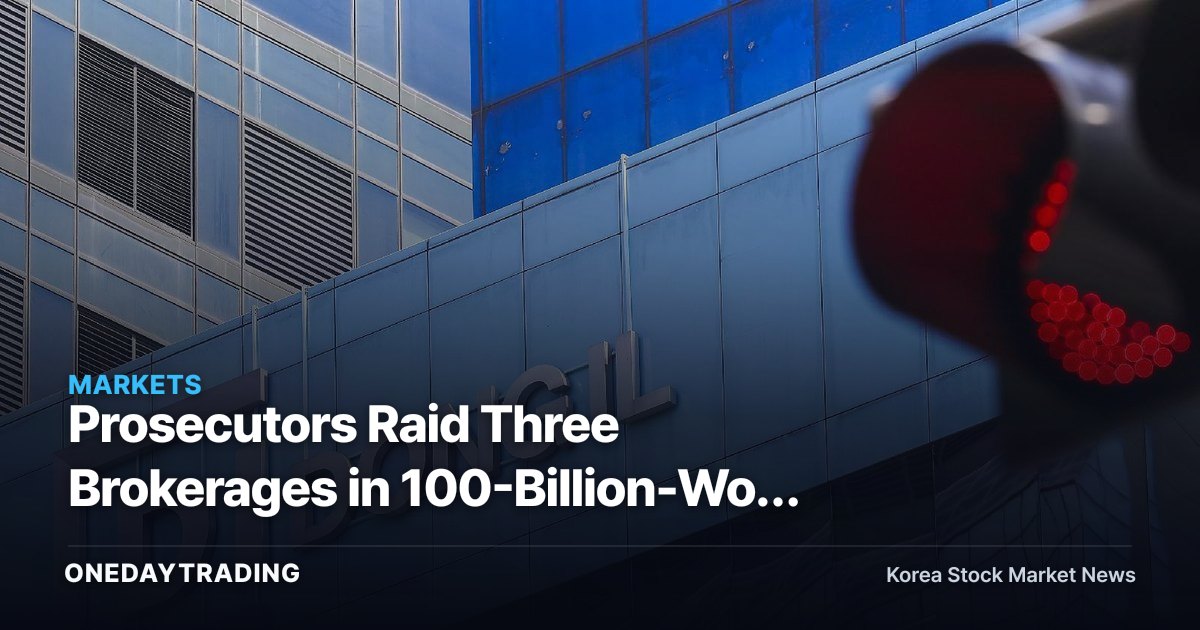
As prosecutors raided three brokerages in the course of investigating a stock manipulation case worth around 100 billion won, the possibility that this could become the first application of the strengthened disgorgement and penalty-surcharge framework under the Capital Markets Act has drawn market attention. Cracking down on price manipulation is a factor that boosts retail investor trust over the long term, but in the short term it carries a double-edged nature: the burden of reputational and internal-control costs falls on the securities industry that provides the trading channels.
Viewed from an investor's perspective, the key point of this issue is not the rise or fall of any single targeted manipulation stock, but rather a structural signal that the intensity of oversight over brokerages' business practices and overall risk management is moving up a notch.
The Full Story
The Financial and Securities Crime Joint Investigation Division of the Seoul Southern District Prosecutors' Office is investigating a stock manipulation case worth around 100 billion won on charges including violations of the Capital Markets Act, and as part of that effort has launched compulsory investigations into three brokerages. With circumstances pointing to the involvement of financial professionals and others, the investigation is focusing on the possibility that insiders with specialized knowledge and access to systems took part in the price-manipulation scheme.
The reason this case is drawing particular attention is the symbolic possibility that it could be the first application of the strengthened punishment and disgorgement system. In the past, there were many complaints that the criteria for calculating illicit gains were ambiguous, leaving actual penalties short of the scale of the wrongdoing. Since the system was overhauled, however, the framework has shifted toward imposing penalty surcharges of up to twice the illicit gains and broadening the scope of disgorgement. The 100-billion-won scale becomes a test case for gauging how forcefully these rules will be applied.
Structural Background
Stock manipulation typically unfolds on the stage of small- and mid-cap stocks with shallow liquidity, combining the spread of positive-catalyst information with matched and fictitious trades to drive up the share price before realizing profits. Because this process mobilizes numerous accounts as well as margin and unsettled trades, brokerages' order-acceptance and abnormal-trading surveillance systems serve as the first line of defense. The fact that prosecutors directly targeted the brokerages is read as a sign that, beyond merely confirming the trades passed through them, they intend to scrutinize gaps in branch- and corporate-account management and internal controls.
Impact on Stocks and Sectors
- The securities industry overall: As expanded investment in abnormal-trading surveillance and compliance infrastructure becomes unavoidable, brokerages with a larger retail weighting are more exposed to short-term cost and reputational risk. That said, a recovery in market trust could act as a long-term positive catalyst by expanding trading value.
- Retail brokerage: Brokerages with a high proportion of retail trading may face stronger oversight of their management of leveraged products such as margin loans and CFDs, leaving room for their related profit structures to be affected.
- Small- and mid-cap theme stocks and suspected manipulation stocks: Low-liquidity stocks (tickers) prone to frequent short-term surges and plunges may see abnormal volatility dampened by tighter surveillance, with the expected effect of reducing short-term speculative supply-demand (order flow).
- Exchange and market infrastructure: Upgrading the system for detecting price manipulation leads to improvements in market-integrity indicators, a positive variable for foreign investors' and institutional investors' confidence in the Korean stock market.
Bullish vs. Bearish Scenarios
The bullish scenario is one in which a forceful crackdown on price manipulation eases the market distrust that is one pillar of the "Korea discount," broadening the securities industry's earnings base through an inflow of long-term retail investment and more active trading. Conversely, the bearish scenario is one in which, should the investigation narrow to specific brokerages, reputational and penalty-surcharge concerns over those stocks weigh on their share prices, while tighter regulation of leveraged products pressures short-term fee and interest income. It must also be kept in mind that, with the investigation still in its early stages and the proof of charges and scope of application not yet settled, this is a zone of uncertainty in which it is difficult to firmly conclude in either direction.
Investor Action Points
- Watch whether the real names of specific brokerages under investigation are disclosed, and check those companies' disclosures and estimated penalty-surcharge amounts.
- Monitor how forcefully the strengthened Capital Markets Act's disgorgement and penalty surcharges are actually applied (assessing whether this is the first application).
- Check whether speculative supply-demand (order flow) is contracting by tracking margin-loan balances and the trading value of low-liquidity theme stocks.
- Watch how increased compliance and system costs and changes in retail revenue are reflected in brokerage stocks' next-quarter earnings.
This article is content automatically summarized and analyzed based on the original news report. View original (Maeil Business Newspaper, Securities)