
Summary
The investment implications of Korea's AI policy are clear. When the government frames AI not as a technology showcase but as a matter of budgets, rules, and infrastructure, valuations for semiconductors, data centers, and platforms are the first to realign. That is precisely the direction Deputy Prime Minister Bae Kyung-hoon pointed to in his remarks at the G20 Innovation Ministerial.
That said, the market has already priced in some AI expectations. What matters now is execution, not announcements. If the AI-for-All initiative, the cross-government AX (AI transformation) push, and the three megaprojects covering semiconductors, AI data centers, and physical AI translate into real demand and orders, the benefits will broaden. If execution lags, however, valuation multiples will wobble first.
What Happened
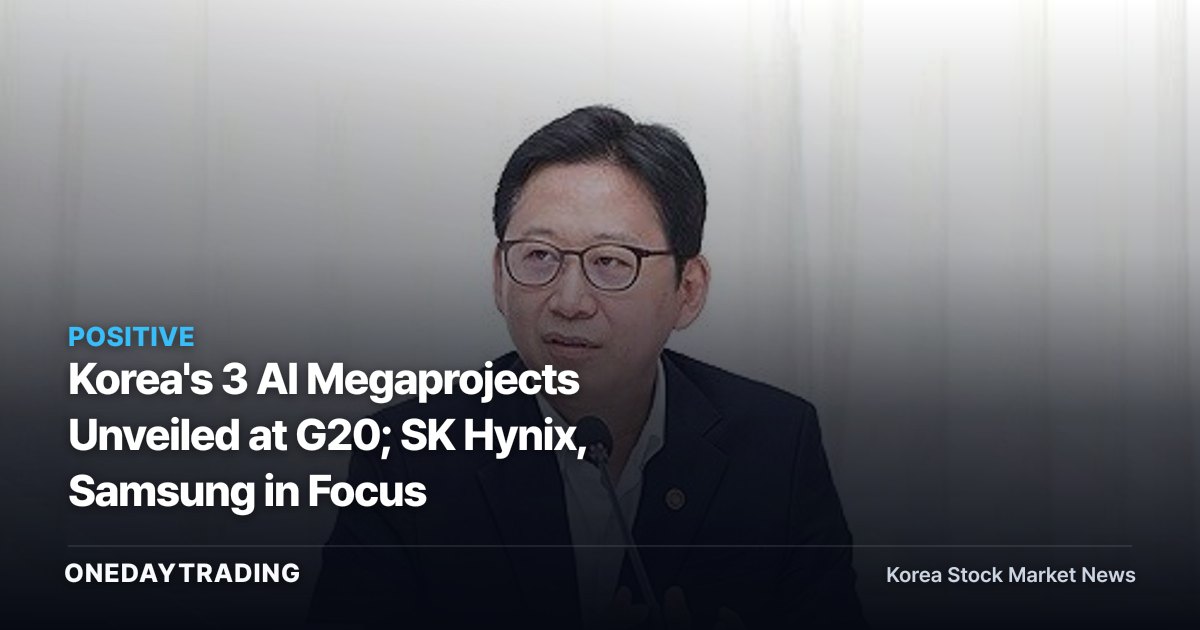
According to the Ministry of Science and ICT, Deputy Prime Minister and Minister Bae Kyung-hoon attended the G20 Innovation Ministerial in Chapel Hill, North Carolina, on Sept. 1 local time as South Korea's chief delegate. This year's U.S. presidency merged the research and innovation ministerial with the digital economy ministerial into a single meeting, formally reflecting AI's role as the central axis of growth and industrial innovation.
In the morning session, Deputy PM Bae presented plans to expand basic research investment, abolish preliminary feasibility studies for R&D projects, streamline research administration, and introduce the Seed Project and K-Moonshot Project. In the afternoon, he shared details of the AI-for-All project, the cross-government AX project, the three megaprojects, the AI Framework Act, and Korea's AI ethics principles. During the same trip, he also met with Michael Kratsios, Director of the White House Office of Science and Technology Policy, to discuss AI and ICT cooperation.
The real story here is not a diplomatic itinerary. It is that Korea has begun presenting AI as a single package of research funding, regulation, and industrial policy. Investors should read it that way: procurement, infrastructure, and the actual pace of commercialization move stock prices for longer than the technology narrative does.
Structural Backdrop
AI policy always triggers two waves of reaction: first expectations, then earnings. The market is already assigning a hefty premium to semiconductors, data centers, power, and networks. But once the government eases bottlenecks in institutions, permitting, and research administration, what remains is a gap in execution speed — and that gap is what separates valuation multiples.
AX, or AI transformation, is the process of converting manufacturing, public-sector, and service workflows to AI-driven operations. If this transformation continues, it won't just lift demand for hardware like GPUs and HBM; it will also improve revenue visibility for cloud, networking, system integration, and security providers. Conversely, if execution slows, it is the expectations baked into related stocks that get corrected before earnings do.
Stock and Sector Impact
- SK Hynix - The most direct beneficiary of AI server proliferation. As HBM demand rises, its memory mix improves, and if policy translates into infrastructure investment, the stock's valuation baseline moves higher.
- Samsung Electronics - Memory, foundry, and server-chip businesses are all in play simultaneously. The harder the Korean government pushes AI industrialization, the wider the ceiling for the domestic supply chain, strengthening the case for securing large customers.
- Naver - If AI-for-All translates into real user adoption, the impact will be felt first in platform, search, and cloud businesses. What matters is not the scale of the model itself but how deeply AI is embedded into the services.
- KT - AIDC and network infrastructure are the core drivers. As AI demand grows, the telecom operator can add recurring revenue from lines, data centers, and enterprise solutions.
- LG CNS - AX ultimately comes down to system integration and transformation projects. As AI adoption grows across the public sector and large enterprises, build-and-operate revenue becomes more important than consulting revenue.
Bull vs. Bear Scenarios
The bull case is straightforward. If government budgets and public procurement move quickly and private investment follows, earnings visibility improves for AI infrastructure, semiconductors, data centers, and platforms. In that scenario, stock prices track orders and utilization rates rather than policy headlines.
The bear case is equally clear. If announcements pile up but execution lags and global interest-rate pressure builds again, valuation multiples for AI capex names get compressed first. If the KRW/USD exchange rate rises above 1,400 won, the cost burden of importing equipment and servers grows, destabilizing the cost structure of domestic infrastructure projects as well.
Investor Action Points
- The next checkpoint is the government budget bill and individual ministries' project announcements. Policy turns into numbers in execution documents, not in conference rooms.
- For semiconductors, watch HBM and server-memory shipment guidance. If AI demand is real, delivery lead times and yield figures will move first.
- For platforms and telecoms, track enterprise AI contracts and the pace of data-center expansion. The speed of revenue conversion matters more than user counts.
- Watch the exchange rate and interest rates together. A sustained strong dollar increases the burden of imported equipment, while rising rates compress growth-stock multiples first.
FAQ
What does "AI for All" mean?
It is a policy vision to create an environment where every citizen uses AI. From an investment standpoint, the focus should be less on consumer apps and more on enterprise services, public-sector adoption, and the infrastructure demand that follows.
Why are semiconductors and data centers mentioned first?
AI looks like a software story, but the real money flows first into servers, memory, power, and networks. HBM, GPUs, and AIDCs move first, and platform and service revenue follows afterward.
What should investors watch for this to translate into earnings?
Budget execution, procurement orders, and the launch timing of public projects need to materialize. Conference remarks alone only lift multiples; earnings follow only once actual order wins and utilization rates catch up.
SK Hynix Key MetricsAs of Sep 2, 2026
| Period Return | 1W +1.32% 1M +28.06% |
|---|---|
| Trading Value · Volume | ₩4.6064 trillion · 2,727,724 shares |
| Supply-Demand (Order Flow) | Foreign investors +₩157.0 billion net buying Institutional investors −₩239.4 billion net selling |
| Recent News Tone | Positive catalyst 6 · Negative catalyst 7 |
Price and order-flow data are real-time figures from Korea Investment & Securities (KIS); order-flow and news-tone aggregation are OneDayTrading's own calculations.
Order-Flow & Momentum Signal🟡 Neutral · Wait-and-see
Positive and negative signals are mixed, making this a wait-and-watch zone.
- ▲Trend AlignmentShort- and mid-term uptrend alignment (day +1.1% · 1W +1.3% · 1M +28.1%)
Upcoming Events to Watch
- 09.10Futures & Options Quadruple ExpirationMediumQuadruple witching — watch for volatility and order-flow disruption
- 09.16FOMC Policy Rate DecisionHighU.S. Federal Reserve monetary policy announcement — sets rate and dollar direction
- 10.08Index Options ExpirationLowKOSPI200 options expiration
- 10.22Bank of Korea Monetary Policy BoardHighBenchmark interest rate decision meeting
This article is automatically summarized and analyzed based on the original news report. View original (Yonhap News, Industry)