
Key Summary
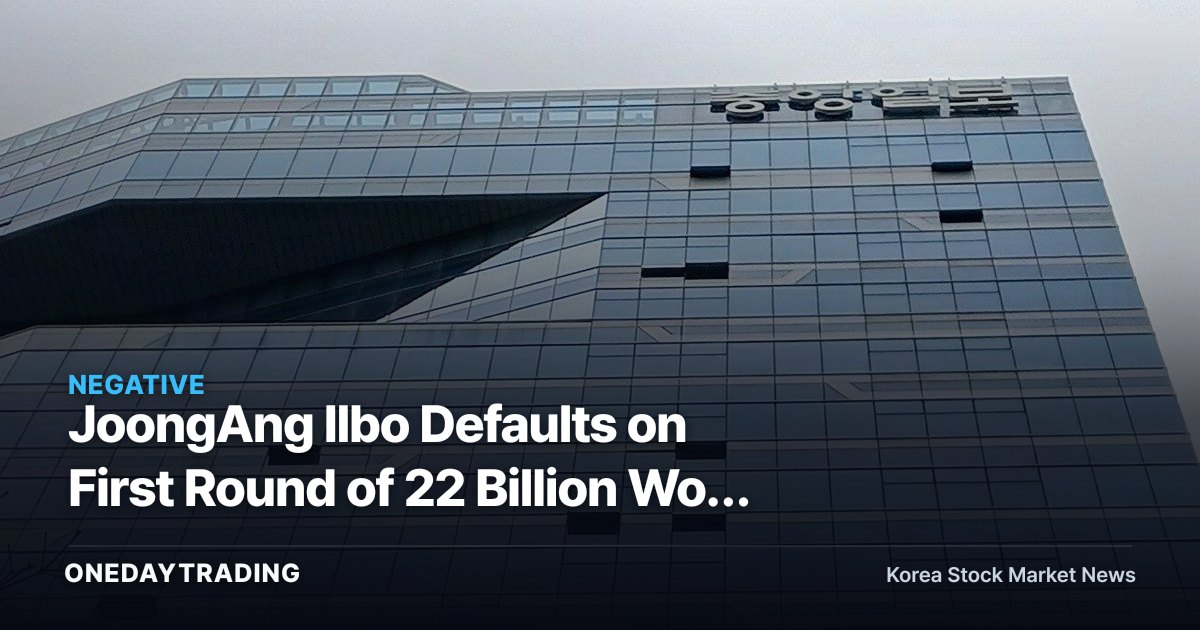
JoongAng Ilbo failed to meet an early redemption request on 22 billion won of commercial paper (CP) and was processed as a first-round default. Although this is an isolated incident at an unlisted media company, it should be read as a signal that credit differentiation in the short-term funding market may intensify once again.
From an investor's standpoint, the key issue is not one company's problem, but whether caution spreads to financially weak firms that rely on CP and electronic short-term bonds, and to the securities and capital industry sectors that hold them.
What Happened
JoongAng Ilbo disclosed that it received an early redemption request on 22 billion won of CP but failed to repay it due to insufficient cash on deposit, resulting in a first-round default. A first-round default is a state in which payment was not made on the agreed settlement date; if funds cannot be secured within an additional grace period, it leads to a final default.
CP is an unsecured short-term debt security issued by companies to raise short-term operating funds. Because it has short maturities and relies on refinancing (rollover), it has the characteristic that if holders demand early redemption and new issuance is blocked, a temporary cash shortage can lead directly to default.
Background and Context
This incident begins as an individual company's liquidity problem, but the reason markets react sensitively is the learning effect. In the short-term funding market in the past, there have been repeated cases where a single repayment failure pushed up refinancing costs across lower-rated issuers and rapidly dampened investor sentiment. In a high-interest-rate environment, the refinancing burden grows even heavier, and the weakest links are the first to wobble.
Impact on the Market and Stocks
- Securities sector: Securities firms that underwrite or broker CP and electronic short-term bonds, or hold them on their own books, are exposed to valuation losses and higher funding costs when credit spreads widen. As the interest rate gap between high-grade and low-grade issuers widens, both brokerage margins and held positions are affected.
- Capital and specialized credit finance companies: With high dependence on short-term market-based funding, rising market caution drives up refinancing rates and pressures net interest margins.
- Low-creditworthiness issuers: The weaker a company's own cash-generating capacity and the more it has leaned on refinancing, the more directly it suffers from rising issuance rates and shrinking demand.
- Media and advertising sector: Amid slowing advertising revenue, the market's expectations regarding the financial strength of traditional media outlets may turn considerably more conservative.
Investor Checkpoints
- Check disclosures for whether a final default occurs and the progress of securing funds within the grace period. A first-round default does not automatically mean a final default.
- Monitor whether credit spreads widen between A1–A2 rated and lower-rated CP, and watch for movements in short-term money market indicators.
- If your holdings are securities or capital companies, check the proportion of market-based funding and exposure to held CP and electronic short-term bonds in their quarterly reports.
- Gauge whether additional similar incidents emerge — that is, whether this is an isolated single event or a chain signal — by tracking issuance and refinancing flows over the next few days.
Outlook
If this case is resolved as an isolated liquidity incident at JoongAng Ilbo alone and repayment is made through asset sales or borrowing, the shock to the broader short-term funding market is likely to be limited. Since it is an incident at an unlisted company, the direct link to stock prices is also narrow.
That said, a point to watch is that if additional weak issuers with heavy refinancing burdens surface in this high-interest-rate environment, credit differentiation could proceed rapidly and make the funding environment more challenging for the securities and specialized credit finance sectors. Rather than drawing conclusions from a single data point, an approach that distinguishes the nature of the event through subsequent issuance flows and spread trends is needed.
This article is content automatically summarized and analyzed based on the original news. View original (Yonhap News Securities)