
Summary
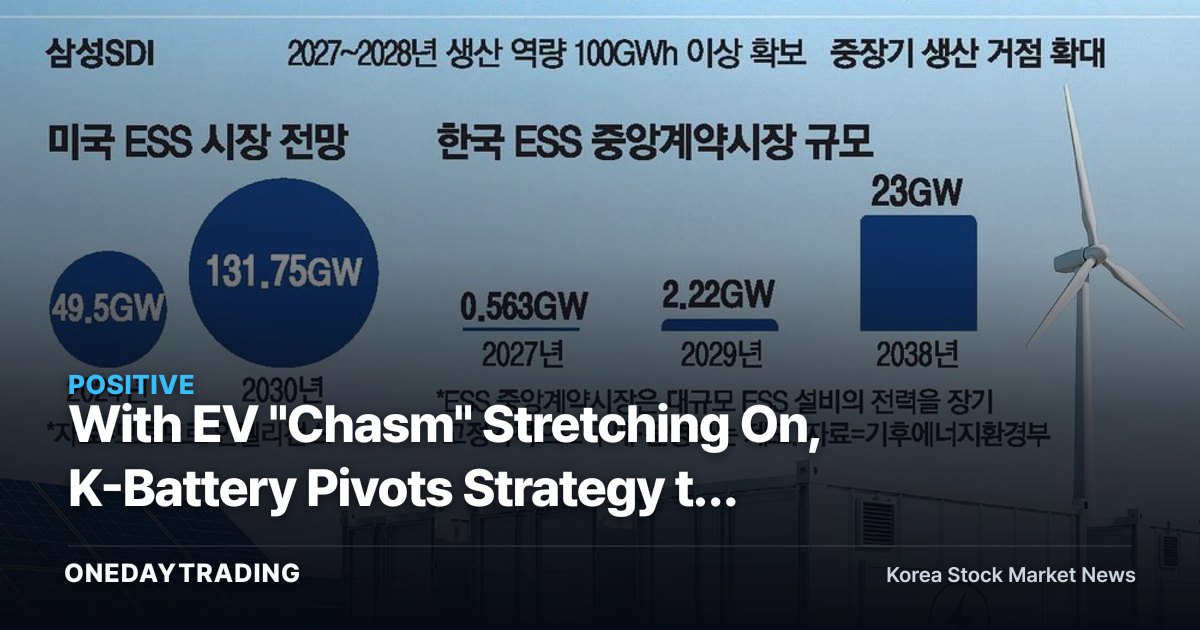
As the EV chasm hardens from a short-term correction into a structural slowdown, Korea's three major battery makers are diversifying production portfolios that once leaned entirely on EVs toward ESS. This is less a simple business-diversification move than a survival-driven pivot aimed at defending utilization rates and profitability.
From an investor's standpoint, the crux is how much ESS revenue can fill the void left by weak EV demand, and how those margins compare with EV cells. Differentiation between companies with high ESS exposure and those without is likely to play out.
The Full Story
The EV chasm is a phenomenon in which shrinking subsidies, inadequate charging infrastructure, and the financing burden of high interest rates combine to weigh down replacement demand for new vehicles. Many had initially viewed it as a temporary slowdown, but as the stagnation has dragged on, automakers have pushed back their electrification timelines, and that impact has spread to the battery industry through reduced cell orders.
In response, LG Energy Solution, Samsung SDI, SK On and others are moving to convert part of their idling EV lines to ESS cell production, or to reallocate new investment toward ESS. In particular, as ESS emerges as a storage solution to absorb surging data-center power demand and the volatility of renewable energy, market-expansion policies at the U.S. and Korean government level are underpinning the shift.
ESS is a market where safety, lifespan and cost competitiveness matter even more than for EV cells. So it is not simply a matter of repurposing lines — the ability to respond with low-cost LFP (lithium iron phosphate) and to win large-scale projects will decide the outcome, and each company's level of preparedness could translate into earnings differences.
Structural Backdrop
Until now, K-battery has targeted the premium EV market centered on high-performance ternary (NCM) chemistry. ESS, however, is highly price-sensitive — a domain Chinese players have already captured with LFP. For Korean makers, pivoting toward ESS is at once an opportunity to seize a growth market and a step into territory where price competition is fierce.
The fact that both Korea and the U.S. are pushing ESS deployment and grid modernization as policy is an important variable. Should the U.S. steer ESS procurement toward domestic or allied supply chains, the entry barriers could work favorably for Korean makers that have local production bases and certification experience.
Impact on Stocks and Sectors
- LG Energy Solution: Among Korean makers, it has the deepest ESS business mix and North American order experience. As the strongest candidate to offset the shock of weak EVs with ESS revenue the fastest, it is seen as the core beneficiary of the strategic pivot.
- Samsung SDI: Holds strengths in its utility- and commercial-grade ESS lineup and safety technology. Raising the share of high-value-added ESS for data centers and the power grid would help defend profitability.
- SK Innovation (SK On): With relatively high EV dependence, the pace of its ESS transition and its progress on LFP will be the key to an earnings recovery.
- EcoPro BM and POSCO Future M: As cathode-material makers, ESS expansion does not immediately boost ternary demand for them, but whether they enter the LFP cathode-material business will determine the scale of their medium- to long-term upside.
- Power and power-equipment sector: ESS deployment dovetails with demand for transformers and grid-interconnection equipment, which can translate into upstream demand for related power-infrastructure companies.
Bull vs. Bear Scenarios
Bull case: If the ESS market grows quickly on the back of Korea-U.S. policy support and data-center power demand, idle lines convert into revenue, improving utilization rates and easing the fixed-cost burden. ESS is less cyclical than EVs, so it can underpin the downside of earnings.
Bear case: Because ESS hinges on low-cost LFP-based competition, there is a risk that margins thin out in a unit-price battle with Chinese players. Early-stage transition investment and certification costs are front-loaded, while if the EV chasm recovers slowly, top-line growth could fall short of expectations — and stocks that have already priced in some ESS optimism carry valuation risk.
Investor Action Points
- In each company's quarterly earnings, check the ESS revenue share and how ESS-segment margins are trending versus EV cells.
- Monitor disclosures of large ESS project wins in North America and Korea, local production plans, and LFP cell mass-production timelines.
- Track the schedule of U.S. and Korean policy decisions on ESS deployment and the grid, along with changes to subsidy and procurement criteria.
- Watch for EV-chasm recovery signals (automaker sales, subsidy policy, the direction of interest rates) in parallel to distinguish whether the ESS pivot is a temporary defense or structural growth.
LG Energy Solution Through Real-Time Data
LG Energy Solution's latest closing price is 404,500 won (+1.12% from the prior day), and the signal light combining foreign-investor and institutional order flow with news and momentum is 🟢 Buy bias. With foreign investors, news and momentum all positive, it is worth a look.
- ▲ Order-flow continuity — foreign investors net buyers for 6 straight days (+6.12 billion won)
- ▲ Trend alignment — short- and medium-term aligned to the upside (today +1.1% · 1 week +1.1% · 1 month +1.1%)
- ▲ News flow — 3 positive catalysts vs. 0 negative catalysts — positive catalysts dominate
Recent related news is favorable, with 3 positive catalysts and 0 negative catalysts.
※ Price and foreign/institutional order-flow data are provided by Korea Investment & Securities (KIS), as of the time of publication.
This article is content automatically summarized and analyzed based on the original news. View the original (Maeil Business Newspaper, Corporate)